
Update2026.10.24 (토)

[Clash Between Beijing's Demand for a Fixed Script vs. Washington's On-Site Negotiation]
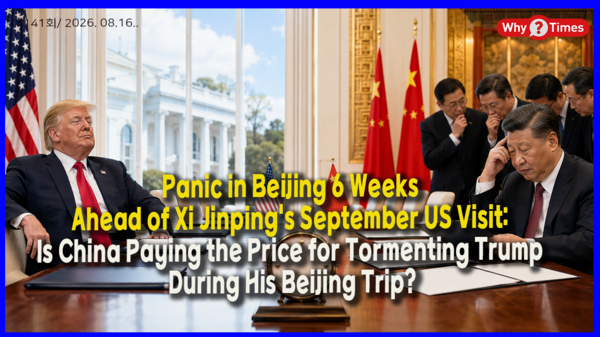
With Chinese President Xi Jinping’s state visit to the United States in September roughly six weeks away, Beijing’s diplomatic leadership is virtually in a state of panic. This anxiety stems from the fact that the US official in charge of overseeing the summit, detailed protocol, joint statements, and even the tangible achievements President Xi can bring back home remain unconfirmed. However, interpreting this situation merely as administrative confusion or an organizational vacuum within the Trump administration misses the core issue. It is far more accurate to view this as an exact reversal of the scenario in May, when China flustered the US side by being uncooperative during preparations for President Trump’s visit to Beijing.
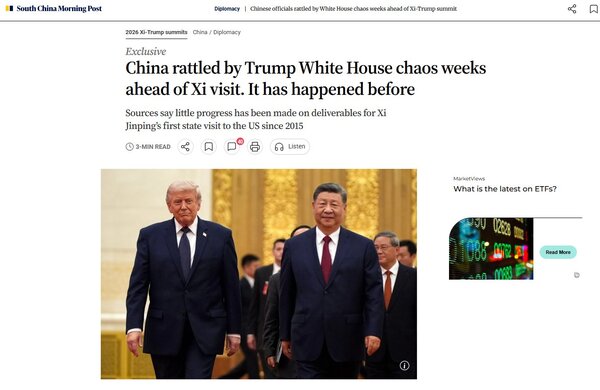
On August 15, the Hong Kong-based South China Morning Post (SCMP) reported that despite President Xi’s upcoming visit being his first state visit to the US since 2015, little progress has been made toward securing concrete deliverables. Sources familiar with the preparations indicate that Beijing is in a state of panic because the US side has not clearly designated a leading official or agency to organize the visit, leaving working-level officials from both sides to conduct routine preparations without a clear chain of command. What frustrates Beijing the most is not the risk of the summit being canceled, but the absence of a fully finished summit script to present to Xi Jinping.
[The US Prepares for a Meeting, but China Crafts a Script for Xi Jinping]
While SCMP framed this situation as internal disarray within the Trump administration, the root cause lies in the fundamentally different diplomatic decision-making structures of the two nations. In the United States, formal institutions—such as the Department of State, the Department of the Treasury, USTR, and the National Security Council—coordinate core agendas and negotiation principles, after which the President engages in final negotiations with the opposing leader on the spot. Every statement and outcome does not need to be locked down word-for-word in advance; new proposals can be made or existing policies adjusted during negotiations.
Trump’s diplomatic style, even within this American framework, relies heavily on spontaneity and real-time maneuvering. Even if government agencies prepare the basic framework and options, Trump holds the ultimate steering wheel. His signature style involves adjusting negotiation intensity based on the opponent's response, presenting unexpected demands, and keeping key cards hidden until the last moment. Therefore, delaying the finalization of detailed agreements on the US side does not automatically imply a total lack of preparation.
China operates in complete contrast. President Xi’s movement, seating order, phrasing used in meetings, wording of joint statements, and even the footage broadcast by Chinese state media must be controlled as strictly as possible ahead of time. Under the Xi regime, a summit is less an open negotiation with a foreign power and more a choreographed political event designed to showcase the supreme leader's authority and infallibility. An unexpected question or a sudden proposal that requires President Xi to respond on the fly presents a severe political risk to Chinese working-level officials.
This is closely linked to the fact that Xi is not viewed as a leader adept at improvisational diplomatic bargaining or open debates. Without prior confirmation on what statements will be made, what demands the other party might present, and what results can be promoted as victories after the meeting, Chinese officials find it difficult to present the US trip plan to Xi with confidence. While the US only needs to make standard preparations for a summit, China must construct a flawless stage to prevent President Xi from making a misstep or looking cornered. Beijing’s current anxiety stems directly from its inability to build this stage.
[The Tactics China Used During Trump's China Visit Are Now Being Returned by the US]
What makes this even more painful for China is that it put the US delegation through the exact same predicament during the preparations for Trump’s Beijing visit in May. At that time, China exerted pressure on the US negotiating team by delaying the confirmation of major agendas, schedules, and protocol matters, forcing the US Treasury and USTR to step in and react on an ad-hoc basis due to vacancies in the State Department. China used its leverage as host to control protocol and scheduling, forcing the US to prepare under incomplete information.
This time, however, the venue is Washington, not Beijing. The White House controls the protocol, meeting venues, media coverage, joint announcement formats, and movement between leaders. Having used its host-nation status in May to pressure the US, China now finds itself kept waiting by the US using the exact same strategy. For China, it is receiving a dose of its own medicine, and if the US is deliberately pacing its preparations, it represents a sophisticated psychological game.
The US can manage real-time situations at the summit even if details remain undecided right up to the event. In contrast, China must finalize the direction and expected results of the meeting before Xi arrives in Washington. Every time the US delays a decision, China is forced to rewrite multiple contingency scenarios. While time flows equally for both sides, the pressure weighs vastly heavier on China due to its heavy reliance on a fixed script.
[More Important Than the Person in Charge: 'What Will Trump Bring to the Table?']
Sources cited by SCMP noted that while White House officials such as Deputy Chief of Staff Stephen Miller and Communications Director Steven Cheung argue for displaying American dominance over President Xi, other aides hope for an easing of tensions. However, this divergence of views does not necessarily indicate a policy void within the US government. Having multiple agencies and advisors present different options, with the President making the final call at the last moment, is standard operating procedure in American executive decision-making.
What China truly fears is not the lack of a designated lead department on the US side, but the complete unpredictability of what unexpected demands President Trump might throw at Xi during their White House meeting on September 24. While a tariff reduction worth roughly $30 billion on Chinese products is currently being floated as the primary concrete card, it remains uncertain whether this will serve as a confirmed summit deliverable. The US-China Investment Board, reportedly agreed upon in May, has yet to initiate full-scale negotiations, failing to materialize into a win Xi can boast about.
Meanwhile, the foundation for the summit has eroded further as the US expanded sanctions targets under the Uyghur Forced Labor Prevention Act and tightened regulations on Chinese robotic devices and power inverters, while China retaliated with sanctions on US companies and export controls on drone technologies. As the date approaches, conflict issues pile up without any visible agreement to save Xi's face.
[Ahead of the Midterms, Trump Could Pull a Surprise Card in Front of Xi]
Ali Wyne of the International Crisis Group noted that President Trump will be hosting President Xi at a sensitive time domestically and internationally. He analyzed that if voter fatigue grows over prolonged conflicts like the war in Iran and the burden on the Republican Party increases ahead of the midterms, Trump may attempt to project a strong leadership image against China. In particular, announcing surprise policies or new demands to pressure President Xi in his own backyard of Washington could maximize the political impact.
This scenario is precisely what China wants to avoid most. If Trump unexpectedly brings up tariffs, Taiwan, Chinese support for Russia and Iran, supply chains, or advanced technology issues on the spot, Xi Jinping would have to respond without a prepared script. Failing to refute effectively would damage his international standing, while responding too aggressively risks driving the summit into complete ruin. Conversely, accepting US demands carries the risk of internal criticism in China for engaging in humiliating diplomacy.
Consequently, while Beijing attempts to fix the US demands and announcements prior to the meeting, the White House has no reason to comply. Maintaining uncertainty only expands the leverage Trump can exercise in negotiations. As the date of Xi's visit nears, the structure inherently makes China far more anxious than the US.
[Why Times Insight]
The essence of this situation is not a simple narrative of an unprepared United States versus a victimized China. It is a direct collision between American-style diplomacy—where formal institutions prepare principles and options before the President negotiates directly—and Xi-style scripted diplomacy, which demands complete pre-control over every move and word of the supreme leader. While SCMP heavily emphasized the absence of a designated US lead department, it failed to fully explain why this exact situation is far more fatal for China.
The US President can adjust his stance with advice from aides even if unexpected topics emerge in the meeting room. For Chinese diplomats, however, the primary objective is to prevent Xi Jinping from encountering unexpected situations altogether. While concentrating power in a single individual might seem to enable faster decision-making, in reality, it eliminates diplomatic flexibility because no one dares report options carrying a potential risk of failure to the top leader.
In May, China used its advantage as the host nation to unsettle the US during preparations for Trump's visit. Now that the venue has shifted to Washington, China has fallen into the trap of uncertainty it once set. To make matters worse, its opponent is Trump, who utilizes unpredictability as his most potent bargaining chip.
Ultimately, while the US is preparing a standard bilateral summit, China must build a flawless political stage to preserve Xi Jinping's authority. Yet, the keys to that stage are currently held by the White House. This is precisely why it is Beijing, not Washington, that is in panic mode ahead of the September visit.
-중국 푸단대학교 한국연구원 객좌교수
-전 EDUIN News 대표
-전 OUR NEWS 대표
-제17대 대통령직인수위원회 정책기획팀장
-전 대통령실 홍보기획비서관
-사단법인 한국가정상담연구소 이사장
-저서: 북한급변사태와 한반도통일, 2012 다시우파다, 선거마케팅, 한국의 정치광고, 국회의원 선거매뉴얼 등 50여권