
Update2026.10.24 (토)

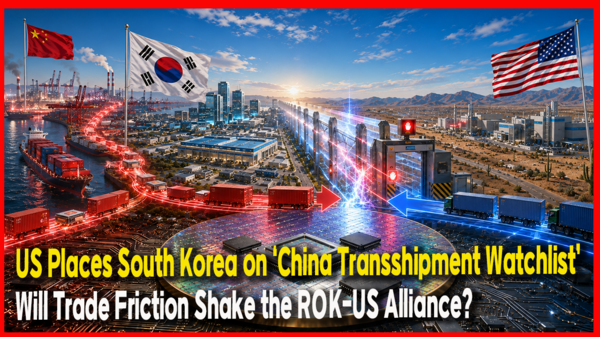
[White House Singles Out Gyeonggi Semiconductor Belt… Alarm Bells Ring Over Trust]
The White House has included South Korea in its highest-tier risk group of nations subject to Chinese product transshipment into the United States, directly designating the Gyeonggi Semiconductor Belt as a potential transshipment corridor for Chinese integrated circuits. While this does not mean actual illegal transshipment cases have been confirmed, the fact that a key industrial base of a major ally appears in an official White House document as a potential channel pressuring U.S. manufacturing carries significant weight.
This comes at a delicate time when Seoul and Washington face growing friction across multiple fronts—including the implementation of $350 billion in South Korean investments in the U.S., semiconductor tariffs, digital regulations, defense cost-sharing, and overarching strategies toward China. Consequently, concerns are mounting that this report could transcend a mere trade warning and ignite new friction that undermines foundational trust in ROK-US relations.
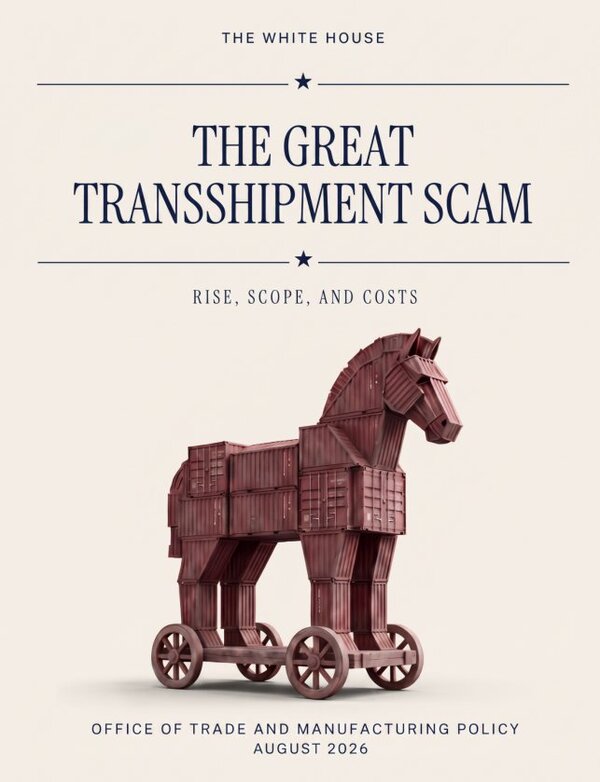
On August 13 (local time), the White House Office of Trade and Manufacturing Policy (OTMP) released a 25-page report titled “The Great Transshipment Scam.” The report noted that after the first Trump administration imposed Section 301 tariffs in 2018 to counter China’s unfair trade practices and technology theft, Chinese firms circumvented these duties by altering packaging, labeling, invoicing, and country-of-origin documentation through third countries. The report analyzed that approximately 40 countries worldwide are connected to China's so-called "shadow transshipment network."
The White House report divided countries linked to this network into three tiers. South Korea was placed in Tier 1—designated as “Diversified Scale Leaders”—alongside Canada, the European Union, India, Israel, Japan, Mexico, and Taiwan. Tier 1 economies are characterized by large absolute volumes of China-linked trade, highly developed industrial bases, and major export platforms bound for the U.S., meaning illegal transshipment risks are embedded within legitimate trade flows. Although distinct from Tier 2 nations (such as Vietnam, Thailand, and Malaysia) that are more deeply integrated into Chinese manufacturing supply chains, it is clear that Washington now views South Korea as a high-priority, large-scale trade hub requiring stricter enforcement.
The language in the report is explicit. It notes that many of America's largest trading partners are embedded in China's transshipment web, identifying South Korea—along with Mexico, Canada, the EU, India, and Japan—as one of China’s “biggest enablers.” This characterization cannot be downplayed as a statistical technicality resulting merely from high trade volume. Rather, it serves as a clear policy signal that Washington will scrutinize South Korean exports far more rigorously in its effort to prevent origin-laundering of Chinese goods.
[Does the Gyeonggi Semiconductor Belt Threaten Phoenix and Austin?]
The most sensitive element of the report is its list of “Ugly Sister Cities.” The White House paired foreign industrial hubs handling China-linked goods with American manufacturing cities potentially harmed by them. In this taxonomy, South Korea’s Gyeonggi Semiconductor Belt is listed as a potential corridor for integrated circuits (HS 854239) that could exert pressure on U.S. semiconductor manufacturing hubs in Phoenix, Austin, Portland, and San Jose.
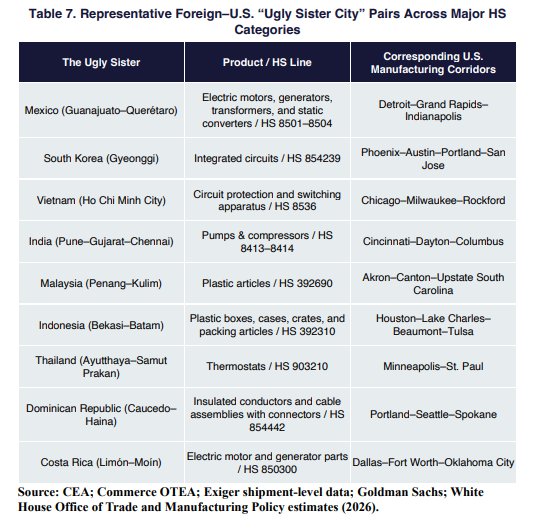
This does not imply that Samsung Electronics or SK Hynix have relabeled Chinese semiconductors as South Korean products. The report explicitly clarifies that its lists are illustrative rather than exhaustive, offering no specific audit results or individual company violations. It functions primarily as a policy modeling tool linking high-risk trade flows to corresponding U.S. domestic sectors.
However, its impact should not be minimized. The U.S. government announced plans to deploy an AI-driven “Detective Border” system—a predictive customs platform managed by U.S. Customs and Border Protection (CBP) that integrates shipment data, logistics pathways, tariff classifications, ownership structures, production capacity benchmarks, anomaly detection, and computer vision to filter suspicious transshipment cargo in real time.
The report estimates total annual illegal transshipment or trade-transfer exposure at between $40 billion and $303 billion, depending on analytical methodology. It claims that resulting U.S. tariff revenue losses range from $10 billion to $136 billion annually. Because the Trump administration frames transshipment not as a routine customs issue but as an economic security threat directly undermining U.S. jobs, manufacturing, and the defense industrial base, origin verification, physical inspections, component tracking, and compliance demands on foreign exporters are expected to escalate significantly.
[Fractured Tariff Agreements… Doubts Over Compliance]
Compounding the problem is that this report arrives at a time when U.S.–South Korea commercial relations are already fragile. Under a 2025 agreement, South Korean leaders pledged $350 billion in U.S. investments—including $150 billion in shipbuilding—in exchange for reciprocal tariff reductions on South Korean goods and a lowering of auto tariffs to 15%. The deal also promised terms for semiconductors no less favorable than those granted to competing nations.
However, earlier this year, President Trump issued a sudden warning that South Korea’s legislative implementation of the investment deal was lagging, threatening to raise tariffs on automobiles, pharmaceuticals, and timber back to 25%. Reuters reported at the time that the surprise announcement exposed serious communication gaps between Seoul and Washington. It noted that U.S. concerns regarding South Korea's regulations on platforms like Coupang and the treatment of American digital firms were cited as non-tariff barriers—signaling that trade talks had evolved from simple rate negotiations into a broader test of Seoul’s regulatory policies and commitment to honoring agreements.
Furthermore, a large-scale enforcement operation targeting South Korean workers at Hyundai and LG Energy Solution’s joint venture plant construction site in Georgia severely damaged public sentiment in South Korea. Critics in Seoul voiced frustration that while Washington demands astronomical investments, it failed to resolve essential worker visas, effectively taking investments while failing to protect Korean companies and workers. Conversely, frustration built in Washington over the execution speed of Korean investments, market opening, and domestic regulations affecting U.S. businesses. A vicious cycle took root, with both sides suspecting the other of failing to honor commitments.
[Overlapping Divergence in China Strategy and Security Policy]
Trade tensions do not exist in isolation from security issues. In a report examining major 2026 issues in ROK-US relations, the Korea Economic Institute (KEI) noted that Washington is pursuing an “alliance modernization” strategy aimed at expanding the alliance beyond the defense of the Korean Peninsula to regional deterrence against China and stability across the Taiwan Strait. Although South Korea agreed in principle to increase defense spending to 3.5% of GDP and address regional threats, Seoul continues to emphasize stable relations with Beijing and the resumption of inter-Korean dialogue. This dual approach explains why Washington, while praising South Korea as a key ally, continually seeks to verify how far Seoul is willing to align on China-related challenges.
Against this backdrop, the White House report naming Korea’s core semiconductor industry as a potential transshipment route demonstrates the blurring boundary between trade and national security. The U.S. views semiconductors not merely as commercial commodities, but as the foundational technology for artificial intelligence, advanced weaponry, and military power. Consequently, growing suspicions that Chinese chips or components are entering the U.S. via South Korea could extend far beyond customs enforcement—potentially influencing export controls on China, technology transfers, semiconductor subsidies, and security reviews for South Korean investments in the United States.
[Why Times Insight]
There is no definitive evidence to conclude that this report represents direct retaliation against the Lee Jae-myung administration's diplomatic approach to China. The trade data analyzed in the report reflects trends accumulated since 2018, and the Gyeonggi Semiconductor Belt is identified as a potential risk corridor rather than an established site of criminal activity. Reporting that South Korea has systematically laundered Chinese semiconductors would be an overt exaggeration.
However, the real danger lies in the narrative taking root in Washington. If the perception hardens that South Korea is slow to fulfill investment promises, tightening regulations on U.S. firms, seeking closer ties with Beijing, and harboring a core industrial hub embedded in China's transshipment network, a trust deficit could open between Washington's view of Seoul compared to its confidence in Tokyo or Taipei.
Friction that began in trade could quickly spill over into semiconductor cooperation, intelligence sharing, joint policy toward China, cost-sharing negotiations, and the role of USFK—threatening the broader alliance structure.
The South Korean government cannot afford to remain passive. Seoul should formally request clarification from Washington regarding the data and criteria used to select the Gyeonggi Semiconductor Belt, while proactively strengthening origin-verification mechanisms for Chinese-origin wafers, components, and back-end processed goods. Additionally, South Korea must provide Washington with a clear timeline for fulfilling its investment commitments and trade agreements.
Alliances are not sustained by rhetoric alone. If Washington suspects South Korea of serving as a conduit for Chinese trade evasion, while Seoul views the U.S. as an overbearing partner imposing unilateral burdens, a single trade report could become the wedge that fractures seven decades of strategic trust.
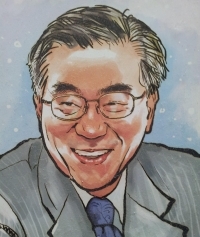
-중국 푸단대학교 한국연구원 객좌교수
-전 EDUIN News 대표
-전 OUR NEWS 대표
-제17대 대통령직인수위원회 정책기획팀장
-전 대통령실 홍보기획비서관
-사단법인 한국가정상담연구소 이사장
-저서: 북한급변사태와 한반도통일, 2012 다시우파다, 선거마케팅, 한국의 정치광고, 국회의원 선거매뉴얼 등 50여권