
Update2026.10.24 (토)

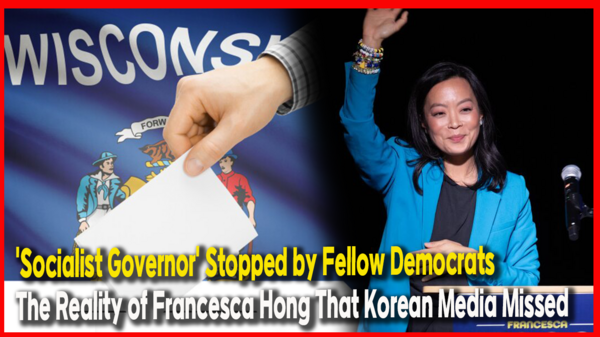
[Overwhelming Lead Turned into a 0.41%p Comeback Defeat… Democratic Voters Shifted at the Last Minute]
The Democratic Socialist wave that seemed poised to sweep the U.S. Democratic Party following Zohran Mamdani's mayoral victory in New York hit a major roadblock in the key swing state of Wisconsin. Korean-American candidate Francesca Hong (Korean name: Hong Yoon-jung), who once led polls by as much as 20–30 percentage points, suffered a narrow defeat by just 0.41 percentage points against Milwaukee County Executive David Crowley, who was backed by the Democratic establishment.
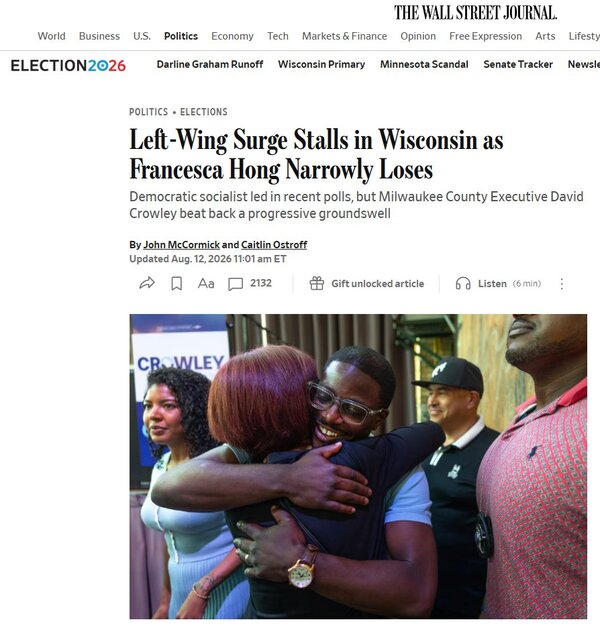
Democratic voters ultimately weighed the risk of losing the general election due to her past radical statements—such as calling to abolish the police and cancel Thanksgiving—more heavily than her progressive economic promises. However, the fact that Hong still captured nearly 40% of the vote serves as another warning that radical socialism within the Democratic Party has far from disappeared post-Mamdani.
In the Wisconsin Democratic gubernatorial primary, Crowley won 39.8% to Hong's 39.4%. Among more than 787,000 votes cast, the gap between the two candidates was only about 3,200. Under Wisconsin state law, a recount can be requested if the margin is less than 1 percentage point, but if it exceeds 0.25 percentage points, the requesting candidate must bear the cost. Consequently, Hong accepted the outcome and endorsed Crowley.
What was more shocking than the loss itself was that Hong's massive lead—which reached up to 30 percentage points in recent surveys—completely evaporated at the ballot box.
Even in poll aggregations cited by Korean media right before the election, Hong led Crowley 50.9% to 31.2% by a 19.7 percentage point margin. In another poll, Hong garnered 44%, nearly double Crowley's tally. This led Korean outlets to heavily highlight the "potential birth of the first Korean-American U.S. governor" and the "Democratic Socialist sensation."
In the actual election, however, undecided Democratic voters as well as moderate and older voters who prioritized general-election electability migrated en masse to Crowley at the last moment. What the polls failed to capture was not mere favorability, but the internal fear within the Democratic Party over whether a radical candidate could safely be sent to the general election.
[Democratic Establishment Hits Emergency Brakes: "We Will Lose the General Election with Hong"]
Crowley's victory was not merely an individual comeback. Having once withdrawn from the primary race, he re-entered as influential moderate candidates dropped out one after another. Governor Tony Evers, who declared he would not seek a third term, publicly endorsed Crowley at the last minute, and financial and organizational support from the Democratic establishment and outside groups flooded in. A sense of crisis—that handing the nomination to Hong could cede the governorship to Republican candidate Tom Tiffany—mobilized the entire party.
This trend was clearly evident in regional voting patterns. While Hong led among younger voters, college campuses, and strongly progressive districts, she failed to build as large a margin as expected. On the other hand, Crowley showed strong performance in suburban areas, among older voters, and in counties with a high proportion of voters without college degrees, leading by over 10 percentage points in some regions. Even among Democratic voters who sympathized with parts of Hong's policy platform, many remained unconvinced that she could defeat the Republican candidate in November's general election.
Wisconsin's political landscape is fundamentally different from New York's. The state chose Donald Trump in 2016, Joe Biden in 2020, and Trump again in 2024—all decided by paper-thin margins of around 1 percentage point. While Mamdani's Democratic Socialist experiment could succeed in overwhelmingly Democratic New York, fielding a radical left-wing candidate in Wisconsin, where Democratic and Republican bases are split almost 50-50, presents an immense gamble for the party. The decisive reason Democratic voters barely stopped Hong came down to "general election survivability," superseding mere ideological agreement.
[Abolishing Police & Canceling Thanksgiving… Radical Past Remarks Come Back to Haunt]
Hong, a formal member of Democratic Socialists of America (DSA), campaigned on platform promises including universal free childcare, public grocery stores, state-level health coverage, minimum wage increases, and tax hikes on corporations and high earners. However, what shook voter judgment in the final stretch was not her economic agenda, but her past extreme statements. Hong had previously claimed the police force exists to "maintain white supremacy" while advocating for budget cuts and abolition, and posted in 2020 that "Thanksgiving should be canceled. It should have been canceled back in 1621."
As controversy grew, Hong clarified that police abolition is not her current platform and that she has no intention of eliminating Thanksgiving. However, in an interview, she failed to clearly retract her past statements, responding instead that "Thanksgiving is also a painful time for many communities," which only fueled the backlash.
What Democratic voters feared was not the survival of a single holiday, but whether a candidate who demonstrated hostility toward American traditions and law enforcement institutions could withstand concentrated Republican attacks and win a general election in a swing state.
This was the same reason key Democratic figures—including former Obama chief adviser David Axelrod—publicly expressed concern over Hong's radicalism and general election viability. Furthermore, even national figures of the Democratic Socialist movement, such as Senator Bernie Sanders and Representative Alexandria Ocasio-Cortez, refrained from officially endorsing Hong. Unlike other progressive candidates running on similar platforms who received national backing, Hong failed to convincingly resolve the self-inflicted controversies surrounding her past remarks.
[Radical Left Alliances with Hasan Piker and Ilhan Omar Heightened Moderate Anxiety]
Candidate Hong's campaigning alongside internet streamer Hasan Piker—who has repeatedly sparked controversy with anti-American and far-left statements—also became a political liability. Piker previously caused outrage by stating "America deserved 9/11," and he appeared at a rally alongside Hong and Democratic Representative Ilhan Omar.
Following Hong's defeat, Piker lashed out on his stream against older voters and Thanksgiving, claiming that "the establishment will pull out all knives to block the socialist left in the future." He also conceded that becoming a prominent face of the Hong campaign may have actually backfired.
This dynamic exposed a fundamental limitation of the radical left wing. Rather than reflecting on their messaging and candidate selection after an election defeat, blaming moderate voters, older demographics, the media, and the Democratic establishment makes it difficult to move beyond metropolitan activist politics to persuade a statewide electorate. Although Hong mobilized a strong grassroots ground game to knock on tens of thousands of doors, she failed to build a broad enough coalition to offset the anxiety caused by her radical rhetoric.
[Why Even Trump Targeted Hong]
Hong's rise prompted direct warnings from Donald Trump himself. Although Trump did not explicitly mention her name, he remarked during a speech in Las Vegas that "There is a woman among Wisconsin's communists claiming Thanksgiving should be abolished and that police exist to maintain white supremacy." He emphasized, "These are dangerous, crazy people. We cannot let them enter public office." Given the quotes referenced, his comments were effectively aimed straight at Hong.
Trump's warning was not merely an attack on a single Korean-American state representative. It was a political alarm triggered by Democratic Socialists attempting to reach beyond major cities into gubernatorial nominations in Midwestern swing states following Mamdani's NYC victory. Although Hong ultimately lost, she still captured 39.4%. This signifies that nearly 4 out of 10 Democratic voters selected a Democratic Socialist as their nominee for governor. While one cannot claim radical socialism has become mainstream in American society, it is hard to deny that it has grown into a political force within the Democratic Party that cannot be ignored.
[Korean Media Focused on 'First Korean-American'… But Missed the Context of U.S. Politics]
The reporting attitude shown by domestic Korean media in this election also warrants reflection. While Korean news outlets mentioned Hong's membership in the DSA and the controversies surrounding her past statements, headlines and primary coverage focused heavily on angles like "First Korean-American," "Polling Leader," and "Progressive Sensation."
Why American voters viewed Hong's stance as radical, and why the Democratic establishment urgently coalesced to block her general election nomination, were relegated to the background. The core issue was less about factual omissions and more about flat, play-by-play reporting that failed to adequately interpret the broader context of U.S. politics.
Korean ancestry alone does not guarantee victory in American elections. Before considering a candidate's ethnic background, American voters evaluate their ideology, platform, and whether they can win in the general election. Nevertheless, Korean media presented poll figures almost as finalized outcomes, failing to adequately read the potential for late-stage consolidation among undecided voters and the Democratic establishment. While a Korean-American politician's challenge is inherently meaningful, expectations based on identity should not replace rigorous scrutiny of a candidate's ideology and policy.
[Why Times Insight]
Francesca Hong's defeat does not mean the U.S. Democratic Party has completely purged Democratic Socialism. On the contrary, the fact that Hong won 39.4% in a quintessential swing state and lost by a razor-thin 0.41 percentage points demonstrates that the organizational power and influence of the radical left have taken deep root within the Democratic Party post-Mamdani. Trump's direct intervention labeling Hong a 'dangerous communist' was also not just a personal attack on her, but a broader warning against Democratic Socialists expanding beyond New York to target governor's mansions in battleground states.
Yet, Wisconsin Democratic voters ultimately rendered a different judgment in the final moments. While sympathizing with economic proposals like universal childcare and minimum wage hikes, they judged that fielding a candidate who repeatedly made hostile statements toward law enforcement, Thanksgiving, and American institutions was too dangerous for the general election. If Mamdani succeeded in overwhelmingly Democratic New York, Hong tested the same playbook in Wisconsin—where Democratic and Republican support is split roughly 50-50. That distinction made all the difference between victory and defeat.
This election yields two key conclusions. U.S. Democrats temporarily rejected a radical socialist's bid for the gubernatorial nomination, but that rejection was a narrow defense won by barely 3,200 votes. The Democratic Socialist movement—symbolized by Mamdani and Francesca Hong—has not disappeared in defeat; rather, it has grown powerful enough to reshape the Democratic Party's nominees and platform. Wisconsin drew a clear boundary against the expansion of the radical left, while simultaneously warning that this faction has firmly crossed beyond the margins of American politics.
-중국 푸단대학교 한국연구원 객좌교수
-전 EDUIN News 대표
-전 OUR NEWS 대표
-제17대 대통령직인수위원회 정책기획팀장
-전 대통령실 홍보기획비서관
-사단법인 한국가정상담연구소 이사장
-저서: 북한급변사태와 한반도통일, 2012 다시우파다, 선거마케팅, 한국의 정치광고, 국회의원 선거매뉴얼 등 50여권