
Update2026.10.24 (토)


[Russian Strikes Utilizing North Korean Missiles Kill 10 Across Ukraine]
Ukrainian drones have neutralized oil refineries deep inside Russia and consecutively knocked out electronic warfare equipment and an S-400 air defense system guarding President Vladimir Putin’s Black Sea estate. Exposing the so-called "Putin’s Palace"—long a symbol of the Russian leader's luxury and security—to Ukrainian strike range is a humiliation for Moscow that goes far beyond mere military loss. Meanwhile, Russia launched a strike on a steel plant in Zaporizhzhia using ballistic missiles identified as supplied by North Korea, killing seven workers who were heading to a bomb shelter. A new phase of the war is unfolding: as Ukraine strips away Russia’s energy infrastructure and the shield surrounding its supreme leader, Moscow is intensifying its offensive by exploiting North Korean arms and Ukraine’s lack of Patriot interceptors.
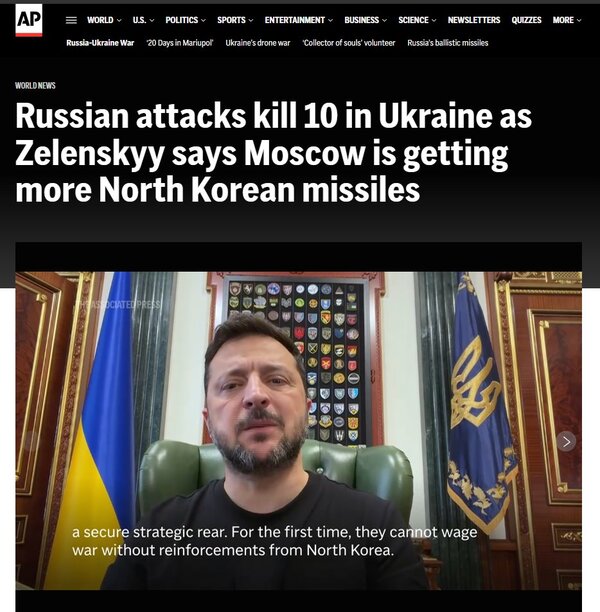
The Associated Press reported: "Early this morning, Russian forces launched a massive attack involving ballistic missiles, drones, and guided glide bombs targeting Zaporizhzhia in southeastern Ukraine. The strikes left at least 10 civilians dead. Metinvest, operator of the local steel plant in Zaporizhzhia, stated that seven employees were killed and 21 injured as they fled toward shelters after air raid sirens sounded."
The Associated Press added: "The attack severely damaged critical infrastructure, including blast furnaces, forcing operations to halt. In the central Dnipropetrovsk region, shelling and drone strikes killed three additional civilians, including a 15-year-old boy."
In response, Ukrainian President Volodymyr Zelenskyy stated that "ballistic missiles supplied by North Korea were used in this attack" and warned that "North Korea is even preparing to deploy additional troops to Russia." He added on social media: "Russia is expanding domestic ballistic missile production, acquiring North Korean hardware, and preparing mobilization measures. These actions signal preparations for escalation, not peace."
The Russian Ministry of Defense claimed the strike was a "precision attack targeting defense industrial facilities and logistical hubs in Zaporizhzhia and Kyiv." However, a significant portion of the victims were civilian workers fleeing to air-raid shelters. The Associated Press noted: "Despite Russia’s claims of targeting military assets, the resulting civilian casualties and industrial destruction once again expose the reality behind Moscow's so-called 'precision strikes.'"
[Electronic Warfare Equipment and S-400 Guarding Putin’s Palace Destroyed in Succession]
The most shocking scene for Putin in this series of events occurred along the Black Sea coast prior to the Zaporizhzhia attack. The New York Post reported: "Ukrainian forces destroyed electronic warfare equipment and air defense systems protecting the so-called 'Putin’s Palace' near Gelendzhik, demonstrating that even Putin’s most secret and symbolic personal space is not beyond the reach of Ukrainian strikes."
The Moscow Times also reported: "An electronic warfare system installed near Putin’s Palace was destroyed by a Ukrainian attack. Satellite imagery clearly showed damage at the site. Designed to jam satellite communications and radio signals within roughly a 20-square-kilometer radius to prevent drone incursions, the system is estimated to cost around $1.5 million per unit."
An even greater shock followed two days later. The New Voice of Ukraine (NV) reported: "An S-400 air defense missile system located just 500 meters from where the EW system was destroyed was also knocked out by a Ukrainian drone strike. Robert Brovdi, commander of Ukraine’s Unmanned Systems Forces, stated that multiple other air defense assets—including Tor systems, Pantsir-S1 units, and radar systems—were also eliminated across southern Russia."
Based on satellite imagery, Russian military analyst Yan Matveev assessed: "Now, Putin’s Palace is left unprotected." The New York Post remarked: "Of course, this does not mean all air defense networks around the estate have completely vanished. However, the fact that key electronic warfare assets and an S-400 system were breached in rapid succession clearly leaves the palace far more vulnerable to Ukrainian drone attacks—a bitter humiliation in itself, as the shield guarding the symbol of Putin's power and safety has been stripped away."
The estate gained widespread international fame through investigations by the Anti-Corruption Foundation, led by the late Russian opposition leader Alexei Navalny. Identified as a massive estate boasting a casino, theater, ice rink, vineyards, and helipads, Putin has repeatedly denied owning it. Estimations of its construction costs vary significantly across reports. However, surrounded by no-fly zones and land owned by the Federal Security Service (FSB), it has long been viewed as an emblem of the Russian leader's supreme privilege.
[Continuous Strikes on Refineries: Russian Hinterlands No Longer Safe]
The destruction of the air defenses near Putin’s Palace was not an isolated incident. Reuters reported: "Ukraine has been carrying out almost daily strikes on Russian oil refineries, petrochemical complexes, and defense-related production facilities, undermining Russia’s ability to sustain the war from deep within its rear. As strike ranges extend to industrial hubs in Tatarstan and Western Siberia, it is clear that internal Russian territories hundreds of kilometers from the front lines are no longer safe zones."
Reuters noted further: "The purpose of these strikes goes beyond causing mere damage to the civilian economy. Refineries are vital infrastructure supplying fuel to the Russian military and serve as a primary revenue source helping Russia endure Western sanctions. Because much of the damaged equipment relies on Western components and technology, repairing them under international sanctions requires significantly more time and capital." Ukraine is simultaneously squeezing Russia's fuel production, military logistics, and financial bases, forcing the costs of war directly into the daily lives of the Russian public.
[Russia Exploits Patriot Shortages as Dependence on North Korean Arms Deepens]
On the other side, Russia is exploiting Ukraine’s most critical vulnerability: a shortage of Patriot interceptor missiles. The Kyiv Independent noted: "According to the Ukrainian Air Force, out of 36 ballistic missiles fired by Russia during two massive attacks in July, only two were intercepted. Russia is accelerating its own ballistic missile production while integrating North Korean missiles to deplete Ukraine’s air defense stocks."
The Institute for the Study of War (ISW), a US-based think tank, analyzed: "As long as the Kremlin believes it can achieve its objectives militarily, it will not engage in serious negotiations or meaningful compromises." ISW warned specifically: "Ukraine’s shortage of Patriot systems provides Russia with opportunities to concentrate strikes on cities and energy infrastructure, which could prove to be a major factor delaying peace talks."
The Associated Press also reported: "Russia has previously deployed some S-300 and S-400 air defense missiles in a land-attack mode. However, this is a distinct capability from the North Korean ballistic missiles reportedly used in the Zaporizhzhia strike. Crucially, as Russia diverts parts of its air defense systems into offensive roles and relies heavily on North Korean ballistic missiles, it is persistently grinding down Ukraine’s limited supply of interceptors."
[Ukraine’s Solution is 'FREYJA'—But It's a Race Against Time]
Determined not to rely solely on Western Patriot deliveries, Ukraine is accelerating the development of its own ballistic missiles and interception systems. Following a high-level meeting, President Zelenskyy emphasized: "Developing our own ballistic missiles and new interception systems is a feat accomplished by very few nations in the world, but Ukraine possesses the scientific foundation and industrial capacity to achieve it."
At the core of this strategy is "FREYJA," a joint interceptor program pursued by Ukraine and several European nations. The Kyiv Post reported: "Under this structure, Ukraine provides interceptor missile and propulsion technologies, while European partners integrate radar, seeker, and command-and-control technology. While developer Firepoint set a target of achieving its first ballistic missile interception by mid-2027, caution remains regarding the realistic timeline, given the complexity of integrating diverse international technologies into a single unified system."
[Why Times Insight]
While Ukraine disrupts Russia’s refineries and the air defenses around Putin’s Palace, Russia is taking advantage of North Korean ballistic missiles and Ukraine’s Patriot deficit to strike civilian industrial assets. This is not merely a cycle of retaliation, but a transition into a new phase of mutual escalation, where Ukraine’s deep-strike capabilities and Russia’s ballistic missile attacks continuously provoke one another.
In particular, the destruction of electronic warfare systems and the S-400 near Putin’s Palace carries symbolic weight far greater than the immediate physical threat to the residence itself. It demonstrates that Ukraine can strip away the defensive shield of the place where the Russian leader felt most secure.
Putin still possesses the missile capacity to devastate Ukrainian cities. However, as North Korean weapons account for a growing share of those strikes, Russia's strategic vulnerability—its inability to sustain a long war without external support—is laid bare. With the shield around Putin’s Palace breached and the Russian military relying ever more heavily on North Korean missiles, the conflict has transformed into a dangerous war of attrition focused on exploiting mutual weaknesses rather than a display of overwhelming Russian military superiority.


-중국 푸단대학교 한국연구원 객좌교수
-전 EDUIN News 대표
-전 OUR NEWS 대표
-제17대 대통령직인수위원회 정책기획팀장
-전 대통령실 홍보기획비서관
-사단법인 한국가정상담연구소 이사장
-저서: 북한급변사태와 한반도통일, 2012 다시우파다, 선거마케팅, 한국의 정치광고, 국회의원 선거매뉴얼 등 50여권