
Update2026.10.24 (토)

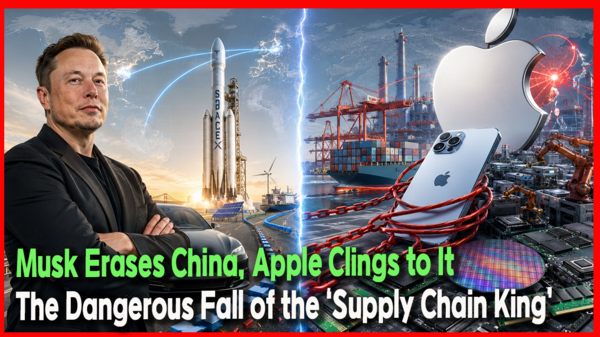
[Apple Tries to Fix a Crisis Born of China Reliance with More China Reliance… CXMT Even Rejects Price Cuts]
Elon Musk has begun removing China-related risks from his core businesses, even if it incurs short-term costs. In contrast, Apple—once celebrated as the "world's greatest supply chain manager"—is attempting to resolve a crisis stemming from its dependence on China by doubling down on that very dependency. Even more shocking is the fact that ChangXin Memory Technologies (CXMT), a Chinese memory manufacturer Apple approached, rejected its demand for price cuts. The former "King of the Supply Chain," who maintained high margins by putting suppliers against each other to drive down costs, must now accept price quotes dictated by a Chinese firm—all while drawing sharp national security warnings from Washington.
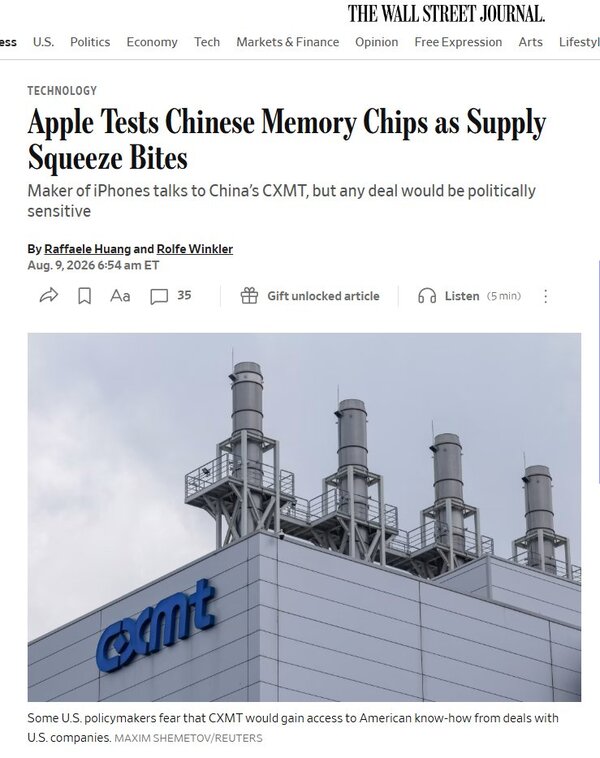
The Wall Street Journal (WSJ) reported on August 10: “In response to AI-driven memory shortages, Apple is testing DRAM produced by China’s CXMT across major product lines, including iPhones and MacBooks.” The report added, “Apple held preliminary negotiations with CXMT, China’s largest semiconductor firm by market cap, over component supply, targeting application in a subset of devices sold within China.”
The Financial Times (FT) had previously reported that Apple initiated certification procedures for CXMT DRAM last month. The latest WSJ report confirmed for the first time that testing has progressed to specific product lineup units. Apple is holding early-stage discussions regarding the integration of CXMT components into select devices sold in China, while reportedly seeking political clearance from the U.S. government.
The WSJ noted: “As incumbent memory leaders such as Samsung Electronics, SK Hynix, and Micron concentrate production capacity on high-value products for AI servers, the supply of general-purpose memory for smartphones and PCs has tightened drastically.” It further observed, “Some PC makers like HP and Acer have also begun installing CXMT memory in products sold outside the U.S.—not necessarily because Chinese memory is cheaper, but because securing sufficient volume from existing suppliers has become increasingly difficult.”
Commenting on the situation, Reuters pointed out: “However, Apple’s move can hardly be seen as a simple supply diversification strategy. Although Apple has dispersed its manufacturing bases to India and Vietnam following the escalation of US-China tensions, the core manufacturing ecosystem underpinning iPhones and MacBooks remains deeply tied to China. Turning back to Chinese suppliers during a supply bottleneck demonstrates that Apple’s ‘de-China’ strategy is far from complete.”
The WSJ also highlighted: “Moreover, CXMT is neither a cheap nor a safe solution. U.S. regulatory restrictions prevent American companies from transferring technology to CXMT or placing custom chip orders.” It added, “With Apple’s signature supply chain management style—which demands meticulous fine-tuning of product specifications and technical data—blocked, Apple is likely limited to purchasing standard, off-the-shelf products already manufactured by CXMT. In essence, it is a card that fails to resolve any aspect of price, technology, or security.”
[“No Discount for Apple”… The tables turn for the first time in supplier relations]
An even more painful point for Apple is its failure to bring CXMT to heel in price negotiations. The WSJ noted, “CXMT reportedly demanded prices comparable to, or in some cases higher than, existing suppliers like Samsung Electronics and SK Hynix. Apple’s calculation to use Chinese memory as cheap bargaining leverage fell apart from the start.”
Reuters reported similarly: “CXMT can afford to take such a firm stance because major Chinese clients, including Huawei, Xiaomi, ByteDance, and Tencent, have already locked up its production output.” It added, “CXMT has signed large-scale supply contracts with ByteDance and Tencent, and its production capacity for the year is effectively fully booked.” Consequently, no matter how large an account Apple represents, CXMT has little incentive to offer discounted allocations.
This serves as a symbolic sign of cracks in Apple’s supply chain myth. Traditionally, Apple leveraged its massive order volume to pit suppliers against one another, squeezing delivery prices and supplier margins to preserve high profitability. However, as AI reshapes the epicenter of memory demand, market dynamics no longer shift solely on Apple’s purchasing power.
Memory suppliers are prioritizing the lucrative AI server market over smartphones, and Chinese chipmakers are filling their production capacity entirely with domestic orders. While this does not imply immediate ruin for Apple, it signals a clear weakening of the key weapons that built its global dominance: price leverage and supply chain control.
[Using Chinese Chips Brings Trouble, Avoiding Them Brings Trouble]
Pressure from Washington is pushing Apple deeper into a dilemma. A bipartisan group of U.S. Senators led by Senate Majority Leader Chuck Schumer sent an open letter to Apple CEO Tim Cook, demanding a pledge that Apple will not use memory chips from CXMT or YMTC. Setting an August 21 deadline, the lawmakers defined CXMT as a Chinese military-linked entity and framed the issue not as routine procurement, but as a matter of national security.
Regarding this, the WSJ observed: “Apple faces a dilemma. Using CXMT chips would expose America’s flagship tech giant to severe criticism for providing a massive sales outlet and credibility boost to a company linked to the Chinese military. Conversely, abandoning CXMT leaves Apple forced to endure memory shortages and price hikes solely alongside established suppliers like Samsung Electronics, SK Hynix, and Micron.”
The impact is already surfacing in product pricing and delivery schedules. Shipping lead times for select MacBook Air configurations have stretched out from two to six weeks, with high-capacity memory models delayed through September. As Apple reflects rising memory costs in its product pricing, the financial burdens generated across the supply chain are increasingly likely to fall on consumers.
In this context, Forbes noted: “While forecasts regarding price increases for the iPhone 18 Pro vary, some analysts raise the possibility of an increase up to $300, citing surging costs for memory and the A20 processor. While this represents market projections rather than Apple's confirmed pricing policy, it underscores how heavily the memory crisis is pressing on Apple’s product strategy and profit margins.”
[Musk, Meanwhile, Begins Erasing the China Factor]
During the same period, Elon Musk chose an entirely opposite trajectory. Nikkei Asia reported: “SpaceX is instructing its Asian suppliers, including those in Taiwan, to ensure Chinese nationals are not involved in manufacturing its products, while actively removing Chinese-made surveillance and communications equipment from its supply chain. This is analyzed as a preemptive measure to hedge against operational and security risks arising from potential China-Taiwan conflict or worsening US-China relations.”
SpaceX is a primary defense and space contractor for the U.S. government. Allowing Chinese engineers or Chinese-made communications and surveillance hardware into its supply chain transcends mere cost management—it poses severe risks to military technology and classified information. Musk opted to isolate the geopolitical variable of China from his core ventures, even at the cost of higher short-term expenses.
Potential moves to decouple Tesla’s China operations are attracting attention in the same light. The WSJ reported: “Tesla examined options to sell, spin off, or structurally isolate its China operations in preparation for a potential combination with SpaceX.” It added, “Because SpaceX is a major U.S. defense contractor, combining with Tesla—which operates a massive manufacturing hub in China—could trigger security and regulatory conflicts.”
However, Musk dismissed the report as “fake news,” stating that no such discussions ever took place. Therefore, it cannot be concluded that Tesla has decided to exit or spin off its China operations. The verifiable facts remain that the WSJ reported on internal considerations, which Musk subsequently denied outright.
[Why Times Insight]
The divergence between Musk and Apple is not a matter of whether one likes or dislikes China. It comes down to a fundamental choice: incur costs now to mitigate risk before geopolitical conflict fully materializes, or prolong dependence on China to protect immediate production and sales. SpaceX is constructing firewalls across its security and supply chain, whereas Apple is attempting to solve vulnerabilities caused by China reliance with yet another Chinese entity.
The most painful truth is that Apple is not taking this path out of ignorance regarding Chinese risks. Rather, its manufacturing and procurement ecosystem is so deeply entwined that the cost of disentanglement has grown prohibitively immense. China was the production base and massive market that propelled Apple to become the world’s most valuable enterprise; now, it acts as a shackle restricting Apple’s options every time a supply chain crisis hits. This represents the synthesized analysis of Why Times based on public reporting.
It is premature to declare this episode as Apple’s downfall. Nevertheless, the simultaneous weakening of three core pillars—price bargaining leverage over suppliers, flawless supply chain execution, and political trust in Washington—serves as an unmistakable warning signal. The contrasting paths of Musk erasing China from his supply chain and Apple reaching back out to Beijing are likely to produce vastly different outcomes when the next geopolitical crisis unfolds.
-중국 푸단대학교 한국연구원 객좌교수
-전 EDUIN News 대표
-전 OUR NEWS 대표
-제17대 대통령직인수위원회 정책기획팀장
-전 대통령실 홍보기획비서관
-사단법인 한국가정상담연구소 이사장
-저서: 북한급변사태와 한반도통일, 2012 다시우파다, 선거마케팅, 한국의 정치광고, 국회의원 선거매뉴얼 등 50여권