
Update2026.10.24 (토)

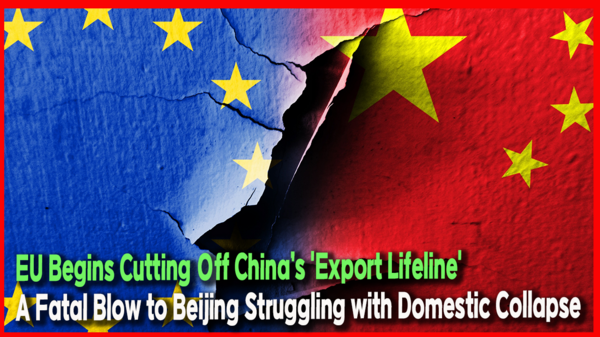
[From Sanctions on Firms Supporting Russia to Tariffs on Low-Cost Goods: Europe’s All-Out Pressure on China]
The European market, where China has expanded exports to bypass US tariff barriers, has begun to falter. The EU has imposed mass sanctions on Chinese companies that supported Russia's defense industry, while simultaneously deploying a multi-layered encirclement targeting Chinese products—ranging from tariffs on low-value parcels and additional duties on electric vehicles (EVs) to a ban on forced-labor products. For China, whose real estate sector and domestic demand have collapsed, exports are barely sustaining growth rates and manufacturing employment. Under these circumstances, the EU's pressure is not merely a conventional trade friction, but a fatal strike tightening the noose around China’s last remaining "export lifeline."
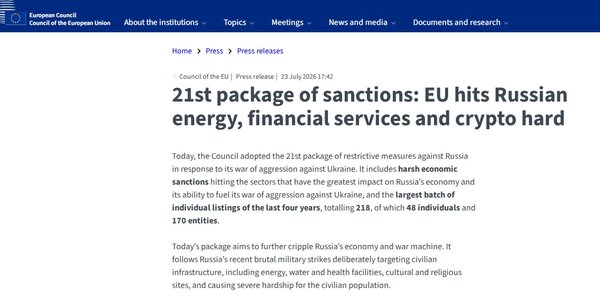
On July 23, the Council of the EU announced that it had adopted its 21st package of sanctions against Russia, stating, "A total of 218 entities and individuals, including 48 individuals and 170 entities, were newly designated—making this the largest single package since Russia's invasion of Ukraine in 2022."
Regarding this, European Relations, a media outlet specializing in European policy and international affairs, reported on the 9th: "Among the 51 entities newly subject to dual-use export controls on suspicion of supporting Russia's military-industrial complex, 14 were based in China (including 4 in Hong Kong)." It added, "The Council of the EU stated that this measure targets the inflow of items such as microelectronics, machine tools, and semiconductor processing equipment that could be used to strengthen Russia's military and technological capabilities."
[China’s Retaliatory Sanctions Fall Short of Stemming EU Pressure]
In response, China immediately took retaliatory measures. AP News reported, "China immediately placed 14 European companies, including Rheinmetall and Tatra Trucks, on its export control list," adding, "These companies will be banned from receiving Chinese dual-use items, and third-country firms will also be prohibited from indirectly supplying Chinese-related goods to them."
However, while the actions of both sides may appear identical at '14 against 14' on the surface, their actual impact is entirely different. While China's measure is a targeted counter-response against specific European defense companies, the EU's pressure is a structural offensive combining sanctions, tariffs, tech controls, and supply chain due diligence to shake China's export industry as a whole. While China may cause inconvenience to a few European defense firms, it lacks the leverage to offset the shock that Chinese products will suffer in the EU market.
Above all, the EU's actions carry the clear justification of "disrupting Russia's war-making capabilities." The longer China continues to supply dual-use items to Russia, the stronger the political justification becomes for the EU to expand additional sanctions. China's counter-sanctions may save immediate face, but they are unlikely to stop Europe's pressure campaign.
[Frozen Domestic Demand vs. Abnormally Inflated Exports]
What is even more dangerous for China is the timing of these sanctions. The Chinese economy is suffering simultaneously from a real estate slump, sluggish consumption, deteriorating corporate profitability, and local government financial distress. While the official growth rate remains near target levels, the GDP deflator, which reflects price fluctuations, has been falling for a prolonged period, and domestic demand recovery remains extremely weak.
The Rhodium Group, an independent US research and economic policy consulting firm, analyzed: "China's actual growth rate in 2025 is estimated to be around 2.5% to 3.0%, far lower than the official announcement," adding, "With China's consumption and investment failing to generate sufficient growth momentum, expanding production in export industries is sustaining the economy."
The Rhodium Group further noted: "China's trade surplus approached nearly $1 trillion in 2024, and in 2025, it surpassed the previous year's total even before November. Conversely, over the same period, RMB-denominated import growth was a mere 0.1%."
Stagnant imports amidst growing exports do not indicate healthy economic growth. Rather, it signifies that weak domestic consumption and investment demand prevent the purchase of foreign goods, while unsold domestic goods are being pushed overseas at discounted prices. An abnormal structure has taken root where a massive trade surplus fills the vacuum left by collapsed real estate and consumption.
Therefore, once the European market begins to close, the shock will not remain confined to export companies. It will spark a vicious cycle: falling factory operating rates, declining corporate profits, wage cuts, and contracting employment—which in turn further depresses consumption. If falling export prices and overcapacity overlap in a Chinese economy already suffering from deflationary pressure, companies will be forced to dump goods at even lower prices, triggering anti-dumping investigations and protectionist measures across nations.
[Tariff Barriers Extended to Temu, Shein, and AliExpress]
The EU's pressure on China extends beyond anti-Russia sanctions. Effective July 1, the EU began imposing a temporary tariff of €3 per item category on small direct-purchase goods under €150. Previously, parcels valued at €150 or less entered the EU duty-free, but this channel is now effectively being closed.
The practical targets of this measure are Chinese e-commerce platforms such as Temu, Shein, and AliExpress. Their competitiveness stemmed from shipping ultra-low-priced goods directly from China to European consumers. With item-specific tariffs, customs clearance costs, and tightened product safety inspections, their low-price strategy is bound to be disrupted.
Compounding this are additional tariffs on Chinese electric vehicles, supply chain subsidy investigations, and the full implementation of forced-labor product prohibition regulations set for December 2027. Unless companies can prove their goods do not contain raw materials or components from the Xinjiang Uyghur region, Chinese solar panels, batteries, and textile products could be blocked from the EU market. For small and medium-sized Chinese exporters lacking supply-chain tracking capabilities, this presents an almost insurmountable barrier.
[Fleeing the US for Europe, Only to Find the Retreat Blocked]
China has redirected export volumes toward Southeast Asia, the Middle East, and Europe to evade high US tariffs. However, as cheap Chinese EVs, batteries, steel, and solar products flooded in, Europe also began fearing the collapse of its industrial base. A consensus has formed that Europe can no longer tolerate "China Shock 2.0"—a wave of Chinese products displaced from the US market rushing into Europe.
The EU's move is critical because it will not end in Europe. The EU's tariff and supply chain due diligence standards are poised to influence policies in other advanced economies, including the UK, Canada, and Australia. Furthermore, if countries like Mexico, Brazil, India, and Southeast Asian nations move to restrict Chinese products to protect their own industries, China's export bypass routes will narrow drastically.
China faces a dilemma: cutting overcapacity destabilizes factories and employment, while maintaining production forces it to push more cheap goods abroad. Yet, the more it expands exports, the stronger global protectionist responses become. The very exports that once rescued the Chinese economy are now boomeranging back as a coordinated international response against China.
[Why Times Insight]
The sanction warfare between the EU and China may appear on the surface as a "force-on-force" confrontation, but the weight of the impact each side must bear is fundamentally different. Restricting Chinese products is a matter of costs and choices for the EU; for China, whose domestic demand and real estate sectors have collapsed, it is a matter of a lifeline sustaining growth and employment.
Moreover, the EU is simultaneously operating four pillars of pressure: sanctions on firms supporting Russia, tariffs on low-value parcels, extra duties on EVs, and bans on forced-labor products. This is not merely about sanctioning a few specific companies, but structurally raising the costs and risks for Chinese products entering the European market.
If Beijing fails to devise a fundamental solution to revive domestic demand and continues to rely solely on export expansion, the EU's pressure will not end as a routine trade friction. The moment the European market falters, China's manufacturing operating rates, corporate profits, employment, and consumption could cascade downward in tandem. Now that Europe is following the US in pushing back against Chinese goods, the crisis Beijing faces is not just declining exports, but the collapse of the very growth model that has served as the final pillar of the Chinese economy.

-중국 푸단대학교 한국연구원 객좌교수
-전 EDUIN News 대표
-전 OUR NEWS 대표
-제17대 대통령직인수위원회 정책기획팀장
-전 대통령실 홍보기획비서관
-사단법인 한국가정상담연구소 이사장
-저서: 북한급변사태와 한반도통일, 2012 다시우파다, 선거마케팅, 한국의 정치광고, 국회의원 선거매뉴얼 등 50여권