
Update2026.10.24 (토)

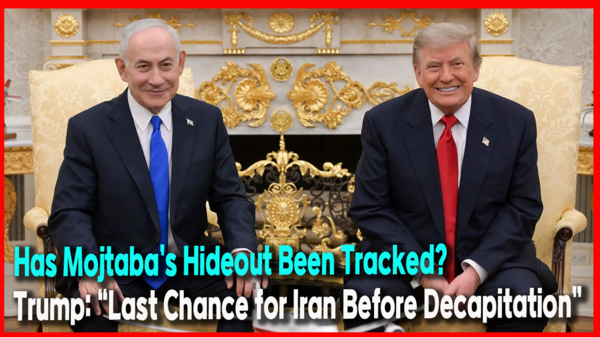
[Trump: “This is truly the last chance”… US and Israel highlight Iran’s three critical vulnerabilities]
US President Donald Trump has issued a virtual ultimatum to Iran, calling it their "last chance". Coincidentally, sensitive intelligence regarding the survival status of the in-hiding Mojtaba Khamenei, Iran’s remaining inventory of ballistic missiles, and the operation status of the underground nuclear facility at Pickaxe Mountain was released simultaneously by the US and Israel just prior to the warning. This serves as a clear signal that Washington and Jerusalem are actively tracking everything—from the top leadership's status to missile counts and nuclear facility activity. Trump's remarks are interpreted as a high-intensity psychological warfare tactic aimed directly at Mojtaba, conveying the message: "If you do not sign the document, you too could become a target."
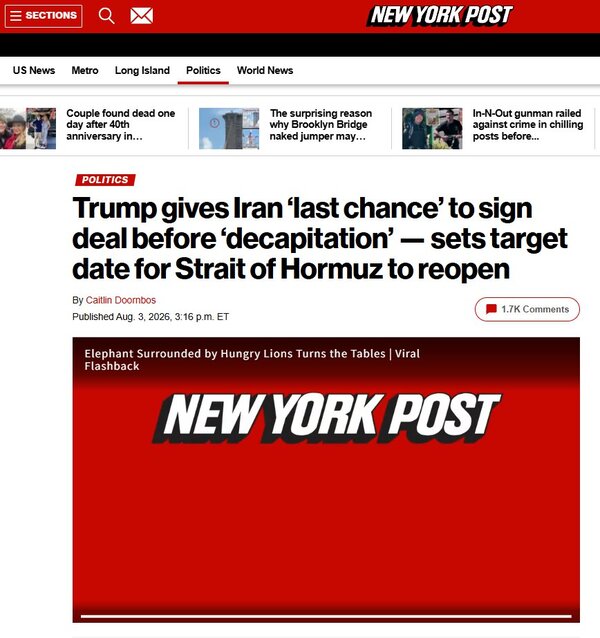
The New York Post reported on the 4th that "President Trump is giving Iran a final chance to avoid destruction," defining it as "the last chance before decapitation". Indeed, speaking at the White House, Trump stated, "This is a last chance. This is the last chance for them to sign a good document".
President Trump noted that "at the request of Iran and several Middle Eastern nations asking for time to establish a general framework for negotiations, the large-scale military operation scheduled for the weekend was suspended, and negotiations to reopen the Strait of Hormuz are currently underway as of the 4th". While military strikes have been paused, the statement serves as a simultaneous warning that if negotiations fail, targets will expand beyond military infrastructure to include the Iranian leadership itself.
The New York Post pointed out that "since the outbreak of the war on February 28, Trump has granted Iran at least 12 opportunities by threatening airstrikes or setting deadlines and subsequently extending them". This time, however, the atmosphere is markedly different. For the first time since the early stages of the conflict, the possibility of a 'decapitation strike'—aimed at severing the head of the regime rather than merely destroying infrastructure—is explicitly being raised.
To be clear, "the last chance before decapitation" is a characterization by the New York Post interpreting Trump's ultimatum, rather than a phrase he uttered directly. Nonetheless, the timing of these words is noteworthy. Sensitive details concerning Iran’s leadership, military capabilities, and nuclear infrastructure surfaced concurrently around the high-level meeting between Trump and Israeli Prime Minister Benjamin Netanyahu at the White House.
[90-Minute Meeting Dominated by the ‘Iran Question’]
President Trump and Prime Minister Netanyahu held a 90-minute closed-door meeting at the White House Oval Office on July 28. While initial expectations suggested topics such as the Israeli military presence in Syria would be discussed, the meeting was reportedly dominated almost entirely by the Iranian issue.
The Times of Israel (TOI) reported that "the two leaders closely reviewed three potential courses of action against Iran: first, a negotiated agreement; second, the continuation of containment and economic pressure; and third, a large-scale military attack." In other words, if Iran fails to sign the agreement, it will be forced to choose between economic suffocation and total military destruction.
It remains unconfirmed whether all intelligence was formally presented during the meeting. However, the three key pieces of information leaked around the time of the summit clearly demonstrate where the US and Israel are focusing their surveillance.
[Vulnerability 1: “Mojtaba is Alive”]
The first area of focus concerns the survival and chain of command of Iran’s Supreme Leader, Mojtaba Khamenei. Citing sources, Axios reported that "US and Israeli intelligence agencies have secured substantial evidence supporting the fact that Mojtaba is alive". Axios also noted that "traces were detected of Iranian officials attempting to schedule in-person briefings with him".
According to Axios, this does not imply that Mojtaba is exercising routine operational control over state affairs. Assessments suggest it remains unclear who is actually governing Iran or whether Mojtaba is issuing direct orders. Reports indicate he issued instructions that nothing be done without his explicit approval, only to express rage when those orders were not executed. In short, while alive, he lacks the absolute authority once exercised by his father, Ali Khamenei.
Mojtaba succeeded to the position of Supreme Leader after his father died in a joint US-Israeli opening airstrike on February 28, but he has not made a single public appearance since. He was absent even from his father’s funeral. The New York Times reported that "he was barred from attending due to fears of an Israeli assassination plot," while Reuters cited reports alleging that "he suffered severe injuries to his face and legs".
In a May interview with CBS's 60 Minutes, Prime Minister Netanyahu similarly remarked, "I believe Mojtaba is alive, but he is highly likely hiding in a bunker or a secret location." Therefore, the key takeaway here is not merely whether he is alive. The fact that the US and Israel are tracking Mojtaba’s survival, command traces, and the movements of those around him represents a devastating psychological blow to the Iranian regime.
[Vulnerability 2: Approximately 1,500 Remaining Ballistic Missiles]
The second vulnerability centers on Iran’s remaining inventory of ballistic missiles. Israeli assessments indicate that Iran currently holds approximately 1,500 ballistic missiles. Compared to the pre-war Israeli military estimate of roughly 2,500 ballistic missiles capable of reaching Israel, this marks a substantial depletion.
This reduction indicates that months of continuous US and Israeli airstrikes, coupled with Iran’s own large-scale missile launches, have rapidly drawn down its stockpiles. With launch pads and production facilities repeatedly hit, the actual operational inventory may be even lower than the headline figure.
However, this does not mean the Iranian threat has been eliminated. An inventory of around 1,500 ballistic missiles remains a formidable force capable of striking Israel, US military bases across the Middle East, and energy infrastructure in the Gulf region. Israeli officials themselves do not expect the regime to collapse solely from a depleted arsenal. The core message is not that Iran is out of weapons, but that the US and Israel are actively monitoring its remaining stock and burn rate.
[Vulnerability 3: The Centrifuges of Pickaxe Mountain]
The third area of focus is the underground uranium enrichment facility located at Pickaxe Mountain near Natanz. The Wall Street Journal previously reported that "Iran relocated thousands of centrifuges into underground tunnels at this site last autumn." CNN similarly reported that "Israeli intelligence provided the US with information indicating that not only centrifuges but also enriched uranium stocks had been transferred there."
However, Israeli assessments concluded that while "centrifuges are present at Pickaxe Mountain, active uranium enrichment is not currently believed to be taking place there." It remains unconfirmed whether this specific piece of intelligence was delivered as a formal briefing during the summit, as both nations' intelligence agencies already share such data, rendering a direct explanation by Netanyahu unnecessary.
Nevertheless, given that the International Atomic Energy Agency (IAEA) has been unable to access the facility or install monitoring equipment, active operation cannot be ruled out definitively. This is precisely why the US and Israel maintain a close watch on Pickaxe Mountain. The moment enrichment resumes or nuclear material is moved, the site could become a top-priority target for the next round of major airstrikes.
[“We Know Your Location and Your Remaining Arsenal”]
The level of concrete reliability varies among these three pieces of intelligence. Evidence confirming Mojtaba’s exact location remains insufficient, the figure of 1,500 ballistic missiles is an Israeli assessment, and the halt of enrichment at Pickaxe Mountain has not been independently verified by the IAEA.
Nonetheless, the sequence of these information disclosures is notable. Messages signaling that the Supreme Leader's survival, command activity, remaining missile inventory, and underground nuclear operations are being monitored were leaked first, followed immediately by Trump's "last chance" ultimatum. This sequence is highly likely a calculated campaign of psychological warfare intended to instill fear of intelligence leaks within the Iranian negotiating team and provoke mutual distrust between the leadership and the military establishment.
[Why Times Insight]
The core of this situation is not whether the US and Israel have secured Mojtaba’s exact hideout. The mere fact that they are continuously tracking the Supreme Leader's survival status, command structure, remaining ballistic missile counts, and underground nuclear movements constitutes a profound threat to the Iranian regime.
Trump's ultimatum ultimately conveys a singular message: "We know your vulnerabilities and your remaining assets." For Mojtaba, who lives in hiding under the constant terror of meeting his father's fate through assassination, the prospect of a 'decapitation strike' exerts a far more direct pressure than any standard military threat.
Considering Trump's past pattern of repeatedly extending attack deadlines, this warning may function more as leverage to drag Iran to the negotiating table rather than an announcement of an imminent strike. However, should Iran discard this final opportunity, the targets of the next operation may no longer be limited to missile bases or nuclear sites. Behind the final deal offered by Trump now lies the very question of Mojtaba Khamenei’s personal survival.

-중국 푸단대학교 한국연구원 객좌교수
-전 EDUIN News 대표
-전 OUR NEWS 대표
-제17대 대통령직인수위원회 정책기획팀장
-전 대통령실 홍보기획비서관
-사단법인 한국가정상담연구소 이사장
-저서: 북한급변사태와 한반도통일, 2012 다시우파다, 선거마케팅, 한국의 정치광고, 국회의원 선거매뉴얼 등 50여권