
Update2026.10.24 (토)

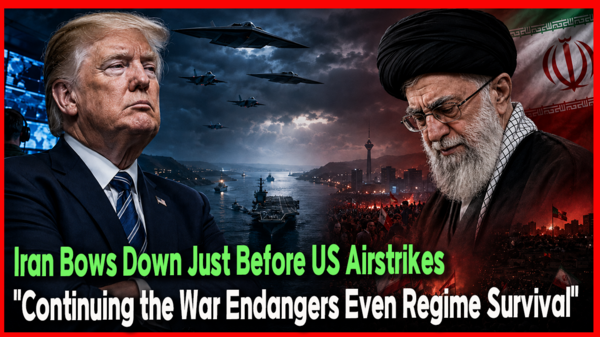
[Trump: "Canceled strikes at Iran's request"... Iran's desperate choice]
Just before large-scale US and Israeli airstrikes were executed, Iran returned to the negotiation table. US President Donald Trump stated that Iran and several Middle Eastern nations requested a suspension of attacks, claiming a "broad framework for a deal" had been established, and that he subsequently called off the scheduled military operation for now. The core conditions are the immediate and complete reopening of the Strait of Hormuz and an end to Iran's nuclear threat.
Behind Iran's abrupt desperation to halt the war appears to be a crisis of regime survival that goes beyond simple military inferiority. With its economy suffocating under the US naval blockade and sanctions, the fear that initiating massive airstrikes targeting energy infrastructure would collapse the national economy—and that the shock could spark large-scale anti-government protests—pushed the Iranian Iranian leadership into the negotiating room.
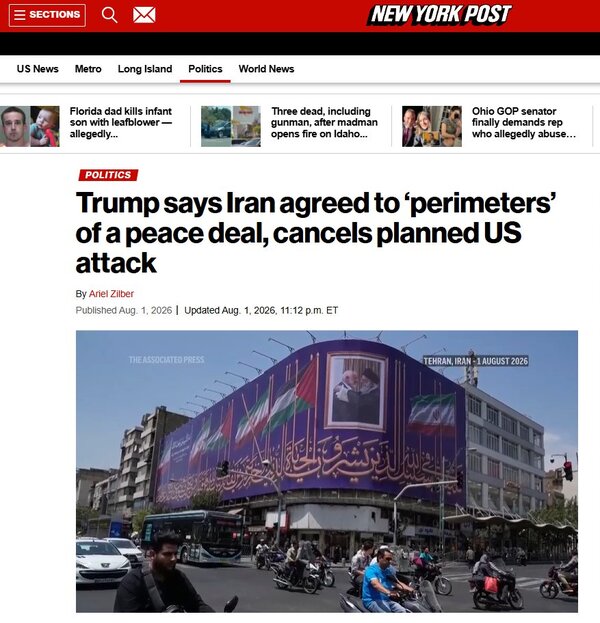
US media reported on the 3rd that President Trump posted on social media on the 1st, stating that the US had been asked by Iran and other Middle Eastern countries to hold off any attack since the perimeters of a deal had been agreed to. He added that this agreement will include the immediate, complete, and total opening of the Hormuz Strait and an end to Iran's nuclear threat, noting that for the future benefit of the world and the survival of a successful and prosperous Iran, he agreed to cancel the attack, subject to being able to rapidly make a deal.
However, Trump has not scrapped the military option itself. He warned that the US is locked and loaded and ready to go against Iran with overwhelming military force, and Israel also joined the US decision to hold off attacks, choosing to monitor the situation for the time being.
Prior to this decision, US media outlets had reported that the US and Israel were preparing an unprecedented bombing campaign targeting Iran's energy infrastructure, which could begin as early as this weekend. In a related analysis, local media also noted that inside Israel, there was a strong current of opinion that the next attack should go beyond merely destroying military facilities and deliver a substantial blow to the Iranian regime's governance capability and economic base.
This indicates that a US attack likely would not have ended as a limited retaliation destroying a few missile bases. It implies it could have expanded into an operation to simultaneously shake oil export facilities, refining and power infrastructure, ports, and logistics networks, thereby weakening not only Iran's war-fighting capacity but also its regime retention capability.
Ultimately, the choice facing Iran was clear: reopen the Strait of Hormuz and resume talks, or risk having the final lifeline of its economy bombed.
[The illusion that time was on Iran's side has shattered]
The primary reason Iran had no choice but to request a halt to the war was that time was no longer on its side. In June, the US and Iran discussed halting combat, lifting the US Navy blockade, reopening the Strait of Hormuz, and re-confirming nuclear non-proliferation through the Islamabad Memorandum of Understanding. However, the temporary ceasefire collapsed in early July, and both sides re-engaged in armed conflict.
Iran believed that blockading Hormuz would serve as a powerful weapon to pressure the US and the West. However, as the blockade dragged on, the damage began hitting the Iranian economy first. Blocking the Strait of Hormuz shocks global oil prices and maritime transport networks, but Iran also relies on the strait for a significant portion of its oil exports and imported goods. The longer the blockade persists, the more foreign currency revenues plummet and prices for daily necessities and logistics skyrocket. For an Iranian economy already weakened by sanctions and war, the Hormuz blockade became a double-edged sword—a spear pointed at the US, but simultaneously a blade choking its own neck.
Alex Vatanka, a senior fellow at the Middle East Institute, analyzed that Foreign Minister Abbas Araghchi focused on transforming US military pressure into manageable negotiating leverage while pushing the most difficult nuclear issues to the back burner. Within Iran, reports indicated warnings that hardliners' judgment that 'time is on Iran's side' was mistaken, and that the prolonged Hormuz blockade was causing far greater harm to the domestic economy than anticipated.
The Institute for the Study of War (ISW) similarly analyzed that voices of concern regarding the economic damage caused by US sanctions, blockades, and war are growing within Iran's pro-negotiation faction. There is a spreading sense of crisis that if the war drags on indefinitely, it could threaten regime stability beyond mere military damage.
[More frightening than major airstrikes: "Explosions on the Streets"]
What the Iranian leadership truly fears is not just US bombing. It is a scenario where bombing collapses oil, power, and logistics infrastructure, exacerbating hyperinflation and shortages of basic goods, thereby directing public rage against the regime. Mohammad Bagher Ghalibaf, Speaker of the Iranian Parliament, recently revealed that five months ago—when Khamenei was killed in a joint US-Israeli airstrike—authorities managed the 'street' as a separate front. He meant that how citizens react and where they move was a front determining the survival of the regime, alongside military, diplomatic, and administrative services.
These remarks expose that the Iranian leadership fears internal unrest just as much as external attacks. If the war drags on, disrupting electricity and fuel supplies while compounding unemployment and price surges, relying on patriotism to rally the public will inevitably hit a wall. If subsequent US and Israeli attacks directly target the economic foundation, the possibility of anti-government sentiment crossing a critical threshold cannot be ruled out.
For the Iranian negotiating faction, continuing the war did not yield an advantage; it only escalated the risks the regime had to bear. Preventing a US attack effectively became synonymous with preventing an internal explosion.
[The Hormuz concession offered by Araghchi]
Amid this sense of crisis, Foreign Minister Araghchi reportedly conveyed a concrete Hormuz compromise proposal to Qatari and US diplomats. The framework proposed that ships use Iranian territorial waters when entering the strait and Omani territorial waters when exiting.
Saudi Arabia and Qatar also stepped in as mediators. Saudi Crown Prince Mohammed bin Salman emphasized in a phone call with President Trump the need to use the language of dialogue to de-escalate tensions and make every effort to create a cooling-off period.
Ultimately, the alignment of urgent concessionary moves by Iranian negotiators and mediation by Gulf states brought the massive US-Israeli attack—which had reached the brink of execution—to a halt. If Trump's account is accurate, intense US military pressure extracted real possibilities for concessions from Iran.
[Hardliners push back: "Request to stop attack is a lie"]
However, it remains unclear whether this agreement will lead to a final settlement. Immediately following Trump's announcement, Iran's semi-official Mehr News Agency quoted military officials denying claims that Tehran asked the US to halt attacks. They warned that the Iranian military maintains the highest state of readiness, and if conflict is inevitable, the battlefield will decide.
Fars News Agency, closely aligned with the Islamic Revolutionary Guard Corps (IRGC), also claimed that no agreement regarding the reopening of the Strait of Hormuz has been finalized. It reiterated the stance that as long as US hostile actions continue, the strait will remain closed. Still, it is difficult to interpret this backlash as the entire Iranian regime rejecting negotiations. Analysts suggest the mainstream IRGC is less about denying negotiations altogether and more about attempting to secure tougher terms while retaining influence over Hormuz.
Currently, internal clashes within Iran are less of a binary "negotiation vs. war" conflict and more of a power struggle over how much to concede to the US. The problem is that if this conflict intensifies, this agreement—like June's temporary ceasefire—could collapse in an instant.
[Why Times Insight]
The core of this current phase is not that Iran has surrendered completely in a military sense. Rather, it is that the combined weight of US blockades, sanctions, and threats of large-scale airstrikes exerted simultaneous pressure on Iran's economy and regime stability, driving negotiators to conclude they could no longer sustain the war.
The Hormuz blockade was Iran's weapon to pressure the US and the West, but over time, it transformed into a trap suffocating Iran's own economy. Compounded by the imminent threat of massive US-Israeli airstrikes capable of devastating energy infrastructure, Iran faced a situation where continuing the war meant risking not only its military facilities, but its economy, public support, and regime survival all at once.
Ultimately, American bombers have paused, but they have not flown away. If Iran fails to translate the reopening of the Strait of Hormuz and an end to nuclear threats into actual action, or if internal hardliners overturn the agreement, this cancellation of attacks will mark not the beginning of peace, but merely a brief reprieve before the next major airstrike.
A question arises at this point: Why do most media outlets fail to report on Iran's internal crisis and the background forcing it to ask the US for negotiations, choosing instead to cover only the superficial narrative that President Trump canceled strikes on Iran yet again? Some reports even focus heavily on highlighting Trump's alleged unpredictability. How should we view media that ignores facts in favor of broadcasting their own ideological convictions?

-중국 푸단대학교 한국연구원 객좌교수
-전 EDUIN News 대표
-전 OUR NEWS 대표
-제17대 대통령직인수위원회 정책기획팀장
-전 대통령실 홍보기획비서관
-사단법인 한국가정상담연구소 이사장
-저서: 북한급변사태와 한반도통일, 2012 다시우파다, 선거마케팅, 한국의 정치광고, 국회의원 선거매뉴얼 등 50여권