
Update2026.10.24 (토)

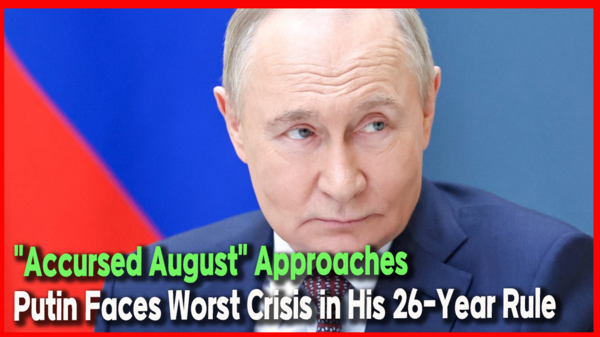
[Largest Drop in Approval Ratings, Consecutive Strikes on Russian Mainland, Allegations of Kremlin Defections]
Ahead of August, which Russians refer to as the "accursed month," President Vladimir Putin's 26-year regime is coming under unusual pressure. With even pro-Kremlin opinion polls recording the largest weekly drop in approval ratings since the full-scale invasion of Ukraine, Ukrainian strikes targeting oil refineries and logistics networks are pushing the cost of war directly into the daily lives of everyday Russians. Compounding this are assertions that Putin's close allies have begun blaming him for the war's failures, alongside diagnoses of system fatigue among the Kremlin elite. While this does not mean Putin will collapse immediately, warnings that cracks are beginning to form at the periphery of a regime frozen like a "rusted bolt" are growing increasingly loud.
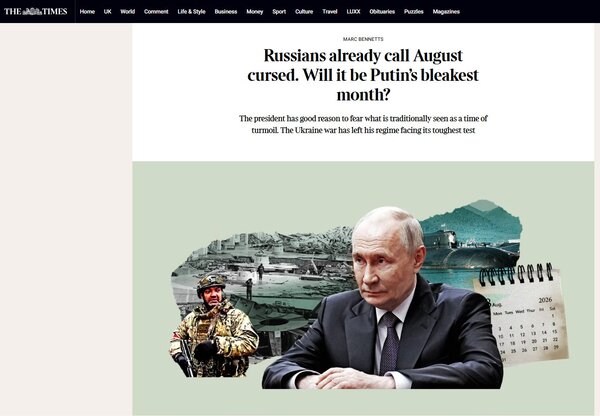
The UK's The Times reported on the 30th (local time), "Russians already call August the cursed month," diagnosing that "this August could turn out to be Putin's darkest month yet." The Times pointed out that "although Putin has weathered numerous political and military crises during his long rule, it is rare for a drop in approval ratings, fuel shortages, Ukrainian strikes on the Russian mainland, and anxiety among the elite to converge all at once."
Behind this dramatic framing lies not a single isolated event, but four distinct signs of fracture observed simultaneously over recent weeks: ▲ an unprecedented drop in approval ratings ▲ publicly raised claims by Ukrainian President Volodymyr Zelensky regarding internal Kremlin defections ▲ the historical pattern known as Russia's "August jinx" ▲ structural crisis diagnoses by Kremlin analysts. Each piece of evidence is examined below.
[Evidence ① Approval Rating Collapse... "Largest Drop Since 2022"]
The most direct warning signal came from public opinion polls. The Moscow Times noted, "In a survey conducted July 10–12 by the Public Opinion Foundation (FOM), classified as pro-Kremlin, Putin's approval rating stood at 66%," explaining that "this is a sharp 5 percentage point drop from 71% a week earlier, marking the largest weekly decline since the partial mobilization announcement in 2022."
The Moscow Times explained, "The same trend was confirmed by the state-run Russian Public Opinion Research Center (VTsIOM)," adding that "Putin's approval rating slid continuously from 70.4% in mid-June to 66.9% at the end of June, 66.0% in the first week of July, and 65.1% in the second week, while trust ratings also dropped from 76.7% to 71.0% over the same period."
In terms of absolute numbers, an approval rating in the mid-60s remains high, so this cannot be immediately interpreted as an imminent "regime collapse." However, in a Russia where media censorship and punishment for anti-war statements are routine, the fact that figures from pro-government polling agencies fell this rapidly is not something to be taken lightly.
On this matter, The Moscow Times noted, "Nationwide fuel shortages, tightened internet controls, rising prices, along with Ukrainian attacks on oil refineries, are cited as primary drivers, as the costs of war begin to penetrate directly into the daily lives of Russians." It added, "The belief that has sustained the Putin regime—that 'the war is far away, and the state protects citizens' daily lives'—has begun to shake."
[Evidence ② Shaking Inside the Kremlin... Rumors of Inner Circle Defections]
Ukraine's long-range strikes are pouring fuel on this anxiety. Target sets have expanded beyond military bases and oil refineries to include fulfillment warehouses for Wildberries, Russia's largest online retailer. Ukrainian officials claimed that "these facilities stored supplies needed by the Russian military, including drone parts and navigation systems."
It is difficult to conclude that attacks on logistics warehouses immediately shake the Russian financial system. However, when refineries, railways, and supply networks are hit simultaneously, shocks can ripple beyond military supply chains into general distribution and consumption across the real economy. Most importantly, it instills fear among the Russian public that "it is no longer safe inside our borders."
Putin has long portrayed himself as a leader who ended Russian chaos and restored order and security. Now, however, the war he initiated routinely produces scenes of burning Russian refineries, long lines at gas stations, and strikes on major distribution centers. As the sounds of war draw closer to daily life in Moscow and Saint Petersburg, the "myth of stability"—Putin's most critical political asset—inevitably suffers damage.
Amid this, Ukrainian President Volodymyr Zelensky's remarks pointing to internal instability in the Kremlin are rattling Moscow. President Zelensky claimed in a video address on July 22, "The situation on the front lines and our long-range and medium-range strikes are creating a new and highly toxic atmosphere around Putin."
Zelensky continued, "Starting this war and failing to end it is Putin's responsibility alone, and the losses suffered by Russians are also Putin's responsibility alone," adding, "His inner circle understands this as well and is sending such signals to us and our partners."
If these statements are true, it indicates that moves have begun inside the Kremlin to shift the blame for the war onto Putin personally. Allies who credited Putin with victory when the war was going well may now be contemplating risk-diversification and survival strategies in preparation for deteriorating conditions.
However, Zelensky did not disclose specific individuals or evidence. Given that his remarks carry elements of psychological warfare inherent to combatants, one should not jump to the conclusion that "Kremlin defections are confirmed." Nevertheless, the mere fact that Zelensky raised this publicly succeeded in making rumors of cracks around Putin a major topic of international concern.
[Evidence ③ Russia’s Dreaded “Black August”]
The third piece of evidence rests on a historical pattern: Russia's unique "August jinx." The Times noted, "In Russia, August has long been called 'Black August' or the 'accursed August,'" recalling that "a coup by Soviet hardliners occurred in August 1991, the nuclear submarine Kursk sank during Putin's first year in power in August 2000, an explosion at the Sayano-Shushenskaya hydroelectric plant killed 75 people in August 2009, and Ukrainian forces advanced into Russia's Kursk region in August 2024, humiliating Putin."
Of course, grouping events that occurred in a specific month does not establish a causal relationship guaranteeing that a major crisis will erupt in August 2026. However, current-day Russia is already experiencing a convergence of fuel shortages, mainland strikes, falling approval ratings, and a prolonged war.
The Times pointed out, "To this is added the pattern of mainland strikes that has continued since the war began. Ukrainian attacks are expanding beyond oil refineries to target logistics warehouses of Wildberries, Russia's largest online retailer, threatening to shake the financial system itself," noting that "this trend is creating an image of 'Russia burning inside its borders every day.'" Should the historical memory of "Black August" combine with anxiety in Russian society, even a minor incident could be amplified into a symbol of regime crisis.
[Evidence ④ Putin Doesn't Move, the System Distorts First]
The fourth piece of evidence comes from the diagnosis of exiled political analyst Tatyana Stanovaya, known for her deep insight into Kremlin dynamics. Stanovaya likened the current Putin regime to a "rusted bolt." She explained that "no matter how much force is applied, the bolt itself does not budge; instead, the surrounding structure absorbs the load, causing cracks and deformations."
This means that "even under pressure, Putin is unlikely to change his war policy or seek compromises." Rather, as Stanovaya observed, "The less Putin moves, the greater the burden absorbed by the military, intelligence services, regional governments, and economic elites. The elites may begin to feel not confidence in winning the war, but fear that the supreme leader is failing to adapt to changing realities."
Even so, it is difficult to foresee an immediate collapse of the Putin regime. The Russian military still controls roughly one-fifth of Ukrainian territory and retains the capability to continue missile and drone attacks. Organized opposition has been effectively eliminated, and security services as well as the bureaucratic apparatus maintain their loyalty to Putin.
As anxiety grows, Russian society may consolidate around a hardline stance rather than demanding peace. The post-invasion resurgence of Stalin statues and busts across Russia and occupied territories illustrates this paradox: as insecurity deepens, calls for strict control and punishment can drown out demands for freedom and reform.
[What Awaits After Putin Is Merely a "Carbon Copy of Putin"]
The Times analyzed that "even if the current crisis escalates into an actual power struggle, it is unlikely to lead to the democratization of Russia." This is because "with liberal opposition leadership mostly dead, imprisoned, or in exile, any successor is highly likely to emerge from within the existing power elite—the military, intelligence agencies, and bureaucracy."
When asked before his death in 2023 what kind of regime would emerge after the Putin system collapses, former Kremlin political strategist Gleb Pavlovsky answered, "A carbon copy of this system." This implies that even if Putin as an individual wobbles, the security apparatus and authoritarian governance structure sustaining Putinism can survive intact.
[Why Times Insight]
The true danger of this "accursed August" lies not in Putin suddenly falling from power. The more significant shift is that the "myth of stability and security" sustaining the Putin regime is crumbling. War no longer remains confined to the distant Ukrainian front lines; it has arrived at Russian gas stations, internet networks, logistics warehouses, and the skies above its cities.
The decline in approval ratings shown even in pro-government surveys is a relatively clear fact, whereas Zelensky's claim regarding inner-circle defections remains independently unverified. "Black August" is also a powerful narrative linking historical events rather than an objective law predicting another crisis. Therefore, interpreting this as an "imminent collapse of the Putin regime" goes too far.
However, the less Putin moves, the greater the risk that the system supporting him distorts first. If the regime turns even more repressive and aggressive to plug the cracks, Russia's crisis could lead not to Putin's downfall, but to the emergence of an "even harder-line Putinism." If what awaits after Putin is not democratization but another "carbon copy of the Putin system," Russia's Black August may prove to be not a one-month jinx, but the starting point of a long-term systemic crisis.

-중국 푸단대학교 한국연구원 객좌교수
-전 EDUIN News 대표
-전 OUR NEWS 대표
-제17대 대통령직인수위원회 정책기획팀장
-전 대통령실 홍보기획비서관
-사단법인 한국가정상담연구소 이사장
-저서: 북한급변사태와 한반도통일, 2012 다시우파다, 선거마케팅, 한국의 정치광고, 국회의원 선거매뉴얼 등 50여권