
Update2026.10.24 (토)

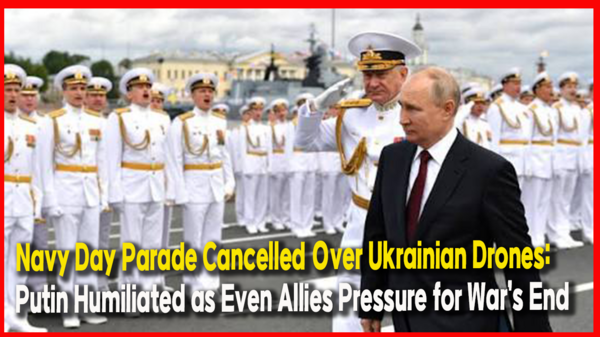
[Putin’s Naval Parade Vanishes Amid Fear of Ukrainian Drones]
Russia has cancelled its flagship Navy Day main naval parade in St. Petersburg for the second consecutive year. As Ukrainian drones and long-range missiles pose an increasing threat to Russia’s second-largest city and Baltic Fleet bases, a massive fissure has emerged in the homeland defense capabilities and military prestige that Vladimir Putin has long boasted. Furthermore, Kazakh President Kassym-Jomart Tokayev publicly urged Putin—right to his face—to freeze the war and return to negotiations. Compounded by reports that a large-scale Russian mechanized offensive was repelled in Donbas, Putin finds himself in a position of humiliation across the security, diplomatic, and frontline domains simultaneously.
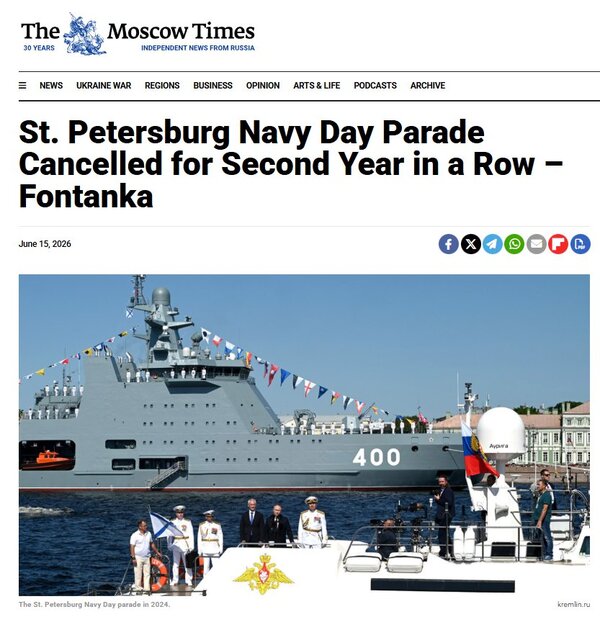
Russia once again cancelled the traditional Navy Day "Main Naval Parade" along the Neva River in St. Petersburg. The measure reflects growing exposure to risk even in heavily fortified major Russian cities as Ukraine’s long-range strike capabilities expand. The event was drastically downscaled to a wreath-laying ceremony and public festivities on Palace Square—a stark contrast to the grand displays held annually since 2017, which brought together vessels from all four major fleets: the Baltic, Black Sea, Northern, and Pacific Fleets.
While scaled-down Navy Day events took place across Russia, the pinnacle of the celebration—the maritime review along the Neva River—was entirely absent. In St. Petersburg, only minimal events such as wreath-laying and public gatherings on Palace Square proceeded. The spectacle was remarkably meager compared to past years, when warships from multiple fleets assembled to showcase Russian naval prowess.
President Vladimir Putin also opted not to inspect assembled warships in person, choosing instead to address commanders via video link from Navy Headquarters. Although he emphasized the fleet's development and claimed that "the Russian Navy is capable of effectively carrying out all assigned tasks," he failed to hold the very event intended to demonstrate that capability to the Russian public.
Kremlin Spokesperson Dmitry Peskov explained that the cancellation was based on "the overall situation," stating that "security is paramount". However, this explanation serves as a tacit admission that Putin was forced to abandon his signature military propaganda showcase due to the threat of Ukrainian attacks.
The Navy Day parade is not merely a festive occasion. Grandly revived by Putin in 2017, the event was designed to signal to the world that Russia had overcome post-Soviet collapse and returned as a formidable maritime power. By gathering warships, submarines, and naval aircraft, Putin used the platform to flaunt the "strong Russia" he claimed to have restored.
Yet, the country that launched a war to "demilitarize" Ukraine now fears Ukrainian drones to the extent that it cannot host a naval parade in its own second-largest city. A leader who was confident at the outset of the invasion that Kyiv would fall in a matter of days has, years later, been reduced to worrying about security in St. Petersburg.
Ukraine’s Unmanned Systems Forces and Security Service (SBU) claimed to have struck the Kronstadt Naval Base—home to the Baltic Fleet—in June. With military strongholds in the Baltic Sea falling within strike range, the Kremlin undoubtedly found it difficult to justify assembling dozens of warships in a narrow waterway for a public parade.
[Call Issued Directly to Putin’s Face: "End the War Now"]
An even more painful moment for Putin occurred on July 25 at the 22nd Russia-Kazakhstan Interregional Cooperation Forum held in Omsk, Russia. Seated alongside Putin in a public venue, President Tokayev stated: "If I may offer my view, it is time to freeze this conflict and return to an 'Istanbul Formula 2.0'."
Emphasizing that "it is tragic that young people are dying," Tokayev referred to Russians and Ukrainians as "brotherly peoples." His remarks clearly implied that rather than pursuing further territorial gains, Russia should freeze the current frontline and return to negotiations.
Kazakhstan has not always aligned with Russia on every issue. Following Russia’s invasion of Ukraine in 2022, the Tokayev administration refused to recognize the self-proclaimed "People's Republics" in Donetsk and Luhansk, maintaining a balanced diplomatic posture between Russia and the West. Therefore, framing his statement as a sudden "rebellion" or "defiance" by an ally would be an exaggeration.
Nonetheless, the scene was undeniably humiliating for Putin. In the past, when Russian national power was overwhelming, requests to end hostilities would have been conveyed discreetly through private diplomatic channels. Instead, this demand was delivered openly and without hesitation directly in front of Putin at an official public event.
Kazakhstan is a member of the Russia-led Collective Security Treaty Organization (CSTO) and a core nation within the Eurasian Economic Union. The fact that the leader of a key ally supporting Russian influence in Central Asia publicly advised Putin to halt the war illustrates a shift in power dynamics.
Peskov immediately countered by noting that "President Tokayev holds a consistent position, but that does not mean we agree with it." Yet, the Kremlin’s public expression of displeasure only underscores the substantial political weight Tokayev’s remarks placed on Putin. Even Russia’s closest allies now have fewer reasons to remain silent while bearing the costs of an endless war.
[Massive Russian Offensive Halted in Donbas]
Disheartening news for Putin continued to emerge from the front lines. According to announcements from Oleksandr Pivnenko, Commander of the National Guard of Ukraine, Ukrainian units, including the 1st Azov Brigade, successfully repelled a large-scale Russian offensive in Donetsk Oblast.
Elements under Russia's 8th Army, 41st Army, and 90th Tank Division attempted an assault toward settlements near Shahove over approximately four hours but failed to breach defensive lines. Ukrainian sources reported the destruction of 7 tanks, 6 armored vehicles, and Grad and Tornado-S multiple rocket launcher systems, along with 123 Russian personnel killed and 29 wounded.
Because these figures represent field reports, they should not be treated as independently verified final statistics. Nor can a single tactical setback be declared as altering the overall trajectory of the Donbas front. However, the fact that a mechanized assault involving units from multiple higher formations was halted by Ukrainian drones, precision strikes, and mobile defense demonstrates that Russian forces remain reliant on attrition tactics involving heavy personnel and material loss.
Notably, Russian military commentator Maxim Kalashnikov publicly criticized high command for forcing reckless operations. The fact that criticism of military leadership—once taboo early in the war—is repeatedly voiced by pro-Russian military bloggers and commentators indicates that frustration over a prolonged conflict can no longer be entirely contained within Russia.
[Why Times Insight]
It would be premature to view the cancellation of the Navy Day parade, Tokayev’s public call for peace, and the failed offensive in Donbas as immediate proof of an impending collapse of the Putin regime. The parade cancellation is a symbolic humiliation rather than an existential threat to regime survival, and Kazakhstan has long maintained an independent foreign policy posture. Similarly, engagements in Donbas represent individual tactical battles within a broader war.
However, the simultaneous occurrence of these three events carries significant weight. As security anxieties in Russia’s heartland, public peace pressure from its closest partner, and repeated attritional failures at the front converge, the founding narrative of Putin's rule—that he restored Russia as a great power—is wobbling.
What threatens Putin today is not a single decisive defeat, but the fact that as the war drags on, failures become harder to conceal, allies speak out more boldly, and the insecurity felt by the Russian populace penetrates deep into its major metropolitan centers.
In the past, Putin’s silence alone was enough to keep neighboring leaders quiet. Today, demands to "end the war" are delivered directly to his face. A leader who once showcased national power through warships now cannot even present those ships to his own people out of fear of Ukrainian attacks. A war launched to subjugate Ukraine is instead eroding Putin’s authority and the myth of Russian power—a stark illustration of how deeply his prestige has fallen.

-중국 푸단대학교 한국연구원 객좌교수
-전 EDUIN News 대표
-전 OUR NEWS 대표
-제17대 대통령직인수위원회 정책기획팀장
-전 대통령실 홍보기획비서관
-사단법인 한국가정상담연구소 이사장
-저서: 북한급변사태와 한반도통일, 2012 다시우파다, 선거마케팅, 한국의 정치광고, 국회의원 선거매뉴얼 등 50여권