
Update2026.10.24 (토)

[Beyond Kursk to Voronezh: Portending a New Phase in the Russia–North Korea Alliance]
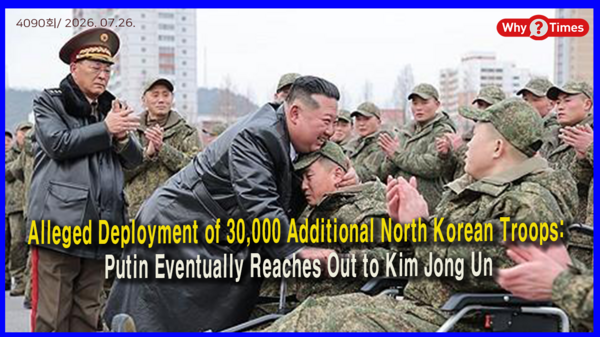
Ukrainian President Volodymyr Zelenskyy claimed that Russia is seeking to deploy an additional 30,000 North Korean troops, with preparations underway in the Voronezh region since June to accommodate them. If true, this newly planned deployment would be more than double the size of the previously dispatched North Korean force. This would mark a critical turning point—shifting the military cooperation between Russia and North Korea, which had been focused on the Kursk front, into a permanent support mechanism sustaining the entire long-term war effort. As Russia’s burden of troop replenishment intersects with North Korea’s drive to acquire advanced military technology, the dangerous transaction between the two nations is evolving on an even grander scale.
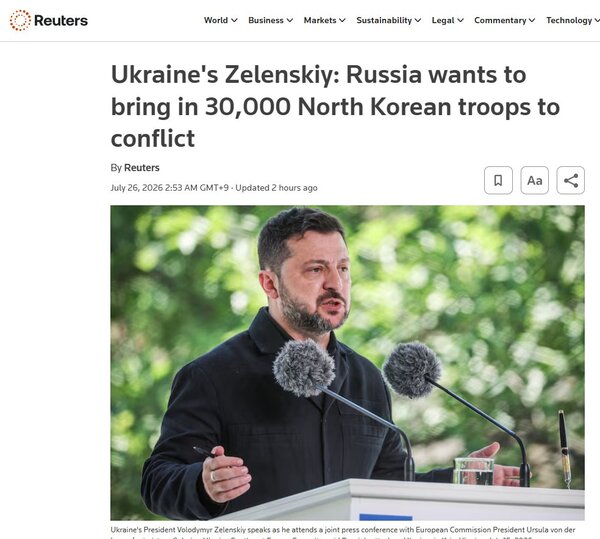
Reuters reported that President Zelenskyy stated in a video address posted on X and Telegram on that day, 'Russia wants to bring in another 30,000 North Korean troops' and 'Preparations have been underway in Russia's Voronezh region since June to receive them.' Reuters added that Zelenskyy further claimed North Korea is preparing to transfer additional ballistic missile launchers to Russia, defining this as a threat not only to Ukraine but to all Asian nations within the range of North Korean missiles.
Reuters noted that neither Russia nor North Korea has officially responded to these claims. It emphasized that the notable element is the location of 'Voronezh.' While North Korean deployments had been concentrated in the Kursk region since October 2024, Voronezh is a separate border region adjacent to Ukraine, located south of Kursk. This implies that the fundamental nature of their military cooperation could shift from supporting a specific high-intensity battleground to permanently stationing North Korean forces across the entire border front line.
[Why Voronezh?: A New Frontline or a Reception Base?]
The location that stands out most in this announcement is Voronezh. Since October 2024, North Korean troops have primarily been deployed in Kursk Oblast to support the Russian military's territorial recapture operations. In contrast, Voronezh lies south of Kursk and represents a separate bordering region directly facing Ukraine.
However, claims that preparations are underway in Voronezh do not conclusively prove that North Korean troops will be directly stationed on the front lines in this region. Voronezh hosts various Russian military training and logistical facilities; thus, it could serve as a staging ground, staging post, or staging hub for assembling, training, equipping, or transferring North Korean troops to other active fronts. Furthermore, their actual operational roles could be divided into non-combat tasks—such as rear security, engineering, logistics support, and air defense facility protection—alongside direct combat missions.
Nevertheless, if the reports regarding Voronezh are accurate, it signals that Russia intends to integrate North Korean forces not as a one-off auxiliary unit for a specific area, but as a permanent combat force required for a prolonged war. The possibility cannot be ruled out that their involvement will expand beyond limited combat in Kursk to a structure supporting the entirety of Russia's western border region.
[From 14,000 to 30,000 More: A Completely Transformed Scale]
Military cooperation between Russia and North Korea gained momentum following the summit between Kim Jong Un and Vladimir Putin in Pyongyang in June 2024 and the signing of the 'Treaty on Comprehensive Strategic Partnership.' Article 4 of the treaty stipulates that if either party is placed in a state of war, the other state shall provide military assistance without delay. A transactional relationship once based on swapping arms for energy has effectively been upgraded to the level of a military alliance.
Subsequently, North Korea dispatched approximately 11,000 combat troops and engineers to Russia, with South Korean intelligence estimating that an additional 3,000 troops were deployed in early 2025. The total initial deployment was estimated at roughly 14,000 personnel. South Korean and Ukrainian intelligence agencies estimate that at least 6,000 of these troops have been killed or wounded, though exact figures vary depending on the reporting agency and timeframe.
Against this backdrop, the additional 30,000 troops currently being discussed represent a leap of an entirely different dimension compared to previous incremental reinforcements. If actually deployed, this figure exceeds double the initial deployment force, significantly impacting the operation of North Korea's overall ground forces. It signifies that Moscow has begun to view North Korean troops not merely as a tactical auxiliary force, but as a strategic asset essential for sustaining its war effort.
[Why Does Russia Need 30,000 More North Korean Troops?]
Behind this move lies the chronic burden of troop replenishment facing the Russian military. Ukraine’s Defense Intelligence agency stated that Russia recruited approximately 195,000 contract soldiers by early July. While this falls short of half the annual goal of 409,000, it is only about 4.6% behind schedule relative to the target for that specific point in time. Therefore, concluding that Russia’s recruitment system has completely collapsed would be an overstatement.
However, daily contract soldier recruitment numbers have declined compared to last year, while massive casualties on the front lines persist. For Russia, expanding nationwide full mobilization carries the risk of aggravating public sentiment and provoking social backlash. North Korean troops present an attractive alternative—a manpower pool that can fill front-line vacancies without imposing a direct domestic political burden on the Kremlin.
The Institute for the Study of War (ISW) also analyzed that the Kremlin is creating the necessary conditions for additional mobilization while maintaining its maximalist objective of total Ukrainian capitulation. Ultimately, rumors of an additional 30,000 North Korean troops should be interpreted not as proof that Russian mobilization capacity is entirely exhausted, but as a signal that the burden of absorbing long-term war losses through conventional domestic recruitment alone is becoming increasingly unsustainable.
[North Korea's Trade-off: Dispatching Troops in Exchange for Advanced Technology]
The compensation North Korea receives for providing large-scale troop deployments, artillery shells, and ballistic missiles extends far beyond simple cash, food, or energy supplies. Western security experts, including those at the Center for Strategic and International Studies (CSIS), express deep concern over the possibility that Russia may provide key technologies required for North Korea's military reconnaissance satellites, nuclear-powered submarines, and ICBM programs.
For Pyongyang, the Ukrainian theater serves as a massive real-world testing ground. It allows North Korea to observe how its indigenous missiles perform against active air defense systems and identify at what stages errors or defects occur. Dispatched personnel will also accumulate firsthand experience in modern warfare—combining military drones, electronic warfare, artillery, and infantry integration. A self-sustaining cycle is thus established wherein North Korea provides troops and weapons in exchange for critical technology and combat data from Russia.
In this process, the international non-proliferation regime targeting North Korea is being fundamentally eroded. In March 2024, Russia exercised its veto at the UN Security Council against extending the mandate of the Panel of Experts assisting the 1718 Sanctions Committee. In September of the same year, Russian Foreign Minister Sergei Lavrov declared North Korean denuclearization a 'closed issue,' effectively indicating tacit acceptance of North Korea's status as a nuclear-armed state. Consequently, Russia—a permanent member of the UN Security Council—is actively dismantling the sanctions regime it originally helped establish.
[European War and Northeast Asian Security Intersect]
This dynamic explains why President Zelenskyy characterized the potential deployment of additional North Korean troops as a threat to all of Asia. If satellite, submarine, and missile technologies transferred from Russia advance North Korea’s nuclear capabilities, and if lessons learned on Ukrainian battlefields are applied to potential conflicts on the Korean Peninsula, the impact of this deployment will not remain confined to Europe.
In particular, improvements in North Korea’s missile accuracy, survivability, and satellite reconnaissance capabilities directly threaten South Korea and Japan, as well as U.S. forces stationed throughout the Indo-Pacific region. Russia is leveraging North Korean manpower to prolong its war in Ukraine, while North Korea is acquiring technology that disrupts the military balance in Northeast Asia in return. Cooperation between the two states is becoming a direct conduit linking security crises in Europe and Asia.
[Why Times Insight]
Reading this report of an additional 30,000 troop deployment as merely an expansion of force numbers fails to capture the core essence of the issue. Why Times defines this development as a deepening of mutual deficits, where Russia’s structural limits in troop recruitment intersect with North Korea’s drive for advanced technology acquisition.
Russia, faced with a contract soldier recruitment rate that falls well short of its annual targets and unable to cover monthly losses of around 40,000 personnel with domestic manpower alone, is relying on foreign forces. In return for plugging this manpower gap, North Korea is acquiring assets—namely satellite, nuclear submarine, and missile technologies—that would have been entirely inaccessible under the conventional international order.
However, a clear caveat must be made: these reports currently rely on Ukrainian intelligence assessments and lack official confirmation from either Russia or North Korea. Whether a deployment to Voronezh signifies direct combat roles on the front lines or rear-area air defense and security tasks remains uncertain. Conclusively labeling this as a second major combat intervention following Kursk at this stage would be an overinterpretation.
Nevertheless, within the broader framework of the CRINK (China, Russia, Iran, North Korea) alignment, the trend of Russia–North Korea cooperation shifting its center of gravity from mere manpower and arms transactions to advanced technology transfer remains highly credible—aligning consistently with years of warnings issued by Western think tanks.


-중국 푸단대학교 한국연구원 객좌교수
-전 EDUIN News 대표
-전 OUR NEWS 대표
-제17대 대통령직인수위원회 정책기획팀장
-전 대통령실 홍보기획비서관
-사단법인 한국가정상담연구소 이사장
-저서: 북한급변사태와 한반도통일, 2012 다시우파다, 선거마케팅, 한국의 정치광고, 국회의원 선거매뉴얼 등 50여권