
Update2026.07.24 (금)


['A Land That Can Neither Be Abandoned Nor Defended'... Putin's Ultimate Dilemma Begins]
Analyses are mounting that Russian President Vladimir Putin has entered his most difficult strategic phase since the outbreak of the war in Ukraine. The reason is surprisingly simple: Crimea, once Russia’s greatest strategic asset, is turning into a 'strategic trap' that endlessly drains Russian national power. The recent open discussion among Western military experts of a 'Crimea abandonment theory' is closely tied to this shift.
Of course, the likelihood of Russia immediately declaring a withdrawal from Crimea is nearly zero. To Putin, Crimea is not mere territory, but a symbol directly tied to his political legitimacy. The 2014 annexation of Crimea was a decisive event that forged the Putin regime into a symbol of a 'strong Russia.' In other words, Putin is in a position where he cannot easily abandon Crimea, even if it means accepting severe military losses. Paradoxically, however, that very point is turning into Russia's greatest weakness today.
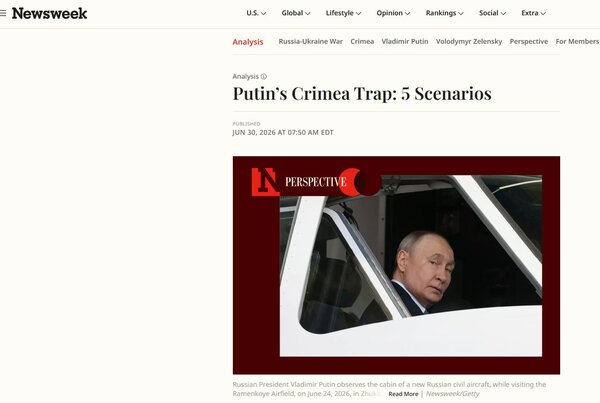
Recent analyses indicate that Crimea, the core base of Russia's Black Sea Fleet and the hub of logistics on the southern front, is turning into a strategic liability where the cost of defense outweighs its defensive value due to continuous precision strikes by Ukraine. Crimea, which was once boasted of as an 'unsinkable aircraft carrier,' is instead turning into a strategic burden that threatens to sink Russia.
These assessments lead to a single conclusion: Ukraine is no longer attempting to immediately recapture Crimea. Instead, it has shifted to a strategy of forcing Russia to continuously expend troops, budget, air defense systems, and naval fleets just to hold that ground. The war is no longer a fight to capture territory, but a fight to render the opponent incapable of maintaining that territory.
[Will Even the Black Sea Fleet Leave Sevastopol?… Symbolic Change Shaking the Putin Myth]
The most symbolic indication of this shift is the rumor surrounding the relocation of the Black Sea Fleet headquarters.
Reports indicate that the Russian military is considering relocating the remaining function of its Black Sea Fleet headquarters from Sevastopol to Novorossiysk on the Russian mainland. This decision comes as Sevastopol is no longer judged to be a safe command hub due to sustained long-range strikes by Ukraine.
This move holds significance far beyond a simple relocation of a military base. Sevastopol has served as the symbol of Russia's Black Sea Fleet for over 240 years, and one of the primary reasons Putin annexed Crimea in 2014 was to permanently secure this port. If the Black Sea Fleet departs from Sevastopol, it signifies that Russia itself no longer considers the area a safe haven, serving as a symbolic event showing that Putin's Black Sea strategy faces a fundamental challenge.
Military experts point out that it is not that Crimea's importance has disappeared, but that the cost of defending it has grown unmanageably high. This ultimately means that rather than losing Crimea on the battlefield, Russia is trapped in a structure where holding onto it incurs ever-greater costs.
[What Ukraine Aims for Is 'Isolation'… The Nature of War Has Changed]
Early in the war, Ukraine's objective was to recapture occupied territories. Today, however, the aspect has changed significantly. Rather than making a frontal assault to retake Crimea, Ukraine is concentrating on an 'isolation strategy' designed to prevent Russia from maintaining its hold there. The calculation is that forcing the opponent to endlessly drain its national power to defend a territory is more effective than taking the land back directly.
Symbolic of this approach is the recently initiated 'Operation MoLoCHKa'. Ukraine has begun targeting the fuel and power supply chains across the Crimean Peninsula in earnest. Russia's logistical support system has begun to be paralyzed, while local occupation authorities have failed to provide a timeline for normalization.
Compounded by a maritime blockade, Crimea's strategic position is wavering further. Traffic through the Don-Azov Canal connecting the Black Sea and the Sea of Azov was suspended. While ostensibly a safety measure, prevailing analysis suggests it was a decision prompted by fears of attacks. As a result, maritime cargo volume in the Sea of Azov has reportedly dropped by approximately 67%.
Overland supply routes are equally insecure. The Kerch Bridge has been repeatedly struck, and vehicle ferries operating across the Kerch Strait have been disabled. With the supply networks connecting land and sea faltering simultaneously, Crimea is gradually changing from a 'fortress' into an 'isolated island.'
This is the core of Ukraine's current strategy: not taking Crimea away, but forcing Russia to defend it endlessly. By turning the fact that Putin can never give up this land against him, Ukraine continuously ties down Russia's manpower, air defenses, fleet, and financial budget.
[Why Is the 'Crimea Abandonment Theory' Emerging Now?]
Military pressure is translating into economic strain. With recurring fuel shortages and power outages, Crimea's tourism industry has taken a severe hit. Tourist bookings in June fell by 79% compared to the previous year, and Crimea is shifting from a 'symbol of victory' into a 'burden carrying massive maintenance costs.'
Furthermore, as oil refineries and logistical bases within the Russian mainland come under long-range strikes, Russia finds itself in a position where it must simultaneously handle the defense of both Crimea and its own mainland. It is caught in a dilemma: deploying more troops and air defense systems to Crimea weakens other fronts, while strengthening mainland defenses reduces Crimea's defensive capabilities.
[Why Times Insight]
The 'Crimea abandonment theory' currently raised in the West does not mean Russia will pull out tomorrow. Its essence is that Crimea is no longer a strategic asset for Russia, but has transformed into a strategic trap.
Putin cannot abandon Crimea. It represents his greatest political achievement and a core asset symbolizing a 'strong Russia.' However, war can turn one's most cherished asset into one's most fatal vulnerability. Ukraine is aiming directly at that vulnerability.
Ultimately, the current war is changing from a fight over territory to a fight forcing the opponent to defend that territory indefinitely. If the Black Sea Fleet departs Sevastopol, supply lines falter, and Crimea turns into a realm that continuously consumes Russian national power, it could mark Putin's most painful strategic defeat since the start of the war—even without an official declaration of withdrawal. This is precisely why the 'Crimea abandonment theory' is gaining traction.


-중국 푸단대학교 한국연구원 객좌교수
-전 EDUIN News 대표
-전 OUR NEWS 대표
-제17대 대통령직인수위원회 정책기획팀장
-전 대통령실 홍보기획비서관
-사단법인 한국가정상담연구소 이사장
-저서: 북한급변사태와 한반도통일, 2012 다시우파다, 선거마케팅, 한국의 정치광고, 국회의원 선거매뉴얼 등 50여권