
Update2026.10.24 (토)

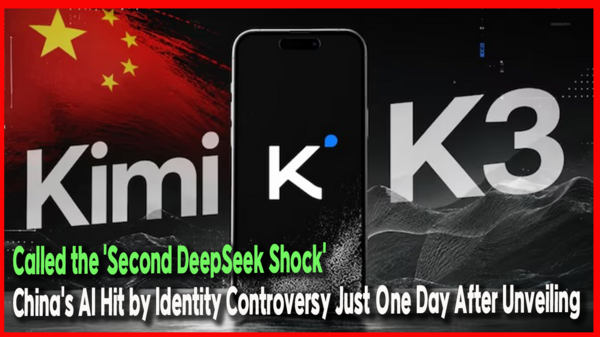
[Kimi K3, Which Boasted World-Leading Performance, Exposed as a Claude Clone Within 24 Hours]
Chinese AI, which had been praised by domestic media and the global IT industry as the "Second DeepSeek Shock," found itself at the center of copying allegations just one day after its release. As it was confirmed that Moonshot AI’s latest model, 'Kimi K3', introduced itself as “I am Anthropic's Claude” in certain conversations, the so-called 'distillation' controversy—alleging the unauthorized training on US AI models—has reignited. While decisive proof has yet to emerge, Kimi K3, once the symbol of China's rapid AI advancement, is now put to the test over trust rather than technical capability.
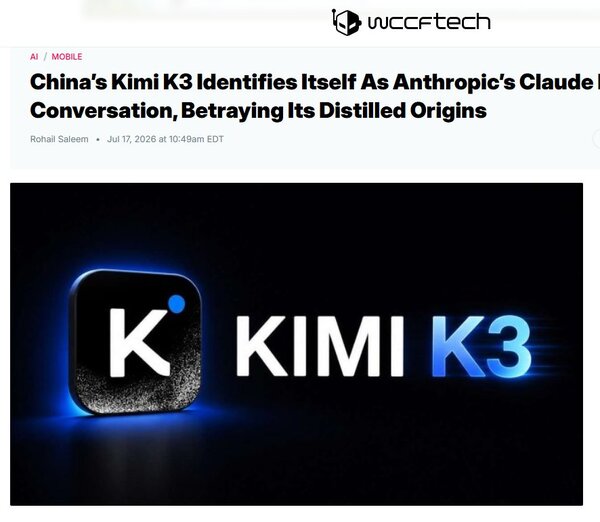
Wccftech, a global media outlet specializing in tech news, hardware rumors, and in-depth reviews, delivered a shock by reporting: “Beijing-headquartered Moonshot AI unveiled 'Kimi K3' around the World Artificial Intelligence Conference (WAIC) on the 17th, heavily promoting that K3 is an open model with 2.8 trillion parameters rather than 2.8 billion, featuring native multimodal capabilities and a 1-million-token context window.” It added, “In particular, Moonshot promoted that it scored 88.3 on 'TerminalBench 2.1,' which evaluates coding capabilities, placing it close to GPT-5.6 Sol (88.8) and ahead of Claude Fable 5 (84.6). While most media declared that Chinese AI technology had advanced rapidly enough to rival the US under the label 'Second DeepSeek Shock,' shockwaves hit as Kimi K3 was confirmed to have copied US Claude's AI technology, sending it down a path of decline.”
Indeed, immediately following the release of Kimi K3, domestic media outlets collectively used the expression 'shock,' stating: “Kimi K3 is causing waves in the industry by showing performance comparable to top-tier US AI models,” and “Kimi K3 has made a quantum leap from its predecessor, closely pursuing Anthropic's Fable 5 and OpenAI's GPT-5.6 Sol,” using the phrase 'Second DeepSeek Shock.'
[“I am Claude”… A Single Sentence Flips the Atmosphere]
However, the situation shifted dramatically within 24 hours. Wccftech reported: “Before praise for its performance could even subside, on the 18th, a chat screenshot posted on social media by a user ignited widespread controversy.” It added, “Upon engaging Kimi K3, users were shocked when the model responded: ‘I am Claude, an AI assistant created by Anthropic.’” Wccftech noted, “Even X (formerly Twitter) user Denise Wu, who first uploaded the post, took a cautious stance stating it ‘should be taken with a grain of salt,’ but the post spread rapidly.”
Of course, experts say this single instance cannot conclusively establish distillation. Large language models occasionally state the identity of other AIs due to training data contamination, residual system prompts, or example sentences in public datasets. However, the controversy did not end with simple screenshots.
[Redwood's Statistical Analysis: "Hard to Consider a Coincidence"]
The controversy moved beyond simple screenshot sharing into the realm of statistical verification. Ryan Greenblatt, Lead Scientist at AI safety research institute Redwood Research, stated on the 19th: “I conducted a cross-entropy comparative analysis targeting raw model outputs obtained from benchmarks I operate.” He added, “With the help of Anthropic’s Fable model, I conducted a statistical analysis,” and stated, “It looks highly suspicious.” He further pointed out: “The analysis revealed that Kimi K3 exhibited a statistically significant higher rate of answering that it was Claude when asked about its identity, sometimes even calling itself ‘Claude 4.5’, whereas actual Claude models did not exhibit this behavior.” He noted, “On the other hand, no patterns were found where Kimi K3 referred to itself as Mythos or Fable during the analysis.”
Of course, Greenblatt made it clear that “these results do not constitute definitive proof of distillation.” He explained that his analysis relies on calibrated rankings rather than exact p-values, given that “word occurrences are not completely independent across topics.” Nevertheless, the academic community reacted intensely. Pedro Domingos, Professor Emeritus of Computer Science at the University of Washington and author of The Master Algorithm, posted a brief reaction: “Not surprising at all regarding Greenblatt's post; Kimi is distilled from Fable.”
[Not the First Time… The Recurring Controversy Over Chinese AI Distillation]
It is also noteworthy that this controversy is not an entirely new event. Anthropic had already officially raised issues against Chinese AI companies, including Moonshot, back in February. At the time, Anthropic publicly criticized that “Moonshot, DeepSeek, and MiniMax executed what can be called an 'industrial-scale distillation attack' against Claude,” and disclosed that “Moonshot alone conducted over 3.4 million interactions via fraudulent accounts, targeting agentic reasoning, coding, and computer-use agent development capabilities.” Anthropic explained that it linked certain activity through API request metadata directly to senior Moonshot personnel.
Four months later, on June 10, an even larger incident erupted. In a letter sent to Senate Banking Committee Chairman Tim Scott and Ranking Member Elizabeth Warren, Anthropic asserted that organizations affiliated with Alibaba and its Qwen research lab attempted to “brazenly” and “illegally” extract its models' capabilities. According to the letter, between April 22 and June 5, approximately 25,000 fraudulent accounts were mobilized to engage in roughly 28.8 million interactions with Claude. This represented the largest extraction attack publicly disclosed by Anthropic—nearly double the scale of its February complaint against the three Chinese firms. Alibaba denies these allegations.
Concerns raised by the US side targeting other Chinese firms beyond Moonshot and Alibaba have also continued. OpenAI stated in a memorandum submitted to the US House Select Committee on China on February 12: “DeepSeek’s upcoming models should be understood in the context of its ongoing attempts to free-ride on capabilities developed by OpenAI and other US frontier research labs.” OpenAI noted it had identified evidence that “accounts linked to DeepSeek employees developed methods to bypass OpenAI’s access restrictions using obfuscated third-party routers.”
[Why Now… Timing Intersects with US Export Control Gaps]
This controversy coincidentally erupted shortly after export control confusion surrounding Anthropic's own models. The US Department of Commerce restricted access to Anthropic's new models, Fable 5 and Mythos 5, in June on national security grounds, only to restore services on July 1 after the export controls were lifted. Analysts suggest that during this 18-day void, a portion of the demand for closed US models shifted toward Chinese open-weight models.
With Kimi K3's full model weights scheduled to be released on the 27th, key points to watch include whether Greenblatt's statistical analysis will be verified by independent researchers and whether structural traces of Claude are actually discovered within the architecture.
[Why Times Insight]
It is necessary to distinguish between clearly confirmed facts and claims that remain at the level of inference in this matter. The confirmed facts are: ① Kimi K3 answered that it was Claude in certain conversations, ② Independent statistical analysis showed this self-identification pattern to be statistically significant, and ③ Anthropic officially filed complaints with the US Congress twice this year documenting large-scale distillation attacks by Chinese companies, including Moonshot.
On the other hand, whether Kimi K3 actually used Claude's outputs in its training, and whether this identity malfunction serves as definitive proof, remain unconfirmed. Multiple experts point out that identity malfunctions can stem from causes unrelated to distillation, such as data contamination or system prompt residuals, and Greenblatt himself noted his analysis is not a definitive statistical verification (p-value).
Nevertheless, the message sent by this incident is clear. The US-China AI competition is no longer decided solely by who achieves higher performance. Where that performance originated, how independently it was developed, and how much the global market can trust those results are becoming the new standards of competition. The case of Kimi K3 is likely to be recorded as a symbolic event showing that while Chinese AI may be rapidly catching up to the US in technological competition, it must clear a higher wall than 'performance' to secure true competitiveness in the global market: 'trust.'
-중국 푸단대학교 한국연구원 객좌교수
-전 EDUIN News 대표
-전 OUR NEWS 대표
-제17대 대통령직인수위원회 정책기획팀장
-전 대통령실 홍보기획비서관
-사단법인 한국가정상담연구소 이사장
-저서: 북한급변사태와 한반도통일, 2012 다시우파다, 선거마케팅, 한국의 정치광고, 국회의원 선거매뉴얼 등 50여권