
Update2026.07.24 (금)


[Hardline Stance Urging to Fight the US to the End: Who Benefited Most?]
As the war with the United States intensifies once again, a different kind of war is unfolding inside Iran. This time, the battlefield is not directed outward at the US or Israel, but inward—a bitter power struggle among the ruling elite over who drove the nation into a direct, catastrophic confrontation.
Against this volatile backdrop, remarks made by Iranian Foreign Minister Abbas Araghchi have triggered severe political waves. Araghchi publicly cautioned that foreign intelligence penetration extends far beyond mere information leaks, warning that it can shake national policy decisions, psychological environments, and public opinion formation.
Experts argue that his statements are far more than a simple admission of a security breach. Instead, they represent a calculated political message targeted directly at the internal hardline faction that relentlessly championed an uncompromising war stance against the US. Even as military clashes escalate, a sharp and dangerous question is taking root within the heart of Tehran's power structure: "Who truly forced us to choose this war?"
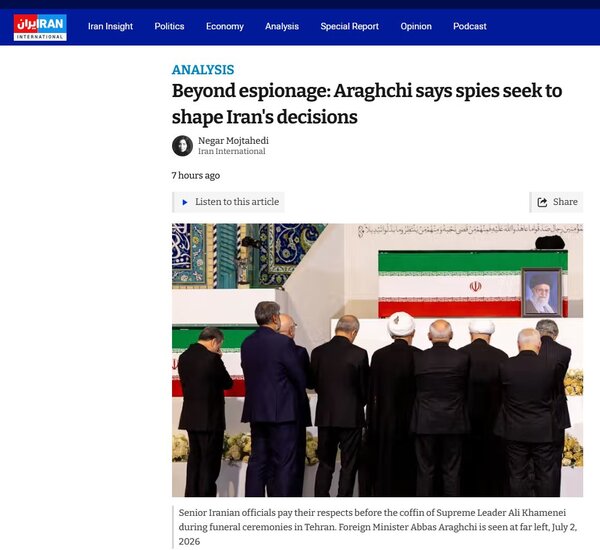
Iran International, a UK-based media outlet specializing in Iranian affairs, reported on the 21st: “In an approximately 90-minute interview with pro-government podcast host Javad Moghoyi, Foreign Minister Araghchi unusually mentioned the penetration of foreign intelligence agencies in detail.”
According to Iran International, the interview focused on the February 28 incident in which the Supreme Leader and top military, security, and political leadership were simultaneously eliminated in precision strikes by the US and Israel. During the interview, the host asked how such a massive security failure was possible, to which Araghchi raised issues going far beyond mere information leakage.
Araghchi stated:
“This kind of penetration does not stop at merely stealing information; it can influence policy-making processes, the psychological environment, and even the formation of public opinion.”
He did not name specific countries directly. While some speculate that given the context of the interview, his remarks were aimed at Israeli intelligence agencies, experts focused more on his phrase "shaking even policy decision-making," turning their attention to the forces behind bringing the US into the battlefield. They noted that acknowledging publicly that the nation's strategic choices themselves could be swayed by external influence is far more significant than the fact that security networks were breached.
[Not Just Simple Spies, But 'Information Warfare Forcing the Choice of War']
The reason Araghchi's remarks are drawing attention is that he used the term "policy decision-making" rather than just "spies." Generally, espionage brings to mind intelligence gathering such as stealing military secrets or tracking the movements of leadership. However, the penetration Araghchi described is an influence operation of a much higher dimension.
According to his explanation, foreign intelligence agencies do not stop at merely stealing information. They can influence what policies national leadership chooses, whether to opt for negotiations, whether to escalate military conflicts, and how to maneuver public opinion. This aligns closely with the concept of 'Influence Operations' commonly referred to in modern information warfare.
In fact, since the Cold War, intelligence agency activities have evolved beyond stealing secrets toward widening political divisions within target countries or inducing extreme choices. Causing an adversary to make the most disadvantageous decisions on its own yields far greater strategic results than simply stealing military intelligence. At this precise point, Araghchi's remarks are interpreted not merely as an admission of security failure, but as raising issues with the policy decision-making process itself that led to war.
[Experts: "What Araghchi Targeted Was Iranian Hardliners Internally, Rather Than External Powers"]
Middle East experts who heard Araghchi's remarks also commonly paid attention to the 'hardliners' rather than 'spies.' Alex Vatanka, a senior fellow at the Middle East Institute (MEI), explained, "The goal of such penetration operations is not limited to handing over leadership locations to the enemy," adding, "Influencing the policy-making process itself is the core."
He then offered a telling analysis: “Araghchi's remarks sound like blaming foreign intelligence agencies, but in reality, they are highly likely a political message aimed at internal hardliners in Iran.” He interpreted in particular that “there is a nuance in these remarks suggesting that certain factions within the regime have persistently advocated policies that ultimately align with what the enemy desired most.”
Omid Memarian, an analyst at the human rights group DAWN, offered an analysis in the same vein. He noted, “Certain decisions by Iranian hardliners were pushed forward continuously despite directly conflicting with national interests,” describing it as “you see the smoke, but you can't see the fire.”
Behnam Ben Taleblu, director of the Iran Program at the Foundation for Defense of Democracies (FDD), also explained, “Public statements like this are often messages directed at rival factions and security agencies within the regime, rather than at the public.” He added, “This does not mean they are moderates, but it demonstrates that at least internal differences in approach exist regarding the best way to preserve the state.”
The analyses of these three experts converge on one conclusion: Araghchi was not merely warning about the presence of foreign spies, but indirectly criticizing internal factions that were either manipulated by that influence or pursued a hardline stance that ultimately aligned with external strategic interests.
['Who Benefits Most?'… Another Question Posed by Geopolitics]
An interesting question arises here: If foreign influence operations did indeed take place, which country stands to gain the greatest strategic benefit as the conflict between the US and Iran persists?
The first entity that comes to mind is Israel. Israel has made curbing Iranian nuclear development and weakening the military power of the Islamic Revolutionary Guard Corps (IRGC) its top security priorities, and it has been evaluated as having world-class capabilities in building intelligence networks and penetrating deep inside Iran. In that sense, it is the most natural candidate mentioned regarding information gathering and security penetration.
However, from a geopolitical perspective, the story changes slightly. Israel is not the only nation to gain indirect strategic benefits if military conflict between the US and Iran is prolonged. For Russia, as American military power and diplomatic bandwidth are concentrated in the Middle East, it secures relative breathing room on the Ukrainian front, and rising international oil prices could favorably impact the Russian economy. China can also relieve some pressure in the Indo-Pacific region if US strategic resources are dispersed to the Middle East.
Of course, this does not mean that Russian or Chinese intelligence agencies influenced Iran's internal hardline stance. Based on currently available public information, there is no evidence to support such claims. However, in international relations, examining "Who stands to gain the most?" (Cui Bono) alongside the event itself is a standard method of analysis. The phrase used by Araghchi—"penetration that shakes policy decisions"—holds great significance in that it suggests modern information warfare can target a nation's strategic choices, far beyond simple intelligence activities.
[Amid Ongoing Gunfire, Blame Game Begins Inside Iran]
The reason Araghchi's remarks are particularly noteworthy lies in the question of 'Why say this now?' Military conflict with the United States has not yet ended. Tensions between both sides remain ongoing, and the possibility of escalating back into full-scale war at any moment lingers. Nevertheless, Araghchi publicly brought up foreign intelligence penetration and its influence on the policy decision-making process. This is read as a sign showing that, even as war continues, an internal blame game over 'Who drove this country to this point?' has already begun among Iranian leadership, rather than just an attempt to explain security failures.
In the meantime, hardliners centered around the Islamic Revolutionary Guard Corps (IRGC) have consistently advocated for a tough stance, framing negotiations with the US as 'surrender.' Conversely, diplomatic channels have warned that direct confrontation with the US could threaten the very survival of the nation. Ultimately, as consecutive precision strikes by the US and Israel dealt severe damage to the top leadership and military command structure, voices asking whether the hardline faction's judgment truly served national interests are growing within Iran.
Under these circumstances, Araghchi's public statement that "foreign intelligence agencies can influence policy-making, psychology, and public opinion formation" is not merely pointing out intelligence activity. Synthesizing experts' interpretations, this can be viewed as an indirect challenge to the internal hardline stance that pushed for confrontation with the US, signaling the start of a political battle over responsibility for the war.
[Why Times Insight]
If one interprets Araghchi's interview simply as a 'spy story,' there is a high probability of missing the core essence. The crux lies in his phrasing: 'Foreign intelligence agencies can shake even policy decision-making.' This effectively serves as an admission by Iran's top diplomat that modern information warfare goes beyond stealing military secrets, attempting to influence target countries' public opinion, policies, and even their choices between war and peace.
However, based on currently public information alone, there are no grounds to confirm that specific countries or intelligence agencies manipulated Iranian hardliners or intentionally induced war with the US. While analyses suggesting Israel gains from a security standpoint, Russia from a geopolitical standpoint, and China from a strategic standpoint are plausible, that does not serve as proof of intelligence agency intervention.
Nonetheless, the question raised by this interview is by no means light. Even before the war has ended, an internal debate over "Who chose direct confrontation with the US, and who benefited most from that choice?" has already begun inside Iran's power corridors. Moving forward, the biggest variable in Iranian politics is unlikely to be the purge of spies itself, but rather the political restructuring between the factions that led the hardline stance and those that advocated for diplomatic solutions. While gunfire continues on the battlefield, another war has already begun in the heart of power in Tehran.

-중국 푸단대학교 한국연구원 객좌교수
-전 EDUIN News 대표
-전 OUR NEWS 대표
-제17대 대통령직인수위원회 정책기획팀장
-전 대통령실 홍보기획비서관
-사단법인 한국가정상담연구소 이사장
-저서: 북한급변사태와 한반도통일, 2012 다시우파다, 선거마케팅, 한국의 정치광고, 국회의원 선거매뉴얼 등 50여권