
Update2026.10.24 (토)

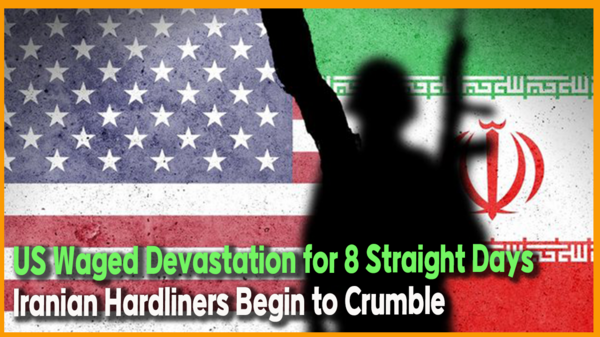
[As Southern Infrastructure Collapses, Public Sentiment Shifts… Fierce Backlash Mounts Against 'Those Responsible for Inciting War']
As the US aerial campaign against Iran enters its eighth consecutive day, the landscape of the conflict is shifting visibly. What began as targeted strikes focused strictly on Islamic Revolutionary Guard Corps (IRGC) military bases and missile sites has now expanded to encompass core national infrastructure—including bridges, railways, power generation facilities, and desalination plants. This shift has pushed southern Iran into a state of functional paralysis.
Rather than merely degrading battlefield capabilities, the operations are directly destabilizing civilian life and the country's industrial foundation. However, the most notable transformation is occurring not on the front lines, but inside Tehran. Voices are openly erupting against the IRGC and ultra-hardline factions who previously rejected negotiations with the US, explicitly demanding they bear the responsibility for bringing this war upon the country. Analysts note that such criticisms—historically unimaginable under the regime—are now being voiced by former national security chairmen and prominent political figures, signaling deep structural fractures within Iran's internal power dynamics.
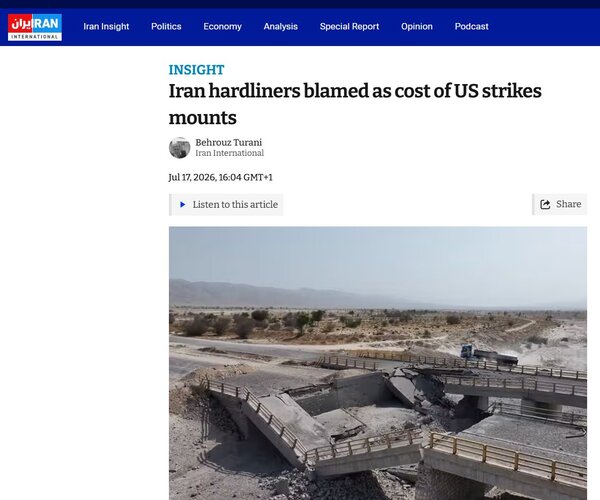
On July 18, Iran International, a UK-based media outlet specializing in Iranian affairs, reported, “As US airstrikes continue for an eighth day, Iran’s moderate and pragmatic factions are significantly escalating their criticism of hardliners.” The report added, “Accusations that the hardline faction brought about the war by systematically blocking diplomatic avenues are spreading rapidly across the political spectrum.”
Iran International highlighted two specific opinion pieces. One was authored by Heshmatollah Falahatpishe, a former lawmaker and former chairman of the National Security and Foreign Policy Committee; the other was a column by political analyst Abdolrahman Fathollahi. Though their rhetoric differed, their conclusions aligned: the current war is a consequence not only of US aggression, but of domestic political factions that spent years pushing an uncompromising hardline agenda while rejecting negotiations.
The reason these arguments are gaining serious traction is that they extend beyond standard political posturing by moderates. As the relentless US air campaign persists, the IRGC’s long-standing doctrine—that 'uncompromising security protects the nation'—is visibly failing in reality. Consequently, a public perception is taking root that the hardline approach has instead placed the state in existential jeopardy.
[What the US Targets is Not Just Military Assets, But 'State Functions']
The objectives of the US military operation have become clearer by the day. During the initial phase of the conflict, strikes were heavily concentrated on IRGC bases, missile facilities, and air defense networks. By the eighth day, however, the target profile changed completely.
Key bridges connecting to Bandar Abbas have been systematically destroyed, while a critical desalination plant near Jask suffered total destruction of its water intake facilities and power substations. The Iranian government formally acknowledged damage to its electricity infrastructure for the first time, requesting southern residents to strictly ration power. The deployment of strike aircraft as far inland as Yazd in central Iran—roughly 650 kilometers from the Persian Gulf coast—follows the same operational logic. The United States has clearly transitioned past the stage of destroying isolated military targets, expanding its campaign to systematically degrade Iran's macro-capacity to function as a wartime state.
The southern region is not a negligible periphery. It is Iran's largest energy and logistical hub, directly linked to the Strait of Hormuz, where crude oil exports, maritime transit, and military supply chains converge. Disruption here inflicts an immediate blow not just on IRGC military logistics, but on the macroeconomic stability of the entire nation.
Washington likely calculated this precise outcome. Inflicting the immediate, tangible costs of war onto the populace can exert far greater political pressure on the regime than merely neutralizing a handful of hidden nuclear sites. Indeed, the Iranian Ministry of Health announced that at least 50 people have been killed and over 500 injured in the airstrikes since July 6. Yet, far more critical than the casualty figures is the structural unravelling of daily survival systems. With water and electricity grids failing and transport links severed, the war is no longer a localized issue for the military, but an existential crisis for ordinary citizens. This shift is naturally triggering a distinct set of domestic political questions.
[“Those Who Blocked Diplomacy Brought About the War”... Accountability Demands Spread Broadly Against Hardliners]
At this exact juncture, Iran's domestic political atmosphere is shifting rapidly. Until now, advocating for talks with the United States or criticizing the IRGC's rigid stance was an absolute political taboo, given that the Supreme Leader and the IRGC have long stood as the definitive symbols of national security. Yet, as the US bombardment drags on and civilian hardships mount, that taboo is visibly eroding.
Heshmatollah Falahatpishe, the former national security chairman, was the first to openly break ranks. In an op-ed published in the reformist daily Towseh Irani, he directly stated, “Extremists distorted religion to frustrate diplomacy, and as a result, Iran has been dragged into two major conflicts.” He specifically pointed out that the nuclear and direct talks with the US pursued between 2021 and 2022 were sabotaged by domestic hardliners. “Those who claimed they would secure a better deal ultimately delivered no deal at all, leaving the public with nothing but war,” Falahatpishe wrote, concluding that “those who sabotaged diplomacy and drove the nation into war must be held politically accountable.”
This is not a mere statement of opinion. In the past, such rhetoric would have been immediately condemned as 'counter-revolutionary.' The fundamental difference now is that these views are being disseminated openly through major domestic media channels.
Political commentator Abdolrahman Fathollahi offered an even more direct critique: “Those who cry for war from the safe confines of the capital, Tehran, do not pay the actual price of conflict. The residents of the south, who are currently under bombardment, are bearing that cost on their behalf.” He emphasized, “What we need right now is not slogans rejecting negotiations, but a diplomatic solution to mitigate national losses. Actively mobilizing all available expertise and diplomatic capacity is not a choice; it is a prerequisite for national survival.”
Iran International interpreted the arguments of these two figures not as isolated personal opinions, but as a direct, public political challenge to the ultra-hardline factions—anchored heavily around the Qom Seminary—that have consistently demanded an absolute halt to talks with the US and urged preparation for a protracted war.
[Beyond Rhetoric, Actual Power Dynamics are Shaking]
Crucially, this shifting sentiment is translating into tangible adjustments within the regime's power structure. Reports indicate that hardline figures have recently been systematically sidelined from key leadership positions within the Iranian parliament's National Security and Foreign Policy Committee. In their place, pragmatic and moderate factions centered around Parliament Speaker Mohammad Bagher Ghalibaf are reportedly expanding their influence.
While Ghalibaf was historically categorized as a hardliner with an IRGC background, he has recently shifted toward realpolitik, emphasizing that while national strength is necessary, diplomacy remains an indispensable pillar of national security. His recent messaging—stating that “diplomacy must be backed by credible strength, but strength alone cannot preserve a nation”—symbolically captures the directional shift currently occurring within Iranian politics.
Predictably, hardliners are pushing back aggressively. Kamran Ghazanfari, a hardline member of parliament, fiercely criticized the current trend, arguing that “the authority of the Supreme National Security Council is expanding excessively,” thereby “weakening the role of both the parliament and the Supreme Leader.” He went so far as to accuse President Pezeshkian and Speaker Ghalibaf of executing a de facto coup.
Concurrently, some ultra-hardline figures are doubling down on extreme rhetoric, claiming that "the third war has already begun" and that "negotiations are finished; the enemy must be completely annihilated." Mohsen Rezaei, an advisor to Mojtaba Khamenei, issued a stark warning: “If the United States continues its attacks for just a few more days, we will enter the phase of total annihilation of the enemy.”
However, regional analysts largely view these explosive statements not as a show of confidence, but as a manifestation of severe anxiety over their slipping political dominance. Historically, when the IRGC issued hardline declarations, the entire political establishment aligned behind them. Today, the dynamic has reversed: moderates are launching open refutations, forcing hardliners into a defensive posture to justify their positions.
This represents a political shift that would have been completely unthinkable just a few months ago. Most critically, the eroding absolute authority of the top leadership remains a fatal vulnerability for the hardline faction. Following the death of Ali Khamenei, the central authority of the leadership weakened during the succession process, and the IRGC is finding it increasingly difficult to project absolute authority due to a succession of compounding military setbacks.
In a highly symbolic shift, even deeply conservative media outlets have recently begun acknowledging that Iran "must rebuild its defensive capabilities." The reality that a rigid hardline policy no longer guarantees victory or security has become impossible to deny, even within conservative circles.
[What the US Shook Was Not Just Military Power, But the 'Political Legitimacy of the IRGC']
When analyzing this conflict, the critical variable is not merely what the US military has physically destroyed, but what it is structurally undermining. On the surface, the damage consists of broken bridges, severed power grids, and ruined desalination plants. Politically, however, the United States is striking directly at the foundational myth built by the IRGC over four decades: the doctrine that only an uncompromising hardline stance can safeguard Iran.
Since the 1979 Islamic Revolution, the IRGC has consistently advanced a singular narrative: that any compromise with the United States would inevitably lead to the collapse of the nation, and that only aggressive military posturing and a defiant foreign policy could preserve the regime. This logic served as the ultimate justification for nuclear development, ballistic missile proliferation, and the extensive bankrolling of pro-Iranian proxy networks across the Middle East.
The current conflict, however, has placed that exact doctrine on trial. The extensive missile arsenals and integrated air defense networks built up over decades at astronomical economic costs failed to provide a sufficient deterrent against sustained US air campaigns. With strategic hubs in the south collapsing sequentially and the civilian population facing escalating structural hardships, the public is naturally arriving at a devastating question: “Is this current reality not the direct consequence of choosing the hardline path?” This exact line of questioning is uniquely lethal to the hardline establishment.
[The Likelihood of a Shift in Iran's Strategy is Growing]
Naturally, it remains premature to definitively forecast the total collapse of the hardline faction. The IRGC remains the most formidable military organization within Iran, retaining immense control over the intelligence apparatus, key economic sectors, the state broadcaster (IRIB), and the judiciary. Ultra-hardline political factions, including those led by figures like Saeed Jalili, still command a significant institutional base.
However, as the war drags on, the center of gravity in domestic politics is highly likely to shift away from military grandstanding and toward the crushing economic and physical costs borne by the population. This is precisely why the current wave of accountability demands differs from past instances. Historically, intensified external pressure from the US caused the public to rally around the regime out of a sense of collective survival. This time, however, the systematic destruction of southern infrastructure, the destabilization of basic utilities, and the freezing of logistical networks are directly disrupting daily survival.
As the burdens of the conflict bleed directly into civilian life, the hardline rhetoric demanding continuous, unyielding warfare is losing its persuasive power. Consequently, it is no coincidence that pragmatists like Ghalibaf have begun broadcasting the message that while strength is a prerequisite, diplomacy is the ultimate solution. This does not represent an idealistic push for peace, but rather a realist consensus gathering strength to prevent total state ruin.
[Why Times Insight]
The most profound consequence of the eight-day US aerial campaign is not found in the raw count of destroyed facilities. It lies in the fact that voices openly challenging the hardline doctrine itself have breached the surface of Iranian politics. It appears the US strategy was designed to achieve exactly this: by focusing strikes on southern transportation links, energy infrastructure, and maritime logistics, Washington forced the public to absorb the immediate consequences of the war, thereby successfully eroding the political legitimacy of the regime's hardliners.
What is currently unfolding in Tehran's political corridors is not a standard rhetorical skirmish between moderates and hardliners. It is more accurately understood as a high-stakes recalibration of national strategy over whether to sustain the war or aggressively pursue a diplomatic exit ramp. The increasingly radical vocabulary employed by hardliners recently—hurling accusations of a "coup," demanding "total annihilation," and insisting on "fighting to the absolute end"—paradoxically reflects a profound sense of vulnerability regarding their slipping grip on the political narrative.
Moving forward, the primary variable to watch is not the duration of the US air campaign, but the depth to which the realization that 'a hardline policy can no longer protect the state' permeates the Iranian establishment. If this internal trend consolidates, the possibility cannot be ruled out that Tehran's strategy toward Washington will gradually transition away from military tit-for-tat exchanges and toward seeking limited negotiations and a pragmatic exit strategy. Conversely, the risk remains that the IRGC may attempt to orchestrate a severe external military provocation in a desperate bid to reclaim domestic political dominance.
Ultimately, the outcome of this conflict will not be decided solely on the kinetic battlefields where US and Iranian forces clash. The true decisive theater is currently inside the power structures of Tehran, and the United States appears to be executing a strategy explicitly calibrated to upend that internal balance of power. This remains the core strategic significance of the eight-day campaign.

-중국 푸단대학교 한국연구원 객좌교수
-전 EDUIN News 대표
-전 OUR NEWS 대표
-제17대 대통령직인수위원회 정책기획팀장
-전 대통령실 홍보기획비서관
-사단법인 한국가정상담연구소 이사장
-저서: 북한급변사태와 한반도통일, 2012 다시우파다, 선거마케팅, 한국의 정치광고, 국회의원 선거매뉴얼 등 50여권