
Update2026.07.24 (금)

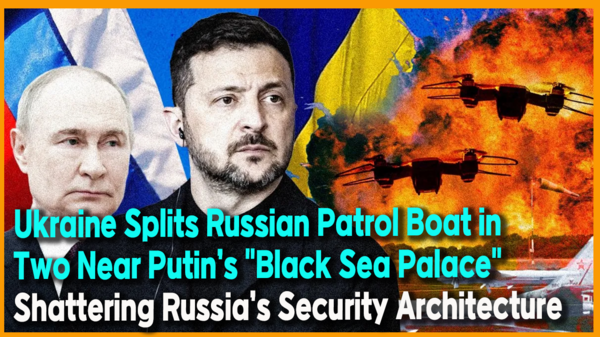
As the war enters its fourth year, Ukraine's strategy is undergoing a fundamental shift. Rather than merely dismantling the Russian military piece by piece as in the past, Kyiv is now focused on completely erasing the very concept of a "safe rear" across Russia.
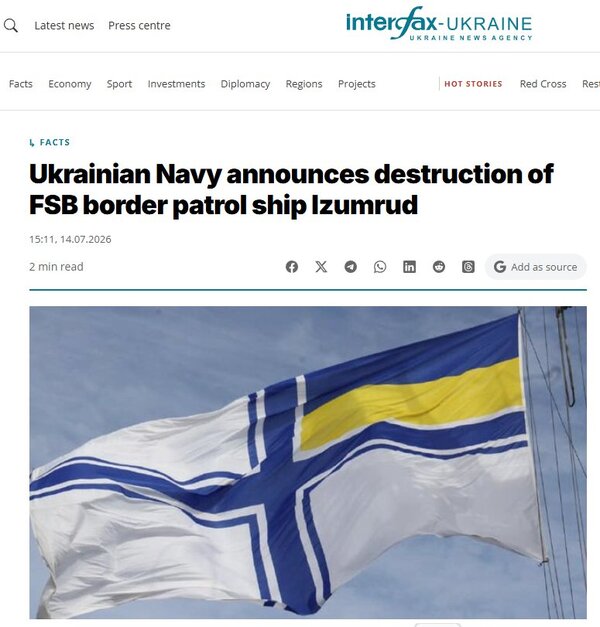
This latest strike symbolically epitomizes this strategic shift. Using a domestically developed unmanned surface vessel (USV), the Ukrainian Navy successfully sank the Izumrud, a Russian Federal Security Service (FSB) border patrol boat anchored in a port near Novorossiysk. Even more shocking is the location of the attack: the waters just 15 kilometers from the notorious "Putin’s Palace," known to be the Russian President's private estate on the Black Sea.
On July 15, Interfax-Ukraine, a prominent Ukrainian news agency, reported: "The Ukrainian Navy used the Sargan-3000 unmanned naval system to sink a second-rank FSB border patrol vessel near Novorossiysk, resulting in casualties and injuries among the crew." The Ukrainian Navy subsequently declared, "Retribution is inevitable. To be continued…"
Shortly after, the Ukrainian Navy released satellite imagery on Telegram, stating, "Satellite images confirm that the Russian border patrol vessel Izumrud was destroyed alongside the quay wall." The released images showed the vessel heavily listing and half-submerged, with black scorch marks from fire visible on the adjacent pier where it was moored.
In a separate address, Ukrainian President Volodymyr Zelenskyy noted, "A patrol ship and a shadow fleet tanker were hit in Gelendzhik," describing the operation as a highly effective strike executed approximately 430 kilometers from the front line. He added that additional successful operations had been carried out against three shadow fleet tankers in the Sea of Azov.
On the surface, this might appear to be the loss of a single patrol boat. However, the message this operation sends to the international community is far more profound: there are no longer any safe zones in Russia, and even Putin himself can no longer guarantee his own absolute safety.
What makes this strike highly symbolic is that the target was not a standard naval warship, but
a vessel belonging to the Russian Federal Security Service (FSB).
As the Kyiv Post reported, "The Izumrud is a large, state-of-the-art border patrol vessel measuring 62.5 meters in length, with a displacement of 630 to 750 tons and equipped with a helipad." Crucially, the outlet noted, "The vessel does not belong to the Russian Navy, but to the Border Guard Service under the FSB, which conducts border patrol, counter-intelligence, and counter-terrorism missions."
The FSB is not a mere intelligence agency. It is the iron-fisted institution responsible for protecting the core of Russian power, managing presidential security, and safeguarding critical national infrastructure. By striking this vessel, Ukraine did not just sink a ship; it directly humiliated the very agency tasked with guarding the heart of the Russian regime.
Furthermore, the Izumrud was a high-value, symbolic target that Ukraine had long sought to neutralize. On November 25, 2018, this exact vessel rammed the Ukrainian Navy tugboat Yany Kapu in the Kerch Strait and attacked the Ukrainian gunboats Nikopol and Berdyansk, leading to the capture of 24 Ukrainian sailors. Russia held those crew members for nearly a year before returning them under intense international pressure. The Ukrainian Navy's declaration that "retribution is inevitable" directly references this past aggression. A score left unsettled for nearly eight years has finally been paid in full.
The geographical context of the strike further elevates its strategic significance.
As Defense Blog analyzed, "The location of this attack is highly significant because Novorossiysk was the 'refuge port' to which Russia relocated the bulk of its Black Sea Fleet after pulling back from Sevastopol." At the onset of the war, Ukraine virtually lacked a conventional navy to challenge the Russian fleet based in occupied Sevastopol. However, through asymmetric warfare utilizing explosive-laden unmanned surface vessels, Ukraine systematically eroded the Black Sea Fleet’s strength. According to the Russian Ministry of Defense's own assessments, approximately 30% of the fleet's combat power has been destroyed or severely damaged.
Defense Blog added, "Consequently, Russia relocated most of its major combat vessels from Sevastopol to Novorossiysk after 2023. Yet, Novorossiysk itself proved to be no safe haven in 2026, as vessels like the frigate Admiral Essen and the minesweeper Valentin Pikul were subsequently struck there."
The National Security Journal observed, "The sinking of the Izumrud is not an isolated incident, but a continuation of Ukraine's four-year-long asymmetric naval campaign in the Black Sea." The journal noted that even without a conventional navy, Ukraine has successfully degraded the Russian Black Sea Fleet from an "offensive strike force into a defensive remnant fleet" through a series of major operations: the sinking of the flagship cruiser Moskva (2022), strikes on submarines and landing ships at the Sevastopol shipyard (2023), and the destruction of the landing ship Caesar Kunikov and patrol ship Sergey Kotov (2024). In March 2024, the UK Ministry of Defence declared the Russian Black Sea Fleet "functionally inactive."
The publication concluded, "This latest strike confirms that Ukraine's reach now extends 430 kilometers deep into the Russian mainland coast—directly on the doorstep of the Russian president’s private estate."
The most striking aspect of this operation is its proximity to Putin’s dacha. The attack took place a mere 15 kilometers from the Gelendzhik estate, widely referred to as "Putin’s Palace," which the Russian president has long used as a private retreat.
Putin is known to be one of the most security-conscious leaders in the world. His hyper-caution was on full display during the COVID-19 pandemic when he met foreign leaders at absurdly long tables, and his travel routes and residences have been guarded with absolute secrecy since the invasion.
Russian media and Western intelligence agencies have reported that Putin significantly heightened his personal security protocols and altered his residency patterns in recent years due to the looming threat of drone strikes. Against this backdrop, Ukraine’s strike demonstrates that they can operate right under the nose of his most guarded private sanctuary.
Ukraine's true target was not just a patrol boat. This was a masterclass in psychological warfare, sending an unmistakable message to the Kremlin: "We know exactly where you are, and we can reach you."
Over the past four years, Ukraine has systematically dismantled Russia's "safe zones." Sevastopol was compromised, and the Kerch Bridge has been repeatedly hit. Moscow itself has been subjected to drone strikes, strategic bomber bases have been targeted, and deep-lying assets like the Omsk oil refinery in Siberia have been hit. Now, even Novorossiysk—the final refuge in the Black Sea—has been proven vulnerable.
In warfare, the "rear" is where logistics are secured, forces are reorganized, and leadership maintains stability. When the rear ceases to exist, the entire nature of the conflict changes. Russia has consistently moved its fleet and strategic installations further back whenever they faced danger. But now, no matter how far back they retreat, there is no longer a single spot that guarantees absolute safety.
The true impact of this attack does not lie in the physical loss of a single patrol vessel. It lies in the total collapse of the concept of a "safe zone" across the Russian Federation.
Ukraine is shifting its grand strategy from a war of attrition aimed at destroying individual military units to a psychological campaign designed to rattle the very foundations of the Russian state. By destabilizing the rear, keeping the high command in a state of perpetual anxiety, and demonstrating to the Russian public that no area is secure, Kyiv is striking at Russia's collective resolve.
Above all, sinking an FSB-operated vessel in the immediate vicinity of Putin’s palace carries immense symbolic weight. This was not merely a tactical success; it was a highly targeted psychological operation signaling to Vladimir Putin himself that his personal sanctuaries are no longer beyond Ukraine’s reach.
While this does not mean Putin is in immediate personal danger, wars are often won and lost in the psychological realm long before physical defeat manifests on the battlefield.
The strike at Novorossiysk will likely be remembered as the moment Ukraine proved to the world that Russia no longer possesses a rear, a safe zone, or any sanctuary where Putin can truly rest easy.


-중국 푸단대학교 한국연구원 객좌교수
-전 EDUIN News 대표
-전 OUR NEWS 대표
-제17대 대통령직인수위원회 정책기획팀장
-전 대통령실 홍보기획비서관
-사단법인 한국가정상담연구소 이사장
-저서: 북한급변사태와 한반도통일, 2012 다시우파다, 선거마케팅, 한국의 정치광고, 국회의원 선거매뉴얼 등 50여권