
Update2026.07.24 (금)

[US Deploys New Weapon to Undermine Chinese Economy]
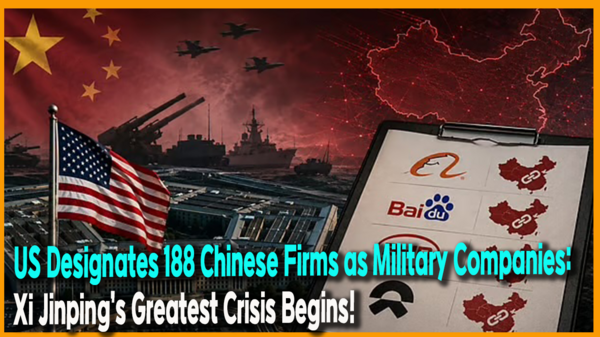
At first glance, the news that the United States has designated 188 Chinese companies as military entities appears to be just another expansion of sanctions against China. However, the essence of this measure goes far beyond a simple expansion of a blacklist. Its significance is greater than imagined because the U.S. has begun changing the very criteria by which it views the Chinese economy. Moving past the approach of sanctioning specific companies one by one, Washington has launched a new strategy to reclassify China’s entire high-tech sector as "potential military assets." This means that the AI, semiconductor, electric vehicle (EV), biotech, and robotics industries—which Xi Jinping has spent the last decade nurturing by staking the nation’s destiny—have all become new targets of U.S. containment, signaling the start of a long-term war aimed at the core growth engines of the Chinese economy. The U.S. is no longer merely attacking Chinese companies; it has initiated a new conflict designed to shake global confidence in the Chinese economy.
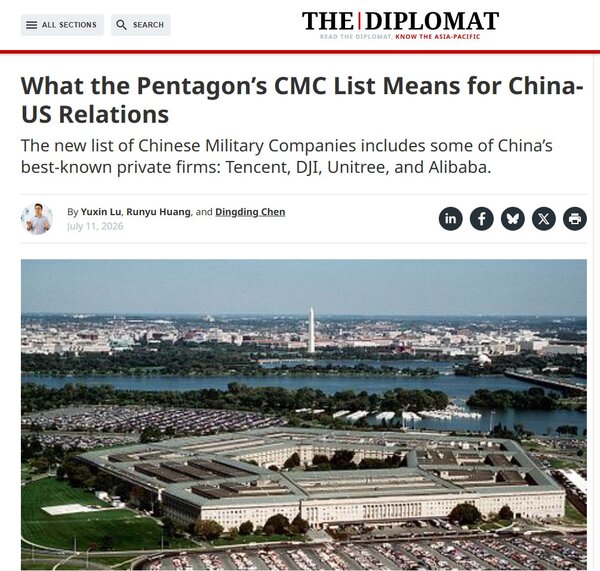
On June 12, the U.S. foreign policy magazine The Diplomat reported that "the U.S. Department of Defense expanded its list of Chinese Military Companies (CMCs) on June 8 to 188 companies, an increase of 64 from the previous list." The report noted that "the newly included entities heavily feature private enterprises representing China's high-tech industry, such as Alibaba, Baidu, BYD, NIO, Unitree, and WuXi AppTec." The Diplomat evaluated this move not as a mere list expansion, but as a new U.S. regulatory framework designed to counter China's Military-Civil Fusion (MCF) strategy.
On the surface, U.S.-China relations seemed to be stabilizing. At the U.S.-China summit held in Beijing in May, U.S. President Donald Trump and Chinese President Xi Jinping announced they would build a "constructive and strategically stable relationship." At the time, analysts suggested that the two nations had formed a consensus on managing their relationship to a certain degree, despite intense strategic competition.
Yet, just a month later, the U.S. Department of Defense executed the largest expansion of the CMC list in history. While maintaining diplomatic channels, Washington is tightening its grip on China's future growth drivers in a more sophisticated and systematic manner.
Here, we must ask a critical question: Why did the U.S. play this card now? Many media outlets focused on the number "188 companies." While the record-breaking scale is important, and the inclusion of global private giants like Alibaba and BYD is highly newsworthy, the true essence of this event does not lie in the numbers. It lies in the fact that the U.S. paradigm for evaluating China has fundamentally shifted. Previously, the U.S. determined sanctions based on whether a Chinese company traded directly with the People's Liberation Army (PLA), manufactured weapons, or conducted military research. In other words, the core criterion was: "Is it currently a military company?"
This time, it is completely different. Alibaba is the world's largest e-commerce company. Baidu is a leader in AI and autonomous driving technology. BYD is a premier enterprise driving the global EV market. Unitree is astonishing the world with its humanoid robots, and WuXi AppTec is a private firm that has built a global biotech R&D platform.
Outwardly, these companies are far removed from the defense industry. Yet, the U.S. Department of Defense has begun incorporating them into the "Chinese Military Company" framework. Why? Because the U.S. is no longer looking at whether they are currently military companies, but rather whether they possess technologies that could become the military power of the Chinese armed forces in the future.
This is where the real significance of this CMC expansion is revealed. The U.S. no longer views China's AI, cloud, EV, biotech, and robotics sectors as mere civilian industries. It has begun treating them as strategic industries that can be converted into PLA capabilities at any moment. This is not just designating companies; it is designating the future of China.
[US Targets China's National Strategy of 'Military-Civil Fusion' Rather Than Individual Firms]
Why, then, has the U.S. begun viewing private companies as military entities at this juncture? The answer lies in the Military-Civil Fusion (MCF) strategy, which Xi Jinping has pushed forward most aggressively since taking power.
Military-Civil Fusion is not a policy where the military and private companies simply cooperate. It is a national strategy that binds industry and the military into a single ecosystem so that China’s advanced technology can be converted into military power whenever the state requires it. In other words, even if a technology is developed by a private company, the system is structured to institutionally link it for the PLA’s use upon state demand.
In practice, artificial intelligence can exponentially enhance command-and-control systems and intelligence analysis capabilities, while cloud computing and big data form the core infrastructure of military information networks. Autonomous driving technology can transition into unmanned combat vehicles and logistics systems, and drone technology simultaneously strengthens reconnaissance and strike capabilities. High-performance batteries for EVs can also be applied to military energy storage devices and unmanned weapon systems.
This is precisely how the U.S. views Alibaba, Baidu, BYD, and Unitree. The U.S. is not questioning whether these companies are making weapons right now. It has begun looking at whether they possess the core technologies that can become the future strength of the Chinese military. This is the most profound departure from previous U.S. policies toward China.
[More Fearing Than Sanctions: The Stigma of Being a 'Military Company']
What warrants even greater attention is the fact that the CMC list itself is not a tool for severe economic sanctions. Being placed on this list does not immediately ban all trade with the U.S. or cut off all exports. Yet, the reason Chinese companies react so sensitively is that the U.S. Department of Defense is targeting market psychology rather than the sanctions themselves.
The moment a company is branded as a national security risk, global financial markets and supply chains begin moving voluntarily. Pension funds re-evaluate their investments, and global banks tighten loan screenings. Multinational corporations reconsider joint R&D and technological cooperation, while suppliers scale back transactions. Insurance companies raise risk premiums, and investors begin reducing their exposure to Chinese companies in anticipation of long-term regulatory risks. Even if the U.S. government does not explicitly ban transactions, the market proactively perceives China as a high-risk asset. This is precisely the "chilling effect" highlighted by The Diplomat.
Real-world examples are already surfacing. Following the U.S. Department of Defense's action, major U.S. lobbying firms cut ties with Alibaba and Tencent. WuXi AppTec also asserted in court filings that some clients canceled new projects or halted existing cooperation following its inclusion on the CMC list.
These shifts do not end with the losses of a few individual companies. If the image of "firms deemed dangerous by the U.S." spreads across all Chinese enterprises, the ripple effect is highly likely to expand across investment, finance, supply chains, and technological cooperation as a whole.
[US Begins Targeting the 'Operating System' of the Chinese Economy]
This is precisely why this expansion of the CMC list poses the most dangerous threat to Xi Jinping. Until now, the U.S. pressured China by raising tariffs, controlling semiconductor exports, and placing specific companies on blacklists.
This time, however, it is on a different dimension. The U.S. is not just sanctioning a few Chinese companies; it is attempting to alter the global standard for how the Chinese economy is perceived. The CMC list does not stop at being a mere list. Already, the U.S. Congress and the executive branch have begun utilizing the CMC list as a critical baseline for various regulatory policies, including the BIOSECURE Act, federal procurement restrictions, tightened investment screening, and supply chain realignments.
Today it is a military company list, but tomorrow it becomes exclusion from government procurement, and next it turns into investment restrictions. Over time, the same criteria are highly likely to apply to supply chains and financial markets. Ultimately, the CMC is turning from a simple list into the "operating system (OS)" that links U.S. regulations against China. This is the most fatal threat to Xi Jinping.
Xi Jinping has nurtured AI, semiconductors, EVs, and biotech as the future growth engines of the Chinese economy under the banners of "Made in China 2025," "New Quality Productive Forces," and "Military-Civil Fusion." Yet, the U.S. has now begun redefining those very future growth engines as "potential military industries." If this trend continues, what China stands to lose is not just the U.S. market. It could lose the trust of global capital entirely.
[Why Times Insight]
This expansion of the CMC list is not an event that merely targeted 188 Chinese companies. It is an event where the U.S. has begun forging a new global standard for looking at the Chinese economy. Going forward, the U.S.-China hegemony rivalry is highly likely to shift from a battle over who imposes higher tariffs to a battle over who commands the trust of the global market.
The hegemonic wars of the 21st century are no longer decided by missiles alone. Victory or defeat is determined by who controls global investment, finance, supply chains, and technical standards. This expansion of the CMC list is not an incident where the U.S. sanctioned a handful of Chinese firms; it is an event where it began reclassifying the Chinese economy into a "high-risk economy" within the global market. The U.S. Department of Defense chose a system, rather than guns, as its weapon. And the moment that system becomes the new global standard, China may face far greater pressure—not from direct U.S. attacks, but from the choices of the global market itself. This is why this measure could signal the beginning of Xi Jinping's ultimate crisis.

-중국 푸단대학교 한국연구원 객좌교수
-전 EDUIN News 대표
-전 OUR NEWS 대표
-제17대 대통령직인수위원회 정책기획팀장
-전 대통령실 홍보기획비서관
-사단법인 한국가정상담연구소 이사장
-저서: 북한급변사태와 한반도통일, 2012 다시우파다, 선거마케팅, 한국의 정치광고, 국회의원 선거매뉴얼 등 50여권