
Update2026.07.24 (금)

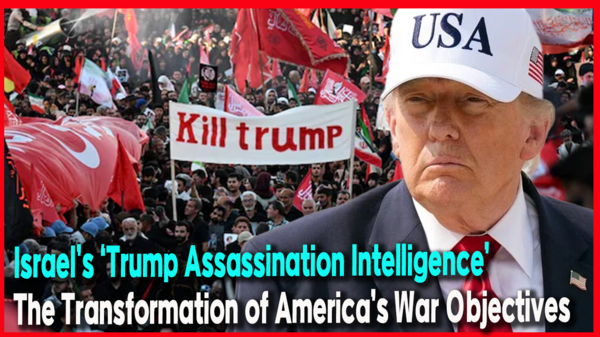
["They Want to Kill Trump!"… The U.S. Gains the Legitimacy to End Iran]
In international politics, it is not always raw military capability that dictates the outcome of a conflict. Far more critical, at times, is the concept of legitimacy—the political justification required to initiate and expand a war. Even the United States, possessing the world's most formidable military, cannot sustain prolonged warfare without a compelling narrative to persuade its public, Congress, and international allies.
Historically, Washington has carefully anchored its major military campaigns in distinct legal and moral frameworks: the violation of international law during the Gulf War, self-defense following the 9/11 attacks for the war in Afghanistan, and the elimination of weapons of mass destruction (WMDs) in Iraq. While the validity of these justifications triggered intense debate, they served as the necessary political logic to mobilize the state.
In this context, the fresh intelligence recently passed by Israel to the U.S. government regarding an Iranian assassination plot targeting President Donald Trump carries weight far beyond a routine intelligence briefing. If this intelligence is verified, it shifts the foundational logic of American military posture. The U.S. would no longer be acting merely under the framework of "deterring a hostile state's nuclear ambitions"—a paradigm open to diplomatic maneuvering. Instead, it would assume the far more potent justification of exercising self-defense against a sovereign state's direct, state-sanctioned threat to the life of the sitting American president. Consequently, this development demands close scrutiny because it possesses the leverage to fundamentally redefine America's broader strategy toward Tehran and alter the definitive objectives of the war in the Middle East.
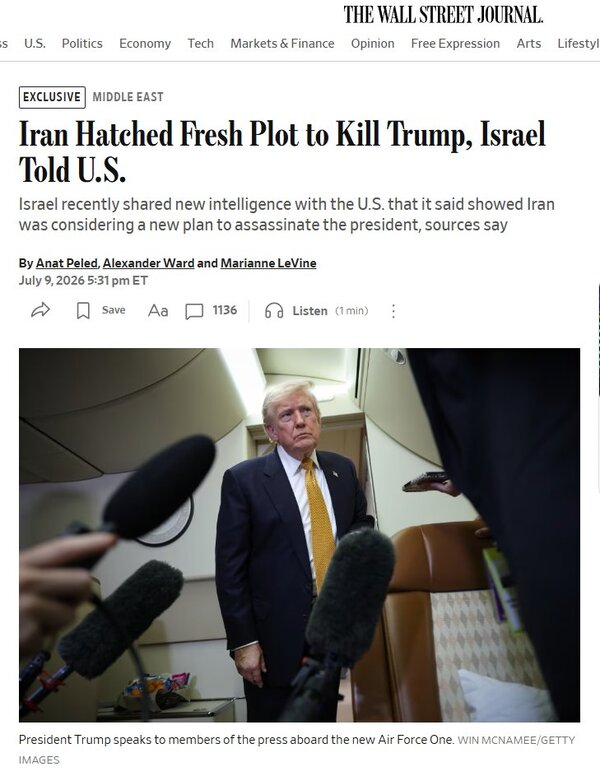
On July 10, The Wall Street Journal (WSJ) reported that Israeli intelligence agencies recently conveyed sensitive data to the U.S. administration, alleging that Iran has devised a new, specific plan to assassinate President Donald Trump. This reporting was subsequently corroborated by major outlets including CNN, The Times of Israel, and The Jerusalem Post.
CNN noted that U.S. intelligence agencies have not yet independently verified the specific operational details of the intelligence. Furthermore, some U.S. officials raised the possibility that Prime Minister Benjamin Netanyahu’s government may have strategically timed the disclosure to pressure Washington into taking a more aggressive, hardline military stance against Tehran.
However, a critical analytical distinction must be made here: "unverified" must not be conflated with "fabricated." While it remains true that the U.S. intelligence community has not concluded its cross-examination and vetting process, this does not imply that Israel manufactured the report out of whole cloth.
On a strictly pragmatic level, the counter-question must be asked: Would Israel risk transmitting a completely baseless intelligence report concerning a threat to the life of a sitting U.S. president to the White House? The probability is exceptionally low. Israel’s Mossad is a premier intelligence agency that has maintained an intimate, decades-long institutional partnership with the CIA. Initiating a geopolitical gamble by feeds-to-White House fabricated data solely for short-term political leverage would incur a catastrophic blow to Mossad's global credibility. It would trigger a severe, potentially irreversible fracture in U.S.-Israel intelligence cooperation and leave the Netanyahu government facing accusations of manipulating the American commander-in-chief into a hot war. This is a gamble no Israeli administration would lightly undertake.
Undoubtedly, strategic calculations are at play. Israel likely timed the release of existing raw data to coincide with a highly sensitive geopolitical window, aiming to maximize its influence over U.S. foreign policy formulation. Yet, choosing the optimal strategic moment to leverage intelligence is a standard practice of statecraft—and fundamentally distinct from fabricating the underlying threat itself.
Furthermore, this threat landscape is not entirely unprecedented. Ever since the 2020 U.S. drone strike that killed Qassem Soleimani, the commander of the Islamic Revolutionary Guard Corps’ (IRGC) Quds Force, Tehran has consistently and publicly broadcast its intent to exact revenge on Trump. The U.S. Department of Justice has previously unsealed indictments detailing Iranian-linked assassination plots against Trump. Rather than a sudden anomaly, this new intelligence signifies that an existing, persistent state threat has mutated into a more concrete and active operational plan.
[The Core of the Incident is Not the Plot Itself, But 'Trump's Perception']
In parsing this development, the tactical specifics of the alleged plot are secondary to a much larger variable: how President Trump himself perceives this information. In the arena of international relations, the subjective perception of a superpower's chief executive frequently alters the global architecture far more than objective facts alone. This was true during the Cuban Missile Crisis and in the immediate aftermath of 9/11. The moment a head of state internalizes a threat as a direct challenge to the state’s existential honor and security, national security doctrine shifts completely.
To date, the Trump administration's calculus regarding Iran has centered on quantifiable benchmarks: the degree of uranium enrichment, the IRGC's threats to maritime security in the Strait of Hormuz, and proxy rocket attacks on U.S. military outposts. However, the moment a state-sponsored plot to assassinate the U.S. president enters the calculus, the paradigm shifts. The adversary is no longer categorized merely as a "rogue nuclear-proliferating state," but as a hostile regime actively seeking to decapitate American leadership. This distinction alters everything.
Nuclear proliferation and regional proxy conflicts can be managed, contained, or leveraged at the negotiating table. Indeed, Washington and Tehran have spent years engaged in a diplomatic tug-of-war over sanctions relief and nuclear limits. Conversely, a state-directed assassination plot against the president completely closes the door to diplomacy. It shifts the American policy framework from one of "managed negotiation" to one of "uncompromising retribution."
[How Will the U.S. Deploy Its Countermeasures?]
The immediate consequence will manifest as a massive expansion of the intelligence war. The CIA, NSA, and DIA are highly likely to aggressively intensify their surveillance operations targeting the external networks of the IRGC and the Quds Force. The scope of this tracking will broaden significantly, sweeping up Iranian-aligned networks not just within the Middle East, but across Europe, Asia, and South America. Simultaneously, Washington will deepen its intelligence-sharing mechanisms with trusted allies—collaborating closely with Israel, the UK, Germany, and France to freeze Iranian operational cells and intercept their underlying financial conduits.
On the economic front, further escalation is inevitable. The U.S. Department of the Treasury is expected to roll out secondary sanctions designed to sever the IRGC’s remaining back-channel financial networks, third-party clearinghouses, and clandestine oil-export infrastructure. Crucially, Washington may target front companies and financial institutions in third countries—such as China or specific Gulf states—that facilitate Tehran's sanctions evasion.
The most critical variable, however, lies in the military domain. If the U.S. intelligence community formally concludes that this assassination plot was authorized or facilitated by state organs in Tehran or the senior leadership of the IRGC, Washington will treat this not as a localized act of terrorism, but as a direct act of state aggression against the United States.
Consequently, the parameters of potential military targets will expand. While prior U.S. airstrikes have traditionally been restricted to nuclear infrastructure, missile depots, and drone manufacturing facilities, future kinetic operations may prioritize the command-and-control nodes of the Quds Force and its overseas operations. Furthermore, the political and military elites who sanctioned or financed the plot could find themselves directly targeted by American military pressure.
While it is premature to claim that the U.S. has finalized a doctrine of regime decapitation, the essential takeaway is that the political and strategic legitimacy required to execute such high-risk military options has been vastly reinforced by this intelligence.
[The Ripples Across American Domestic Politics]
Should this intelligence be conclusively validated, it will trigger a rapid realignment within domestic U.S. politics. The Republican Party has consistently advocated for a maximum-pressure campaign against Tehran; the injection of a direct, physical threat against Trump will supercharge this hawkish rhetoric, making it the dominant position in Washington.
The Democratic Party will find its political maneuvering room severely restricted. While internal policy rifts persist regarding the long-term architecture of Middle Eastern diplomacy, no mainstream political faction can afford to appear passive when presented with evidence of a foreign adversary plotting the assassination of the American head of state. Consequently, Congress is highly likely to forge a bipartisan consensus to fast-track enhanced sanctions, expand intelligence budgets, and authorize robust military readiness protocols, permanently hardening America's long-term posture toward Iran.
[Beyond the Middle East… A Variable Capable of Shaking the Global Order]
The ramifications of this intelligence extend far beyond the Washington-Tehran-Tel Aviv triangle. If the United States concludes that Iran has crossed the line into state-backed assassination plots against its leadership, the shockwaves will reverberate through global markets and macro-geopolitics.
The immediate casualty will be global energy stability. The Strait of Hormuz remains the world’s most critical maritime chokepoint, facilitating the transit of a massive share of global petroleum. With recent skirmishes already driving up maritime insurance premiums and shipping overheads, any further escalation of U.S. military pressure—and a reciprocal move by Iran to weaponize its capacity to close the Strait—will exert immense upward pressure on global crude prices.
Europe will face immediate economic vulnerability. Having aggressively reconfigured its energy supply chains to decrease its reliance on Russian hydrocarbons, the Continent has grown heavily dependent on Middle Eastern crude and liquefied natural gas (LNG). A renewed energy crisis in the Gulf will instantly translate into domestic inflationary pressures across Europe, complicating the monetary policies and interest-rate trajectories of the European Central Bank (ECB).
China, too, will be forced into a complex strategic calculus. Beijing is the primary consumer of Iranian crude oil exports, and the broader Middle East serves as a foundational geographic pillar of its Belt and Road Initiative. An expanded kinetic conflict between the U.S. and Iran will force Beijing into a costly dilemma, balancing its critical energy dependencies against its broader relationship with Washington. Furthermore, if the U.S. clamps down on the global shipping and financial networks trading with Tehran, Chinese state enterprises will inevitably sustain direct economic collateral damage.
Russia faces its own strategic paradox. Conventional analysis suggests that a diversion of American military bandwidth and logistics toward the Middle East would alleviate operational pressure on the Ukrainian front, benefiting Moscow. However, Iran has evolved into one of Russia's most indispensable strategic and military partners. Should the Iranian regime face catastrophic military or economic degradation under American pressure, Moscow’s broader Middle Eastern strategy and its revisionist anti-Western coalition would suffer a severe blow.
Ultimately, this intelligence report is not an isolated security issue; it is a systemic variable capable of simultaneously upending the strategic calculations of every global superpower.
[Israel’s Objective May Have Been to Reshape 'Perception']
An analysis of this event must also account for Israel’s underlying geopolitical intent. Skeptics argue that the Netanyahu government leaked this data precisely to drag a reluctant United States back into a comprehensive military confrontation in the Middle East. Yet, even if that political motivation holds true, it does not invalidate the underlying substance of the intelligence. Rather, it reveals that Israel’s primary objective was to fundamentally reshape America's strategic perception.
Modern intelligence agencies do not operate merely as passive collectors of raw data; they function as strategic architectures that carefully calibrate the timing, channel, and presentation of information to achieve specific geopolitical outcomes. Transmitting a specific, highly volatile threat to the White House at a moment when U.S. foreign policy is in flux is a textbook deployment of intelligence as an instrument of statecraft. The critical question moving forward is how the White House ultimately chooses to interpret this data. The answer to that question will define the future architecture of the Middle East.
[Why Times Insight]
The core significance of this development does not lie in the sensationalism of a "Trump assassination plot." Its real importance lies in how it forces the United States to fundamentally redefine the state of Iran. Historically, Washington’s Iran policy has operated on a dual track: treating Tehran as a hostile regional actor that must be contained, while simultaneously viewing it as a state actor with whom nuclear proliferation must be managed via diplomacy.
However, if U.S. intelligence formally validates this Israeli brief, concluding that state organs in Tehran orchestrated a targeted plot against the American president, that dual-track framework collapses. The strategic center of gravity will pivot away from managing regional stability and nuclear containment, shifting decisively toward systematically dismantling Iran's external operations capabilities and neutralizing its state-directed military threats. While this may not explicitly manifest as an overt policy of regime change, applying kinetic and asymmetric pressure directly to the regime's core leadership will become a highly realistic and prioritized policy option in Washington.
One must also consider the profound institutional risk assumed by Israel. Given the foundational reliance of Mossad on its long-term credibility with the U.S. intelligence community, the likelihood that Tel Aviv would forward an unbacked, fabricated file concerning the life of the sitting president is virtually non-existent. Therefore, the global community must look past superficial debates over the plot’s validity. Analysts must focus on why Israel chose this specific geopolitical juncture to present this intelligence, and how the White House calibrates this data into its national security matrix.
Ultimately, this transmission is not a standard security brief. It represents a major strategic inflection point that has the potential to reshape the terminal objectives of the conflict in the Middle East, rewrite America's containment doctrine toward Iran, and send shockwaves through the global geopolitical order. Moving forward, the critical variable to monitor is not Tehran's immediate rhetoric, but the final policy conclusions reached by Trump and the White House. That singular calculation holds the power to dictate the future of the Middle East.

-중국 푸단대학교 한국연구원 객좌교수
-전 EDUIN News 대표
-전 OUR NEWS 대표
-제17대 대통령직인수위원회 정책기획팀장
-전 대통령실 홍보기획비서관
-사단법인 한국가정상담연구소 이사장
-저서: 북한급변사태와 한반도통일, 2012 다시우파다, 선거마케팅, 한국의 정치광고, 국회의원 선거매뉴얼 등 50여권