
Update2026.07.24 (금)

[It’s the Grid, Not Just Solar Panels—The Security Warning Triggered by Hidden Communication Devices]
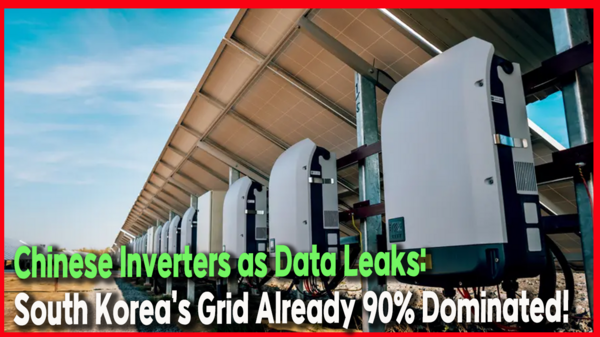
Solar inverters are far more than just devices that convert electricity. They serve as the "brain" linking solar power generation to the national grid, acting as critical control equipment for power flow. This is precisely why the United States has designated Chinese solar inverters as a national security threat and initiated import restrictions. The situation in South Korea is significantly more precarious. While the U.S. has launched regulations out of national security concerns despite Chinese inverters accounting for only about 24% of its market, China already commands an estimated 80% to 90% share of South Korea’s domestic solar inverter market. The issue has escalated from industrial competitiveness to the very safety of core national infrastructure.
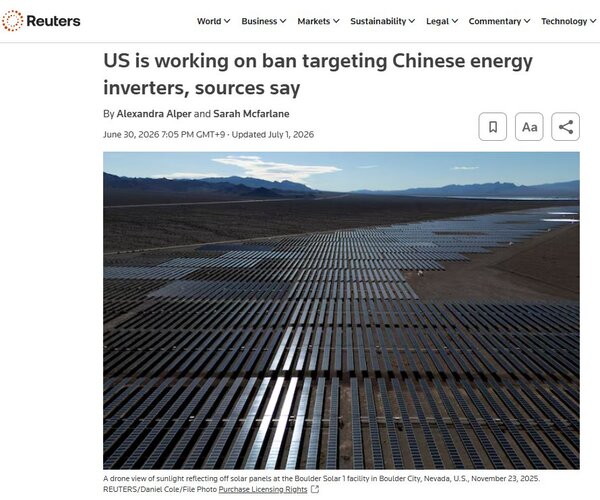
Reuters reported that "the Trump administration, alongside the Federal Communications Commission (FCC), is drafting regulations to restrict new imports of Chinese-made energy inverters that connect solar and energy storage systems (ESS) to the power grid." The report added that "the U.S. government views Chinese inverters not merely as industrial products, but as potential security risks capable of disrupting the power grid or threatening the operation of critical national facilities."
This measure did not emerge overnight. The U.S. Department of Defense already excludes solar cells, modules, and inverters produced by companies from "countries of concern," including China, from defense procurement through the National Defense Authorization Act (NDAA) for Fiscal Year 2026. However, the upcoming FCC regulation is far more significant, marking the first attempt to expand the scope of restrictions beyond the military sector to the entire civilian power grid.
China immediately pushed back. The Chinese Embassy in the U.S. claimed that "the United States is overextending the concept of national security to unfairly suppress Chinese enterprises." However, the sentiment within U.S. political circles is quite the opposite. Republican Senator Tom Cotton publicly backed tighter regulations, stating, "Dependence on Chinese-made inverters could put the entire U.S. power grid at risk."
Why, then, has the U.S. begun targeting inverters now? The turning point came last year following an exclusive report by Reuters. Reuters revealed that "U.S. energy experts, while dismantling and inspecting Chinese inverters, discovered communication devices nowhere mentioned in the product manuals." As the investigation expanded, the issue widened; unapproved communication devices, including cellular communication modules, were subsequently found in various Chinese-manufactured batteries.
Reuters pointed out, "The danger of these devices is clear. While inverters connect to the internet for remote maintenance, hidden communication modules can establish separate communication pathways that bypass existing security frameworks." In other words, "the possibility that manufacturers could remotely manipulate equipment or shut down systems entirely cannot be ruled out." Reuters cited an anonymous expert at the time, who remarked, "This essentially means another doorway exists inside the power grid."
Even more concerning is the fundamental role of the inverter. An inverter does not simply convert direct current (DC) to alternating current (AC). It is a vital control device that regulates voltage and frequency in real time, maintaining the balance of the entire power grid. If numerous inverters malfunction simultaneously or are remotely controlled from the outside, it could trigger disruptions extending beyond regional blackouts to destabilize the entire regional grid. This explains why semiconductor factories, data centers, military installations, and telecommunications networks could suffer a cascading chain reaction.
Against this backdrop, the U.S. has stopped viewing inverters as mere industrial hardware and has begun treating them as national security assets.
[The EU Moves First, Warning of the Risks of Chinese Inverters]
Europe sounded the alarm even before the United States. In May, the European Union (EU) designated China, Russia, North Korea, and Iran as "high-risk supplier countries" and decided to restrict EU funding for solar, wind, and energy storage system projects utilizing inverters from these nations. This effectively declared a phased exclusion of Chinese-made inverters from Europe’s critical energy infrastructure.
The EU’s hardline stance is driven by factors far beyond trade disputes. Following Russia’s invasion of Ukraine, Europe learned firsthand that energy security is inextricably linked to national security. Having suffered from reliance on a single source for natural gas, European leadership concluded that an overdependence on a specific country for renewable energy infrastructure could expose another strategic vulnerability.
Currently, Chinese firms virtually dominate the global inverter market. Global energy consultancy Wood Mackenzie noted that "Huawei and Sungrow hold the top two spots in the global inverter market, significantly outpacing European manufacturers." Industry estimates indicate that more than 220 GW of solar installations currently operating in Europe utilize Chinese inverters. Thus, Europe's anxiety stems not from mere price competition, but from the structural issue of a specific nation's enterprises holding a virtual monopoly over core grid control systems.
Crucially, the EU determined that the financial burden of excluding Chinese equipment would be manageable. The Financial Times (FT) projected that "inverters account for only about 5% of the total project cost in large-scale solar power plants, and replacing Chinese products with those from alternative suppliers would increase overall project costs by less than 2%."
This is a highly significant development. Historically, the primary driver for selecting Chinese equipment was "price." Now, however, the perception that national security supersedes cost efficiency is rapidly gaining traction among Western nations.
[South Korea Faces Securer Threat—Reliance on China Four Times Higher Than the U.S.]
Yet, the nation facing the highest level of exposure is neither the U.S. nor the EU. It is South Korea. The U.S.-China Economic and Security Review Commission (USCC) stated, "The share of Chinese-made inverters used in the U.S. is around 24%. Even at this level of dependence, the U.S. concerns itself with national security risks and is expanding import regulations into the private market."
In contrast, domestic industry insiders estimate that the share of Chinese products in the South Korean solar inverter market has already reached 80% to 90%. By U.S. standards, South Korea is operating under an exponentially higher level of risk.
The outlook presents even greater challenges. The South Korean government is pursuing policies to vastly expand renewable energy installations by 2030. However, if the current market structure persists, reliance on Chinese inverters will inevitably scale up alongside the expansion of renewable energy.
Ultimately, the core issue is not simply the high volume of Chinese products in use. The true structural security risk lies in relying on the technology of a specific foreign nation for a substantial portion of the national grid's core control infrastructure.
As Western nations accelerate the realignment of their supply chains, South Korea has belatedly initiated countermeasures. In May, the government, Korea Electric Power Corporation (KEPCO), the Korea Energy Agency, and private enterprises launched the "Solar Inverter Industry Development Consultative Body" to build a domestic inverter ecosystem.
The technical subcommittee is tasked with developing security certification frameworks and next-generation power semiconductors, while the infrastructure subcommittee, led by KEPCO, is establishing a verification testbed. The institutional subcommittee is discussing standards for recognizing domestically produced inverters and frameworks for collaborative production systems. KEPCO is also reportedly considering the establishment of a technology holding company to foster next-generation, Gallium Nitride (GaN)-based inverters as a strategic sector.
Realistically, however, these initiatives are only at the starting line. The domestic market is already firmly under the control of Chinese products, and domestic firms face severe structural hurdles in matching their price competitiveness. Developing technology, building production bases, and establishing security certification frameworks will take considerable time.
Meanwhile, the U.S. and the EU are already moving into the implementation phase of supply chain realignment. Once the U.S. finalizes its FCC regulations, the world’s largest economic blocs—the U.S. and the EU—will simultaneously exclude Chinese inverters, likely forging a new global market order.
For South Korea, this paradigm shift presents both a crisis and an opportunity. The EU has floated South Korea, Japan, the U.S., and Switzerland as trusted, alternative supply chain partners capable of replacing China. If domestic companies can secure robust cybersecurity features and technological competitiveness, they stand a strong chance of capturing a portion of the global market previously dominated by China.
However, the prerequisite remains clear: South Korea must first secure its own domestic power grid. It is contradictory to eye overseas market expansion while remaining heavily dependent on Chinese equipment at home. This underscores why the government and industry must simultaneously pursue localization, security audits of existing installations, supply chain diversification, and the strengthening of cybersecurity standards.
[Why Times Insight]
Many still measure national security by the count of fighter jets, aircraft carriers, and missiles. Modern warfare, however, has fundamentally transformed. Facilities that appear to be everyday industrial infrastructure in peacetime—such as power grids, telecommunications networks, semiconductors, data centers, cloud infrastructure, and AI servers—become the primary strategic targets the moment a conflict erupts. Inverters fall precisely into this category. They are not simple electrical components that alter currents; they are core apparatuses that control the national power grid.
This explains why the U.S. and the EU are taking issue with Chinese inverters. What they fear is not a specific company, but the latent vulnerability of national critical infrastructure falling under foreign control and influence.
The situation is far more acute for South Korea. While the U.S. has moved to regulate Chinese inverters despite them holding a mere 24% market share, South Korea relies on China for 80% to 90% of its market. By Washington's metrics, Seoul is carrying an extraordinarily high security risk.
Ultimately, the future of supply chain competition is shifting away from "who can manufacture at the lowest cost" toward "who can be trusted." Just as it happened with semiconductors and telecommunications equipment, solar inverters have now moved to the center of geopolitics.
The latest U.S. regulatory push is not an isolated measure targeting a single product. It is a declaration that the power grid itself is being integrated into the domain of national security. The shift is already underway. The critical question now is how swiftly South Korea can adapt. Delaying action will mean not just losing market share, but leaving the safety of core national infrastructure compromised.

-중국 푸단대학교 한국연구원 객좌교수
-전 EDUIN News 대표
-전 OUR NEWS 대표
-제17대 대통령직인수위원회 정책기획팀장
-전 대통령실 홍보기획비서관
-사단법인 한국가정상담연구소 이사장
-저서: 북한급변사태와 한반도통일, 2012 다시우파다, 선거마케팅, 한국의 정치광고, 국회의원 선거매뉴얼 등 50여권