
Update2026.07.24 (금)

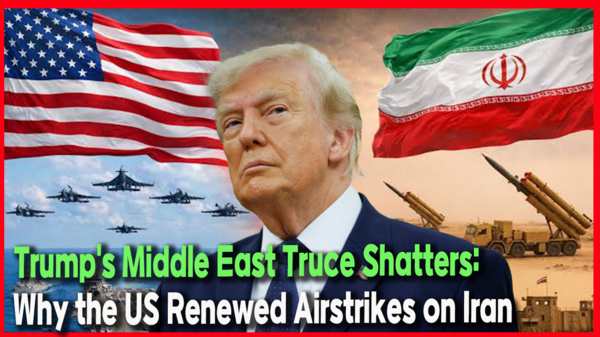
[US Launches Immediate Retaliatory Airstrikes Following Attacks on Merchant Ships in Hormuz]
The fragile 60-day truce engineered by the United States and Iran is buckling. Following a series of projectile and drone strikes on three commercial vessels in the critical Strait of Hormuz, the US military launched immediate retaliatory airstrikes against Iranian-linked military facilities. In response, Tehran declared a suspension of talks, pushing the "Islamabad Memorandum of Understanding (MOU)" signed just last month into its third severe test in a matter of weeks.
On the surface, this looks like a standard cycle of maritime provocation followed by military retaliation. Yet, the underlying truth is distinct: this is not the opening salvo of a brand-new war, but rather the structural unraveling of an inherently volatile ceasefire. This development demonstrates that comprehensive peace never truly took root.
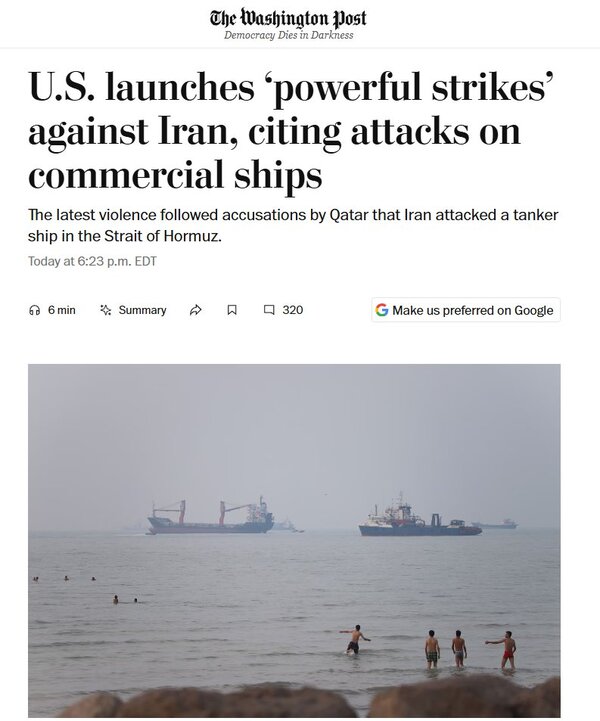
According to The Washington Post, US Central Command (CENTCOM) confirmed the airstrikes on July 7, stating they were designed to "impose heavy costs" on forces targeting innocent civilian mariners in international waters. US officials explicitly framed the maritime assaults as a direct violation of the June ceasefire. Maritime monitoring bodies, including the UK Maritime Trade Operations (UKMTO), confirmed that three vessels—including a Qatari-flagged LNG carrier and a Saudi Arabian merchant ship—were hit near the Omani coast.
While Tehran did not formally claim the assaults, Iranian state television noted that the vessels had "ignored warnings from military authorities," signaling that ships operating outside Iran's unilaterally approved corridors would remain targets. Global energy markets reacted instantly, with Brent crude jumping roughly 2% as traders re-priced the persistent risk radiating from the world's most critical oil chokepoint.
The more significant development, however, lies in Washington's coordinated policy response. Simultaneously with the airstrikes, the US Treasury’s Office of Foreign Assets Control (OFAC) revoked the General License (GL X) that had temporarily permitted Iranian oil exports under the truce. This double-barreled approach—pairing military force with the immediate reimposition of economic penalties—signals a strict return to transactional diplomacy: the benefits of the truce are entirely performance-based. Yet, even as it applied maximum pressure, the administration kept diplomatic channels cracked open, indicating that negotiators remain active. The airstrikes function less as a prelude to total war and more as aggressive leverage within a high-stakes coercive framework.
[The Accord Was Never a True 'End to the War'—It Was a Conditional Truce]
To understand the sudden escalation, it is essential to look at the anatomy of the Islamabad MOU. Signed in mid-June following months of intense regional conflict that began in late February, the agreement was widely misconstrued by the public as a permanent peace treaty. In reality, it was structured as a conditional, 60-day probationary period designed to test each side's compliance.
The document set up an extendable two-month window to negotiate complex regional issues:
Normalizing commercial shipping through the Strait of Hormuz
Resuming comprehensive nuclear talks
Phased relief of economic sanctions
The conditional release of up to $25 billion in frozen Iranian assets
The foundational flaw of this architecture was its hyper-reactivity. It was explicitly designed so that if either party perceived a violation, sanctions would snap back automatically and military options would instantly return to the table. It did not resolve the underlying conflict; it merely paused it under strict conditions.
The cracks appeared almost immediately after signing. Minor maritime friction occurred in late June, drawing limited US strikes on radar facilities and provoking warnings from the Islamic Revolutionary Guard Corps (IRGC). Vice President J.D. Vance reinforced the administration's stance, warning that "violence would be met with violence." Consequently, the latest July 7 clash is not an unforeseen disruption, but the predictable breakdown of an unstable framework.
[A Narrowed Negotiating Space in Post-Khamenei Iran]
The volatility is compounded by volatile domestic politics inside Iran. Following the death of Supreme Leader Ayatollah Ali Khamenei, the country remains locked in a high-stakes internal power transition.
The timing of the Hormuz attacks coincided directly with the final, massive public mourning processions for Khamenei in the holy city of Qom. With hardline factions capitalizing on fierce anti-American sentiment among the crowds, political space for Iranian moderates has shrunk significantly. Foreign Minister Abbas Araghchi’s declaration that "final negotiations will not proceed under continuous threat" reflects this domestic pressure. Iranian negotiators cannot afford to look weak or offer concessions while hardline security forces use regional defiance to solidify their domestic standing. Until the upper echelons of Iranian leadership fully stabilize, aggressive posture in the maritime arena remains a politically safer bet for Tehran's factions than diplomatic compromise.
[Trump Aims to Avoid Total War, Yet Conflict Remains Unavoidable]
Paradoxically, neither Washington nor Tehran wants this friction to devolve into an all-out war. The White House has consistently reiterated that the door to a final deal remains open if Iran halts its regional proxy actions and maritime provocations.
Washington's restraint is dictated by its broader global commitments. The administration's primary long-term strategic focus remains anchored on countering China, while managing the ongoing war between Russia and Ukraine. Re-engaging in a massive, open-ended ground or air war in the Middle East would severely disrupt this global balancing act. The administration's public frustration with NATO allies regarding burden-sharing highlights its desire to limit peripheral security expenditures.
Tehran faces a similar dilemma. Rebuilding its internal political hierarchy while recovering from severe economic isolation makes a full-scale military confrontation with the US highly dangerous for regime survival. Yet, a structural deadlock remains: the IRGC cannot yield its leverage over the Strait of Hormuz without abandoning its strategic identity, and the US cannot compromise on the absolute principle of international freedom of navigation.
The Structural Cycle: The Middle East is locked into a tightly bound loop where economic distress and battlefield dynamics feed into each other. If diplomatic trust erodes, maritime trade chokes; as shipping risks spike, economic pressure forces both sides back to coercive military postures.
With the 60-day negotiating window under the Islamabad MOU ticking toward its conclusion in mid-August, the region is highly likely to endure a cyclical pattern of provocation, targeted retaliation, backchannel negotiation, and renewed friction. True peace was never established; rather, a temporary mechanism was built to manage an ongoing conflict, and its structural seams are beginning to split.
Mourners Demand Retaliation at Khamenei Funeral — This video report captures the intense anti-American sentiment and calls for retaliation during the public funeral processions for Ayatollah Ali Khamenei, illustrating the immense domestic political pressure currently shaping Iran's hardline foreign policy response.

-중국 푸단대학교 한국연구원 객좌교수
-전 EDUIN News 대표
-전 OUR NEWS 대표
-제17대 대통령직인수위원회 정책기획팀장
-전 대통령실 홍보기획비서관
-사단법인 한국가정상담연구소 이사장
-저서: 북한급변사태와 한반도통일, 2012 다시우파다, 선거마케팅, 한국의 정치광고, 국회의원 선거매뉴얼 등 50여권