
Update2026.07.24 (금)

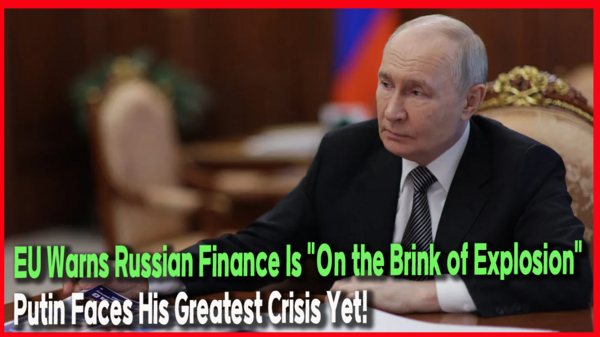
[EU: "The price of shifting war costs to banks… an 'explosive crisis' is possible"]
Russia has maintained a surprisingly resilient economy over the past four years despite powerful Western economic sanctions. While the West repeatedly predicted that the Russian economy would soon collapse, the Putin regime weathered the storm by expanding its defense industry and driving a state-led economy. However, European intelligence agencies are now warning that Russia's true economic crisis may begin in its financial system rather than on the battlefield. While the war economy appears functional on the surface, an immense burden has accumulated behind the scenes within the banking sector that has sustained it. In other words, the problem Russia faces now is not just a standard banking crisis, but the reality that the bills deferred by the war economy are finally starting to come due.
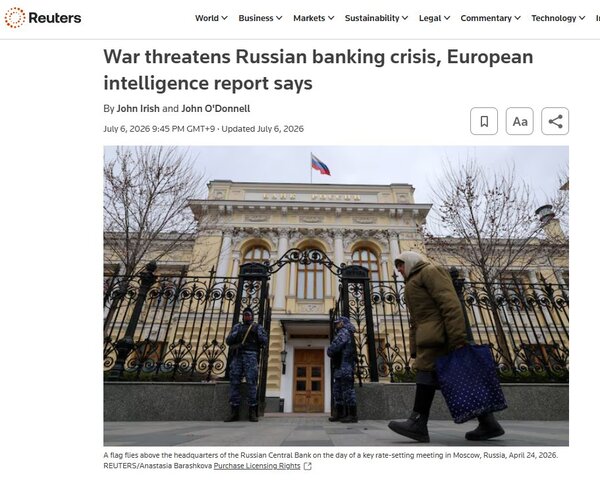
Reuters reported on the 7th (local time) that it had obtained an intelligence report distributed to European government officials, which stated that "the Russian banking sector could face an 'explosive' crisis." Titled "Note on the Possibility of a Russian Banking Crisis in 2026," the report assessed that while Russian banks survived Western sanctions, internal, structural risks are now escalating rapidly.
[Russia's war was sustained by its banks, not the state]
The dynamic highlighted most heavily in this report is deceptively simple: the Russian government did not fund its massive war effort through state finances alone. As the war dragged on, defense enterprises required continuous funding, military factories needed to scale up production, and capital had to be supplied to the private sector to prevent the economy from freezing over completely. Had the state budget absorbed all of these costs, fiscal resources would likely have hit their limit much sooner.
The Putin administration chose instead to leverage the banking sector. It directed banks to provide large-scale policy loans to defense companies, military suppliers, and the housing market, with the government subsidizing interest rates or offering various support packages. On paper, these were bank loans; in reality, the state weaponized the balance sheets of commercial banks to keep the war economy afloat. Thanks to this arrangement, the Russian economy appeared unexpectedly stable: the defense industry kept humming, and unemployment remained low. The cost, however, was a relentless accumulation of high-risk loans on bank balance sheets.
The report singled out this factor as the single greatest threat. While government support and debt restructuring have masked the issue so far, any external shock could cause these hidden non-performing loans (NPLs) to come crashing into the open all at once. In fact, approximately 10% of corporate loans are already classified as high-risk, and the individual NPL ratio at some major banks reportedly surged to as high as 15% last year.
[Warning sign: People are starting to choose cash over banks]
Slowing economic growth is also becoming prominent. The Russian Ministry of Economic Development slashed its GDP growth forecast for this year from 1.3% to a meager 0.4%, while cutting next year's outlook in half.
Yet, there is a number far more alarming than the growth rate. According to the Central Bank of Russia, the volume of cash held outside the banking system surged by more than 17% this year compared to last, surpassing 19 trillion rubles. This figure signifies more than just a preference for cash. Banks rely on deposits to extend loans to corporations and grease the wheels of the economy. When the public begins stockpiling physical cash instead of trusting banks with their money, banks struggle to secure funding and are forced to restrict lending.
Most financial crises manifest through a erosion of institutional trust long before NPL defaults peak. The fact that VTB, Russia’s second-largest bank, announced it would increase provisions to brace for potential loan losses is directly tied to this shift in public confidence.
[The Kremlin claims "All is well," but...]
Unsurprisingly, the Russian government strongly denies any impending crisis. The Central Bank of Russia maintains that the banking sector's capital health is at its highest level in three years, and Sberbank—the country's largest lender—emphasizes that it has fully adapted to Western sanctions.
Some Western experts also believe a financial meltdown is unlikely in the immediate future, arguing that high military spending continues to prop up the economy and that trade with Asian nations like China and India remains robust.
However, even this optimism cannot deny one fundamental truth: the current Russian economy is sustained exclusively on the premise of relentless defense spending. As long as the war continues, the risks absorbed by the banking sector will inevitably multiply.
[The West shifts its crosshairs from energy to finance]
Recognizing this vulnerability, the EU has begun shifting its strategy. While its initial focus centered on choking off crude oil and gas exports, it is now zeroing in on destabilizing the Russian financial system itself.
Once the EU’s proposed 21st sanctions package takes effect, approximately 90 additional Russian banks are expected to be blacklisted. Pressure will simultaneously tighten on cryptocurrency networks, oil trading channels, and drone manufacturers.
This is not a generic sanctioning of banks. In modern warfare, defense firms can only sustain production if banks provide the liquid capital. If the financial system buckles, the military industry falters—and if the military industry falters, Russia's capacity to wage war erodes at its core. This is precisely why the West is now training its sights directly on Russian banks.
[Why Times Insight]
The true warning delivered by this EU intelligence report is not merely that Russian banks are in jeopardy; it is that the war economy, sustained for over four years, is finally receiving the bills it tried so hard to hide.
Vladimir Putin did not fund this war out of state coffers alone. By constructing a system where the banking sector backstopped defense firms, military supply chains, and policy financing, he engineered an illusion of economic stability. The trade-off, however, was a quiet, steady pileup of toxic loans and bad debt on bank balance sheets.
In the early stages of the war, this mechanism worked effectively. Defense factories ran around the clock, and unemployment stayed low. But as the conflict turned into a war of attrition, the burden shifted to the financial system grew exponentially.
Crucially, these economic fractures are beginning to converge with recent shifts on the battlefield. Ukrainian forces have recently intensified their counteroffensives around Lyman, Pokrovsk, and northern Donetsk, delivering precision strikes against Russian command facilities, drone bases, and ammunition depots. Assessments show that the Russian military is exhausting both personnel and hardware in a prolonged war of attrition, with its offensive capabilities visibly degrading across multiple frontlines.
U.S. Vice President J.D. Vance also observed in a recent interview that the Russian military has entered a bottleneck phase, losing more than it gains by pushing forward. Bill Browder, a prominent Kremlin critic, similarly analyzed that Russia is entering a phase where its military, economy, and domestic society are coming under intense pressure simultaneously.
The key takeaway here is that economics and warfare do not operate in vacuums. If the economy falters, the defense industry struggles to secure capital; if the defense industry weakens, the frontlines suffer heavier losses. Conversely, a deteriorating frontline demands more troops, more weapons, and more military expenditure—injecting brand-new strains right back into the financial system.
When this vicious cycle takes hold—where economic decay worsens the frontline, and frontline degradation further breaks the economy—a nation's capacity to sustain war collapses rapidly. Russia may very well be standing at that exact crossroads.
Wars are not fought with guns and missiles alone. The moment the money runs out, the war moves toward its end. And right now, the first domino to wobble in Russia may not be its frontline, but the financial system that has held that frontline up.


-중국 푸단대학교 한국연구원 객좌교수
-전 EDUIN News 대표
-전 OUR NEWS 대표
-제17대 대통령직인수위원회 정책기획팀장
-전 대통령실 홍보기획비서관
-사단법인 한국가정상담연구소 이사장
-저서: 북한급변사태와 한반도통일, 2012 다시우파다, 선거마케팅, 한국의 정치광고, 국회의원 선거매뉴얼 등 50여권