
Update2026.07.24 (금)

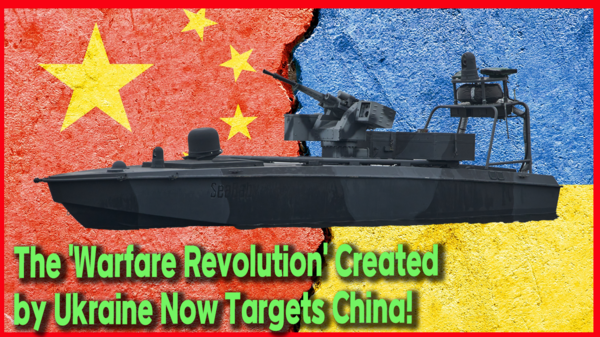
[The New Warfare Invented by Ukraine: Changing the Global Formula of War]
The war between Russia and Ukraine has now stretched past its fourth year. While countless tanks, fighter jets, and missiles have surfaced on the battlefield, the most profound legacy of this conflict is ironically not a single new weapon system. Instead, it is the complete overhaul of how warfare itself is conducted. Locked in combat with Russia—historically rated as the world's second-strongest military power—Ukraine has shattered the conventional wisdom that "expensive, high-tech weaponry dominates the battlefield." The United States has already begun integrating these lessons into its strategy to counter China, while Japan and Taiwan are actively moving to study Ukraine’s wartime experiences firsthand.
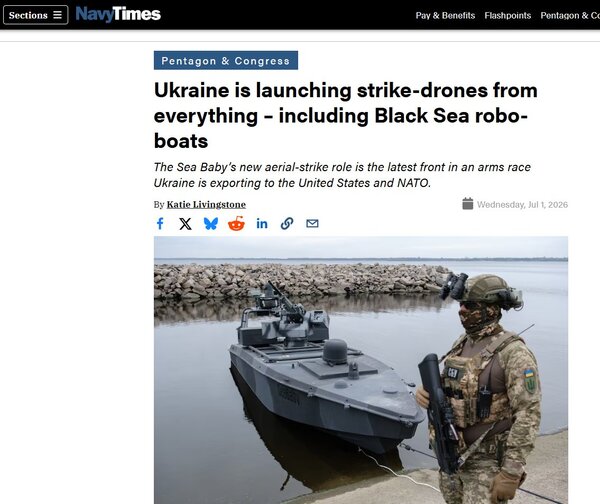
The U.S. military media outlet Navy Times recently highlighted the remarkable evolution of the "Sea Baby" maritime drone operated by the Security Service of Ukraine (SBU).
Just two years ago, the Sea Baby was an uncrewed kamikaze surface vessel designed to ram into Russian warships and detonate. While it made a name for itself by terrorizing Russia's Black Sea Fleet, its underlying concept remained an expendable, single-use weapon. Today, however, the Sea Baby has evolved into an entirely different asset.
The latest generation can carry up to two tons of equipment within its hull and navigate distances exceeding 1,500 kilometers to approach hostile coastlines. Crucially, it can transport six to eight first-person view (FPV) attack drones—launching them as needed—and operate thermobaric rocket launchers.
This represents far more than a simple firepower upgrade. It means that maritime drones are transitioning from self-detonating assets into "mobile maritime platforms" capable of transporting and deploying multiple drones—essentially evolving into miniature aircraft carriers.
Warfare is no longer the exclusive domain of massive destroyers or aircraft carriers. An era has arrived where a swarm of uncrewed vessels costing tens of thousands of dollars can yield far greater strategic outcomes than a multi-million-dollar warship.
Ukraine's innovation has expanded beneath the surface as well. According to Navy Times, Ukraine’s uncrewed underwater vehicle (UUV), the "Sub Sea Baby," successfully struck an Improved Kilo-class submarine docked at the Russian port of Novorossiysk last December.
While Russia denied the damage, satellite imagery captured the following day told a different story. Significant blast markings were visible on the pier, and the submarine was noticeably listing. The vessel remained immobilized at the same berth for over a month, leading Western military experts to assess that it had effectively lost its combat capabilities.
The significance of this incident goes beyond the damage inflicted on a single submarine. Historically, global navies have designed their operations around the premise that a submarine inside a heavily fortified harbor is at its safest. Ukraine shattered that long-held assumption with a single underwater drone.
The greatest danger in warfare is not the introduction of a new weapon, but the moment old orthodoxies collapse. Ukraine is currently rewriting those orthodoxies in global military history.
[What Shocked the U.S. Most Was Not the Drones, but the 'Speed']
The greatest shock Ukraine delivered to global military experts did not stem from specific hardware like the "Sea Baby" or "Magura" drones. The true shock lay in the methodology behind how those weapons are developed and scaled.
In an analytical report on the war, the Center for Strategic and International Studies (CSIS) noted, "The real takeaway for the U.S. military is not a specific drone model, but Ukraine's procurement system." In other words, Ukraine’s true competitive edge lies not in the standalone performance of its weapons, but in the blistering speed at which those weapons evolve.
At the onset of the war, Ukraine possessed a rigid military procurement system similar to Russia's. Developing a new piece of equipment traditionally required defining performance requirements, securing budgets, undergoing test evaluations, and entering mass production—a cycle that took years. However, the war would not wait for bureaucratic procedures. In an environment where a weapon effective today becomes obsolete a month later, conventional procurement methods guaranteed strategic failure.
Ultimately, Ukraine bypassed this by applying the development methodologies of commercial IT firms directly to national defense—a paradigm shift known as "Agile Defense Innovation." When a frontline soldier identifies a new problem, that information is relayed directly to the manufacturer. The builder modifies the design within days, and the upgraded product is immediately tested back on the front lines. The data harvested from these engagements directly informs the next iteration. A weapon development cycle that once took years has been compressed into a recurring loop of mere weeks.
[The World's First Drone Ecosystem Formed by 'Brave1']
At the epicenter of this innovation is "Brave1," a defense tech platform established by the Ukrainian government. According to the defense news outlet Defense One, Brave1 is far more than a simple procurement system. It functions as a massive ecosystem where frontline units can order certified drones directly from manufacturers while feeding back real-time data—such as hit rates, failure modes, flight ranges, and communication jamming vulnerabilities—back to the producers. Effectively, the battlefield serves as the laboratory, and the soldier acts as the test evaluation officer.
The results have been staggering. The number of domestic drone manufacturers in Ukraine has surged from just seven before the war to approximately 500 today. Ukraine produced around 4 million drones last year and is targeting 7 million units this year—a volume that surpasses the combined production capacity of all NATO member states.
Even more notable is the quality. An interceptor drone co-developed by the British firm Skycutter and Ukraine's SkyFall scored 99.3 out of 100 points in a U.S. Department of Defense performance evaluation, outperforming American competitors by a wide margin. It was evaluated as being cheaper, faster to produce, and demonstrating higher battlefield reliability.
Confronted with these metrics, the Pentagon did not dogmatically stick to domestic products; instead, it began exploring options to directly procure Ukrainian-made drones. This is not merely a hardware purchase. It signifies that the world’s preeminent military superpower has recognized Ukraine as the premier authority on modern technological warfare.
[The United States Begins Redesigning Future War Against China]
The lessons of the war in Ukraine have been directly mapped onto the U.S. Indo-Pacific strategy. According to USNI News, published by the U.S. Naval Institute, the U.S. Navy is advancing a plan to deploy thousands of uncrewed surface vessels (USVs) across the Indo-Pacific theater by 2030. This is not just an numerical expansion of assets; it represents a new operational concept designed to attrit the Chinese fleet via the simultaneous deployment of manned and uncrewed forces the moment China attempts to project power into the Western Pacific.
Wargames conducted by the Hudson Institute and the Japanese Ministry of Defense yielded identical conclusions. In a simulation replicating a Chinese invasion of Taiwan, the assets delivering the most devastating blow to the adversary were neither destroyers nor F-35 fighter jets—they were uncrewed surface vessels (USVs) and uncrewed underwater vehicles (UUVs).
Bryan Clark, Director of the Center for Defense Concepts and Technology at the Hudson Institute, explained, "By operating manned and uncrewed forces in tandem, we were able to preserve initial forces to the maximum extent possible and buy critical time for U.S. reinforcements to arrive."
This serves as a concrete manifestation of the "Drone Hellscape" concept previously outlined by Admiral Samuel Paparo, Commander of the U.S. Indo-Pacific Command, proving it has matured from a conceptual framework into a codified operational reality.
In short, Washington is not merely analyzing the war in Ukraine as an isolated European conflict; it has already begun implementing Ukraine's asymmetric warfare model into the blueprint for a future conflict with China.
[The Warfare Revolution Born in Ukraine Has Arrived in the Indo-Pacific]
The new mode of warfare forged in Ukraine is no longer confined to the European theater; it has bridged into the Indo-Pacific. A symbolic demonstration of this shift occurred during "Balikatan 2026," a joint U.S.-Philippine military exercise conducted last April.
U.S. Army Special Forces (Green Berets) utilized Ukraine's latest "Magura" maritime drone to successfully strike and sink a designated target ship. The exercise took place in the waters off Itbayat Island, the northernmost point of the Philippines—located a mere 150 kilometers from Taiwan.
The implications of this exercise are unambiguous: the United States has begun transplanting battlefield-proven Ukrainian tactics straight into its strategy to contain China. Oleg Roginsky, CEO of Uforce—the manufacturer of the Magura drone—noted that it marked "a historic moment where combat techniques validated on one battlefield are transferred directly to another."
The United States is not alone in this pivot; Taiwan has also reached out directly to Kyiv. James C. F. Huang, Chairman of the Taiwan External Trade Development Council (TAITRA), recently visited Lviv, Ukraine, to discuss joint production schemes and supply chain integration with local drone manufacturers. Huang is not simply a business figure; he is a former Minister of Foreign Affairs and a prominent foreign policy and national security expert within the ruling Democratic Progressive Party (DPP). His direct engagement underscores that Taipei is approaching this cooperation through the lens of core national security strategy.
Japan's approach is even more assertive. The Japanese government is pushing to establish a "Japan-Ukraine Drone Cluster" involving Ukrainian defense firms, universities, and research institutes. Tokyo has allocated approximately 100 billion yen in its fiscal year 2026 budget specifically to secure uncrewed naval capabilities. In a striking historical reversal, Ukraine—which was solely a recipient of military aid just a few years ago—has transformed into the epicenter of military innovation from which the U.S., Japan, and Taiwan are actively learning.
[North Korea Is Reading From the Same Textbook]
For South Korea, a more pressing vulnerability looms. The democratic coalition is not the only side studying Ukraine's wartime insights. The S. Rajaratnam School of International Studies (RSIS) in Singapore recently raised the possibility that North Korean personnel deployed to Russia could serve as drone warfare instructors upon their return, threatening to rapidly propagate real-world tactics and operational experience throughout the entire North Korean military.
Pyongyang is already accelerating the mass development of loitering munitions (kamikaze drones) and reconnaissance UAVs. If North Korea pairs these assets with the low-cost, mass-production paradigms validated in Ukraine, the security environment on the Korean Peninsula will enter a highly volatile phase. In tomorrow’s conflict, a swarm of hundreds of low-cost drones could present a significantly more complicated threat vector than a single multi-million-dollar ballistic missile.
[Why Times Insight]
Many observers note that the war in Ukraine has ushered in the age of the drone. However, that assessment captures only half the reality. Ukraine did not merely popularize drones; it rewrote the operating system of warfare itself. Just as the machine gun redefined World War I, the aircraft carrier reshaped maritime order in World War II, and nuclear weapons recalibrated global strategy during the Cold War, the Russia-Ukraine conflict is inaugurating an era where "speed governs the battlefield."
The ultimate arbiter of victory is no longer who possesses the most expensive arsenal, but who can observe, iterate, manufacture, and field capabilities faster than the adversary. This is why the United States is analyzing Ukraine. This is why Japan and Taiwan are forging partnerships with Kyiv. And this is why North Korea is studying the same conflict from the closest possible vantage point.
Where does South Korea stand in this calculus? Seoul remains anchored to a rigid defense procurement framework and complex acquisition cycles that take years to navigate. Transparency and budgetary oversight are undeniably critical. However, if the tempo of battlefield evolution outpaces institutional frameworks, even the most advanced weapon system loses its utility if it cannot be delivered to the front lines in time.
The singular truth Ukraine has demonstrated over the past four years is that the most formidable military in future warfare is not the one with the largest stockpile, but the one that learns and adapts the fastest. The international community is currently digesting this new textbook. South Korea must pivot immediately, treating "speed of adaptation" rather than raw hardware performance as the core metric of national security competitiveness.

-중국 푸단대학교 한국연구원 객좌교수
-전 EDUIN News 대표
-전 OUR NEWS 대표
-제17대 대통령직인수위원회 정책기획팀장
-전 대통령실 홍보기획비서관
-사단법인 한국가정상담연구소 이사장
-저서: 북한급변사태와 한반도통일, 2012 다시우파다, 선거마케팅, 한국의 정치광고, 국회의원 선거매뉴얼 등 50여권