
Update2026.07.24 (금)

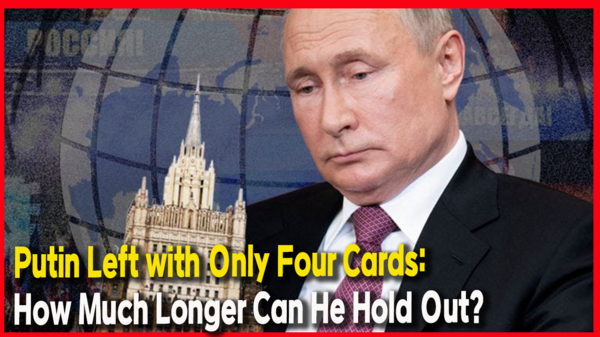
[The Heart of Siberia Breached: Precision Strike on the Omsk Refinery]
A Ukrainian drone has penetrated the heart of Siberia, a region Russia long believed to be its ultimate safe zone. Flying approximately 2,700 kilometers—the longest distance recorded since the start of the war—the drone executed a precision strike on the Omsk Refinery, Russia's largest oil refining facility. This strike was more than just physical destruction; it was a highly symbolic blow targeting both Russia's war-making capabilities and its economy. Compounded by fuel shortages, economic stagnation, and diplomatic pressure, President Vladimir Putin's strategic options are rapidly dwindling. Today, Russia’s greatest crisis is not the loss of territory, but the reality that its choices are vanishing.
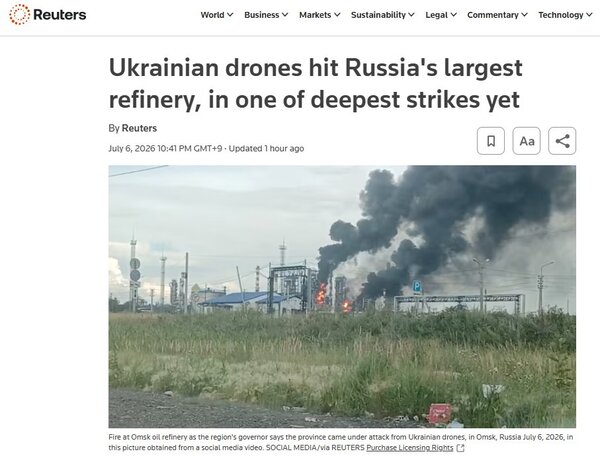
On July 7, Reuters reported, "Ukraine’s Special Operations Forces (SSO) and the Main Directorate of Intelligence (HUR) launched a drone strike on July 6 against the Omsk Refinery, located in the Omsk Oblast of Western Siberia." The report noted, "The facility is roughly 2,700 kilometers away from the Ukrainian border, making it one of the most distant targets Ukraine has hit since the outbreak of the war."
The General Staff of the Armed Forces of Ukraine stated, "The ELOU-AVT-11 primary refining unit, which is critical to the refining process, was damaged. When the initial stage of separating crude oil into gasoline and diesel is halted, all subsequent refining processes are effectively paralyzed."
Commenting on the attack, The Moscow Times pointed out, "The Omsk Refinery is Russia's largest refining facility, processing approximately 21 million tons annually and accounting for roughly 12% of the country's total refining capacity." The outlet added, "The Ukrainian military has defined this strike as a hit on the last core stronghold among Russia's 11 major gasoline production facilities."
However, the true significance of this attack goes beyond the destruction of a single refinery. Omsk is deep within the Siberian interior, a place Russians firmly believed was absolutely secure. Since the war began, Ukraine has systematically struck border regions, areas around Moscow, the Black Sea coast, and the Crimean Peninsula. Yet, Siberia was viewed as a space virtually untouched by the conflict. This attack signifies that even this final psychological safe zone has crumbled. In other words, Ukraine has proven it can strike anywhere inside Russia. This comes as a profound shock to the Russian public, making it clear that the war is no longer a distant border conflict, but a reality threatening the entire nation.
[Fuel Shortages, Not Missiles, Are Bringing Russia Down]
A more critical issue is that this strike is not an isolated incident. Over the past year, Ukraine has relentlessly targeted Russian refining facilities. Initially viewed as sporadic airstrikes, the underlying intent has become clear over time: a long-term strategy to dismantle the Russian military's fuel supply chain itself.
Indeed, Radio Free Europe/Radio Liberty (RFE/RL) reported, "Restrictions on the sale of gasoline and diesel are currently in place in more than half of Russia's federal subjects." The report added, "The Kapotnya Refinery, one of Moscow’s largest suppliers, has entered a prolonged shutdown, and major energy facilities are being repeatedly exposed to drone attacks."
RFE/RL further noted, "Russia's problem is no longer just the destruction of a few refineries. The country is entering a structural deficit where production capacity simply cannot keep up with consumption."
"The fact that executives from Russia’s largest oil companies sent a letter to President Putin describing the refinery damage as 'unprecedented' underscores this sense of crisis," RFE/RL stated. "Energy experts also assess that the resilience of the Russian oil industry is rapidly deteriorating."
Crucially, this pressure compounds over time. War is not won or lost in a single massive strike. Before one refinery can be repaired, another is hit, and the resulting fuel shortages ripple through logistics and industrial production. As this cycle repeats, the costs Russia must bear will inevitably grow exponentially. The Omsk strike was not merely a drone attack; it was a demonstration to the world that even the heart of the Russian economy is no longer safe.
[Putin Is No Longer Dictating the War]
What deserves close attention here is how Putin's leverage has fundamentally shifted. In the early stages of the war, Putin held the initiative, deciding when to attack, when to negotiate, and when to escalate tensions. The international community focused heavily on what choice Putin would make next.
Today, the tables have turned. Ukraine has acquired the capability to strike deep into the Russian homeland, Western military aid continues to flow, and the Russian economy is being squeezed simultaneously by fuel shortages and sanctions. Instead of being the one who sets the stage, Putin is turning into a leader who must constantly react to situations engineered by his adversary.
The Omsk strike is a case in point. Russia failed to prevent it and only launched retaliatory airstrikes after the damage was done. This was not a calculated move in a campaign designed by Moscow, but a forced reaction to an enemy attack. This marks a critical shift in the conflict. Wars are not decided by troop numbers and weaponry alone; holding the initiative and forcing the opponent to move is far more vital. The current momentum on the battlefield is gradually shifting in a direction where Ukraine is forcing Russia's hand.
[Putin's Remaining Four Cards Turn Out to Be Traps]
President Putin appears to have a few options left on the table. He could commit more troops, escalate nuclear threats, provoke NATO, or expand hybrid warfare. However, Western military and security experts consistently point out that Putin is not holding viable cards, but rather dangerous dilemmas. This is the core assessment recently reported by the UK’s Financial Times (FT), drawing on evaluations from Western officials and security experts.
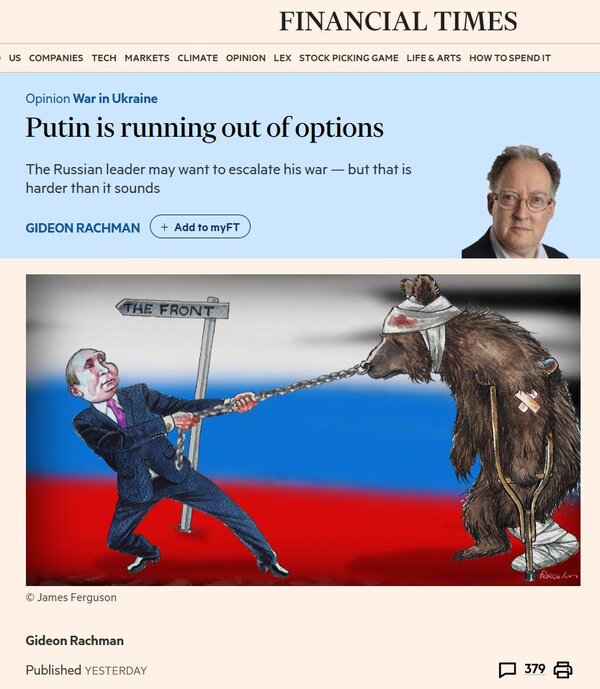
The First Card: A War of Attrition via More Troops
The most realistic choice is to continue funneling troops into the front lines. Indeed, Russia is expected to launch another offensive in eastern Ukraine this summer using additional mobilized forces. However, the problem is that its forces are being depleted at an unsustainable rate.
Western intelligence agencies analyze that the Russian military is suffering tens of thousands of casualties every month, and the pace of replenishment cannot keep up with these losses. Consequently, pouring in more troops could trigger a paradox where Russia's overall war-fighting capability actually weakens.
A total mobilization is frequently discussed, but it remains highly impractical. A full-scale draft could cause severe domestic shockwaves, forcing a population that has largely viewed the war as "someone else's problem" to bear its direct burdens. Ultimately, this card is less of a winning strategy and more of a way to buy time while absorbing heavy losses.
The Second Card: Nuclear Threats... But Believers Are Dwindling
The potential use of tactical nuclear weapons has been Putin's most frequently brandished card. However, the context has shifted. Not only the West, but also China has publicly opposed the use of nuclear weapons. Beijing, despite being Russia's strategic benefactor, has reportedly signaled multiple times that a nuclear escalation is unacceptable.
An even greater issue is that repeated nuclear brinkmanship has devalued the threat itself. A Western official quoted by the FT noted that Putin has already debased the currency of his nuclear threats. Because Moscow repeatedly threatens without executing, it no longer shakes the international community as it once did.
The Third Card: NATO Provocation
Scenarios involving military provocations aimed at the Baltic states or Poland are regularly floated. Yet, the likelihood of execution remains low. With Russia already struggling to manage the Ukrainian front, opening a new theater would impose a massive burden. Above all, the moment Russian actions touch NATO territory, the risks Moscow faces would escalate exponentially compared to now. Instead of turning the tide of the war, it is far more likely to drag Russia into a deeper quagmire.
The Fourth Card: Hybrid Warfare
The most viable option remains hybrid warfare, such as cyberattacks or infrastructure sabotage. Indeed, instances of sabotage and cyber operations suspected of being linked to Russia are steadily being uncovered across Europe. However, this is unlikely to provide a decisive solution, as the West possesses the capability to respond in kind. Cyber warfare targeting critical infrastructure—such as energy grids, communication networks, and financial systems—is no longer a domain exclusive to Russia. Consequently, the prevailing view is that hybrid warfare will only heighten the risk of escalation without shifting the balance of the war.
[Why Times Insight]
The most profound shift in this war is not that the Russian military is retreating. It is that Putin can no longer dictate the timeline or flow of the conflict. At the start, Putin decided when to strike, when to talk, and where to concentrate his forces. Today, he is scrambling just to react to the circumstances created by Ukraine’s long-range drone strikes, Western military assistance, and the structural pressures on the Russian economy.
The attack on the Omsk Refinery illustrates this perfectly. The expansion of the battlefield into Siberia—the very place Russia deemed safest—means that Ukraine can now disrupt Russia's timetable. It is a clear signal that the initiative is steadily shifting.
Of course, this does not mean an imminent Russian defeat. Russia still possesses vast military power and resources, and it remains impossible to predict exactly when the war will end. What is certain, however, is that as time passes, Putin's strategic options are shrinking while the risks he must absorb are mounting.
For a strategist, the most fatal moment is not the moment of defeat. It is the moment when the options for victory disappear one by one. Putin now stands at that very juncture. And this, fundamentally, is the true crisis confronting Russia.


-중국 푸단대학교 한국연구원 객좌교수
-전 EDUIN News 대표
-전 OUR NEWS 대표
-제17대 대통령직인수위원회 정책기획팀장
-전 대통령실 홍보기획비서관
-사단법인 한국가정상담연구소 이사장
-저서: 북한급변사태와 한반도통일, 2012 다시우파다, 선거마케팅, 한국의 정치광고, 국회의원 선거매뉴얼 등 50여권