
Update2026.07.24 (금)

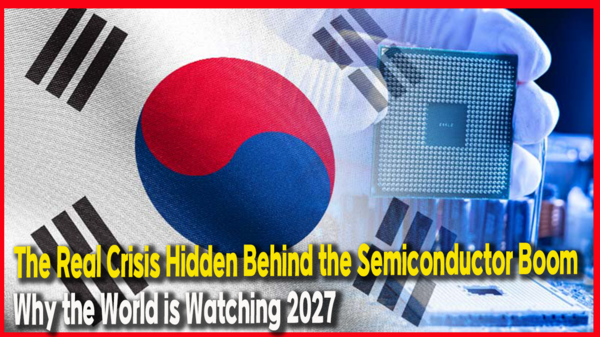
[Is South Korea’s Ultimate Economic Crisis Approaching in 2027?]
The South Korean economy currently finds itself in a deeply paradoxical situation. The semiconductor industry is enjoying an unprecedented boom, and exports are showing a clear recovery trend. The government has even unveiled a blueprint to leverage these semiconductor windfall revenues to establish a national fund earmarked for future generations. On the surface, the economy appears to have firmly realigned with a growth trajectory. Yet, a growing chorus of foreign economic experts and media outlets are issuing stark warnings: South Korea’s ultimate economic crisis could hit as early as 2027.
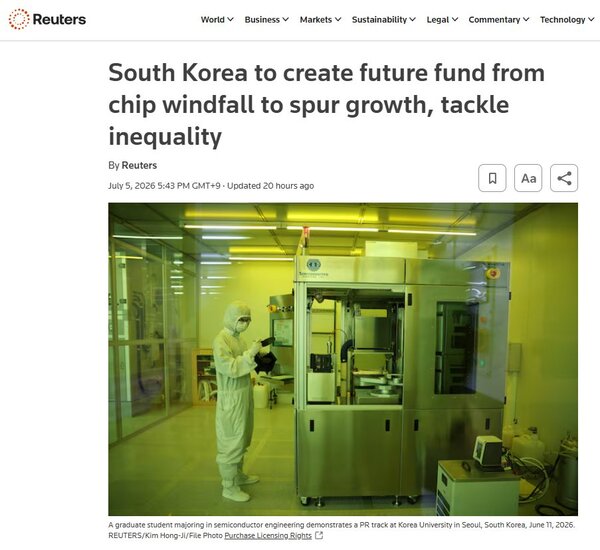
On July 5 (local time), Reuters reported that "the South Korean government is pushing to create a 'Future Fund' utilizing surplus tax revenues generated by the semiconductor sector to secure future growth engines and address social inequality." Some analysts view this as a meaningful policy step, signaling that the government intends to use the chip boom as seed money for long-term sustainability rather than consuming it as a fleeting windfall.
Right at this juncture, however, major international economic institutions are flashing entirely different warning signs, catching many off guard. The Organisation for Economic Co-operation and Development (OECD) warned that "the South Korean economy faces the unprecedented possibility of remaining stuck in the 1% growth range for three consecutive years," while The Wall Street Journal (WSJ) characterized South Korea’s ultra-low birth rate and rapid aging as "a demographic shock unprecedented in modern economic history."
Compounding this, Bloomberg sounded the alarm over a continuous decline in the country’s potential growth rate. Meanwhile, the Center for Strategic and International Studies (CSIS), a prominent U.S. think tank, diagnosed that "the South Korean economy is currently trapped in an illusion created by the semiconductor boom." What makes these assessments fascinating is that although these institutions analyzed entirely different sectors, they arrived at nearly identical conclusions. Their core argument converges on one point: "The true test for the South Korean economy will begin not now, but from the year 2027."
[Why Is the World Zeroing In on 2027?]
The 1997 Asian Financial Crisis was triggered by the depletion of foreign exchange reserves, and the 2008 global financial crisis stemmed from a meltdown of the financial system. However, the 2027 crisis projected by domestic and international economic experts is of a fundamentally different nature. This time, it is neither foreign exchange nor finance. The critical distinction is that the very growth engine required to revive the economy risks grinding to a halt.
The OECD’s projection means far more than a minor dip in growth figures. The prospect of South Korea’s growth remaining in the 1% range for three consecutive years for the first time in history signifies that low growth is not a temporary, cyclical recession, but is instead hardening into a "New Normal."
In the past, the South Korean economy rebounded swiftly whenever it encountered a crisis. Following the 1997 crisis, it rose again on the back of world-class export competitiveness; after the 2008 crisis, it regained its footing through its robust manufacturing and IT sectors.
Today, however, the dynamics have fundamentally shifted. The economy is not merely taking a temporary breather; rather, the fundamental structural forces driving it are deteriorating one by one. The labor force is shrinking, private consumption is decelerating, corporate investment is contracting, and productivity gains are stagnating. Under these conditions, standard short-term stimulus measures are highly unlikely to trigger the robust rebounds seen in the past.
For this very reason, international economic institutions view 2027 not just as a random calendar year, but as a watershed moment where South Korea’s economic fabric undergoes a structural transformation. What breeds deeper concern is that this shift is not localized; it is occurring across multiple fronts simultaneously.
Four massive macroeconomic tailwinds—demographic transformation, surging debt, eroding industrial competitiveness, and the reconfiguration of global supply chains—are converging to squeeze the South Korean economy at roughly the same time. Historically, when one pillar faltered, other sectors stepped in to stabilize the economy. 2027 will be different. The multiple pillars that have long sustained the South Korean economy are highly likely to fracture concurrently.
This is precisely why global observers are deeply concerned about South Korea. Their anxiety extends far beyond a mere 1 or 2 percentage point fluctuation in GDP growth. They see this as a historic inflection point that will dictate whether South Korea can maintain its dynamism as an advanced economy, or irrevocably slip into permanent, structural stagnation.
[Demographics, Debt, Industry, and Supply Chains: The 'Four Bombs' Set to Hit the Korean Economy in 2027]
The reasoning behind international institutions identifying 2027 as a critical danger zone is multifaceted. Economies have always faced hurdles. The 1997 crisis lacked liquidity, the 2008 crisis shook financial institutions, and the COVID-19 pandemic brought global commerce to a sudden halt.
This looming crisis, however, presents a different pattern. The gravest risk lies in the fact that the four primary pillars supporting the South Korean economy are beginning to fracture simultaneously.
The First Bomb: The Shrinking 'Economically Active Population'
Many view the ultra-low birth rate simply as a population decline issue. However, international research bodies are far more alarmed by the contraction of the workforce driving the economy rather than absolute headcounts. The period around 2027 coincides with the mass retirement of the baby-boomer generation—the very architects of South Korea’s industrialization—from the labor market. Concurrently, the influx of younger generations replacing them is severely diminished due to decades of ultra-low fertility. This implies far more than a localized labor shortage. A shrinking workforce suppresses overall production, a dwindling tax base deteriorates national fiscal health, contracting consumer pools dampen domestic markets, and a deficit of homebuyers drains long-term vitality from the real estate sector. In short, nearly every cog in the economic engine begins to shrink simultaneously. This is precisely why the OECD and Bloomberg flag the drop in potential growth rate as the most critical threat.
The Second Bomb: World-High Debt Levels
While the South Korean economy expanded, it accumulated staggering amounts of debt in the process. Household debt remains among the highest globally, and the vulnerabilities surrounding real estate Project Financing (PF) have yet to be thoroughly resolved. Furthermore, a prolonged period of elevated interest rates is rapidly depleting the financial resilience of small business owners and small-to-medium enterprises (SMEs). The core danger is not the debt itself, but how it suffocates consumption. Even as incomes rise, households forced to allocate a substantial portion of their earnings to debt servicing have no choice but to cut back on spending. Depressed consumption prompts corporations to defer investments, which in turn leads to job losses. This drop in employment feeds back into weakened consumption, creating a vicious cycle where the economy loses its self-sustaining growth momentum. Unlike 1997, where corporate restructuring cleared the path for a rapid restart, debt today is turning into a "chronic disease" slowly eating away at the economy's holistic vitality.
The Third Bomb: Shifting Industrial Competitiveness
At present, the single strongest bulwark defending the South Korean economy is undoubtedly semiconductors. With the dawn of the AI era, demand for advanced memory chips, including High Bandwidth Memory (HBM), has exploded, with Samsung Electronics and SK Hynix leading the global marketplace. However, it is a mistake to view the wider industrial landscape through this optimistic lens alone. Excluding semiconductors, broader manufacturing growth is slowing significantly. In high-value-added future industries such as system semiconductors, advanced packaging, and AI platforms, the United States and Taiwan are rapidly pulling ahead. Taiwan, anchored by TSMC, virtually monopolizes the global advanced foundry market, while the U.S. is aggressively shifting the semiconductor supply chain toward its shores backed by massive subsidies and technology investments. While South Korea remains a memory powerhouse, it faces increasingly fierce headwinds in the battle for future industrial hegemony.
The Fourth Bomb: Geopolitical Alignments
Historically, economics and national security were treated as separate domains. Today, they are deeply intertwined. Semiconductors, batteries, artificial intelligence, shipbuilding, and defense are all directly bound up with supply chain security. Corporate competitiveness is no longer determined solely by technological prowess; the specific supply chain ecosystem a company belongs to now dictates its survival. The U.S. is accelerating the restructuring of supply chains around its allies, while China is countering by pushing for total technological self-reliance. South Korea sits at a highly critical strategic crossroads between these two powers. Consequently, any spike in diplomatic uncertainty immediately impacts exports, corporate investments, and advanced technology sectors as a whole, rather than just rattling financial markets. This marks a radical departure from past crises.
When these four systemic threats converge, they do not operate in isolation. A shrinking workforce suppresses consumption; depressed consumption deters corporate investment; reduced investment erodes industrial competitiveness; and weakened industrial competitiveness cuts exports. A decline in exports ultimately drags down GDP growth, which in turn strains fiscal revenue and financial stability. Ultimately, the four triggers—demographics, debt, industry, and supply chains—amplify one another, coalescing into a single, massive structural crisis. This is why international observers interpret 2027 not as a minor cyclical downturn, but as an irreversible structural inflection point.
[Is Semiconductors Saving the Korean Economy—or Creating the Most Dangerous Illusion?]
Among recent international reports analyzing South Korea, one of the most eye-catching is a study published by the Center for Strategic and International Studies (CSIS) titled "South Korea's Market Boom—and the Bubble Beneath It."
The title itself speaks volumes. CSIS cautions against misinterpreting the recent strength of the South Korean stock market as a sign of broad macroeconomic health. The report points out that "the current upward trend is driven primarily by two corporations—Samsung Electronics and SK Hynix—delivering historic earnings in the AI chip market, rather than a holistic improvement in the structural health of the South Korean economy."
In reality, semiconductors are currently driving the lion's share of South Korea's export growth. Propelled by massive expansions in AI data center investments and skyrocketing demand for HBM, the memory chip industry is riding a historic "supercycle."
However, CSIS reminds us of a fundamental reality: the memory chip industry is inherently highly cyclical. When demand spikes, tech firms race to build fabrication facilities and ramp up capacity. Yet, the moment supply outpaces demand, prices plunge sharply, turning booms into severe gluts overnight.
The semiconductor industry has repeated this volatile cycle for decades. The overriding concern raised by CSIS is that South Korea is currently mistaking this cyclical windfall for absolute macroeconomic health. The report specifically identifies the stock market's extreme concentration on a single industry—AI semiconductors—as a dangerous systemic risk.
As long as the semiconductor industry thrives, the stagnation of other sectors remains obscured. The domestic consumption slump is masked, productivity deceleration goes unnoticed, and the erosion of potential growth rates is barely felt. However, the moment the semiconductor supercycle turns, the structural flaws that have accumulated out of sight are highly likely to burst into the open all at once.
Viewed from this perspective, the "Future Fund" initiative reported by Reuters warrants a closer look. While allocating semiconductor windfall profits toward investments for future generations is an admirable concept, a more pressing question remains: Is this fund truly designed to prepare South Korea for a post-semiconductor era, or will it simply serve as an excuse to remain complacent within the current chip boom? This is the pivotal question global observers are asking.
[Why Times Insight]
During the 1997 Asian Financial Crisis, South Korea suffered from a severe shortage of foreign reserves. During the 2008 global financial crisis, its financial markets trembled. Yet, both crises shared a common denominator: the core "growth engine" required to restart the economy remained intact. Corporations retained global competitiveness, the domestic labor pool was robust, and global trade recovered rapidly. Consequently, South Korea was able to leap forward again after enduring painful structural adjustments.
What international experts fear today, however, is a far more fundamental malady: the very engine driving the economy is gradually losing steam. The OECD warned of growth stagnation, the WSJ highlighted a demographic cliff, Bloomberg pointed out a declining potential growth rate, and CSIS flagged the semiconductor illusion as the most hazardous structural risk.
Though their starting analytical points differed, their conclusions converge on a singular reality: the ultimate threat to the South Korean economy is not an external shock, but the erosion of its internal resilience. South Korea still possesses world-class manufacturing competitiveness and dominates several global sectors, including semiconductors, shipbuilding, defense, batteries, and nuclear energy. Its human capital and technological prowess are undeniably top-tier.
The issue is not a deficit of latent potential, but a failure to foster an institutional framework capable of unlocking that potential. Unless labor reforms to address demographic changes, service-sector innovations to boost productivity, aggressive capital allocation toward future industries, and strategic supply chain diplomacy are pursued in tandem, the success of a single industry like semiconductors will not be enough to sustain the entire nation.
Thus, 2027 is highly likely to be a historic crossroads—a year that determines whether South Korea will passively accept structural low growth as its permanent "New Normal," or successfully pivot back onto a vibrant growth trajectory. This is the root cause of global anxiety over the country's economic future. The defining question we must confront right now is clear: "Is the semiconductor boom saving the South Korean economy, or is it merely masking its true structural crisis?"
The time spent answering this question may very well be the final golden hour left for South Korea before 2027 arrives.

-중국 푸단대학교 한국연구원 객좌교수
-전 EDUIN News 대표
-전 OUR NEWS 대표
-제17대 대통령직인수위원회 정책기획팀장
-전 대통령실 홍보기획비서관
-사단법인 한국가정상담연구소 이사장
-저서: 북한급변사태와 한반도통일, 2012 다시우파다, 선거마케팅, 한국의 정치광고, 국회의원 선거매뉴얼 등 50여권