
Update2026.07.24 (금)

[Can Politics Destroy a Nation? The Question Posed by Vance]
Why did the British Empire, which once ruled over a quarter of the globe, decline so rapidly? While many point to Brexit, economic stagnation, and the hollowing out of manufacturing, U.S. Vice President JD Vance offered a fundamentally different diagnosis. He argued that the root cause of Britain's decline lies not in its economy, but in the "failure of politics."
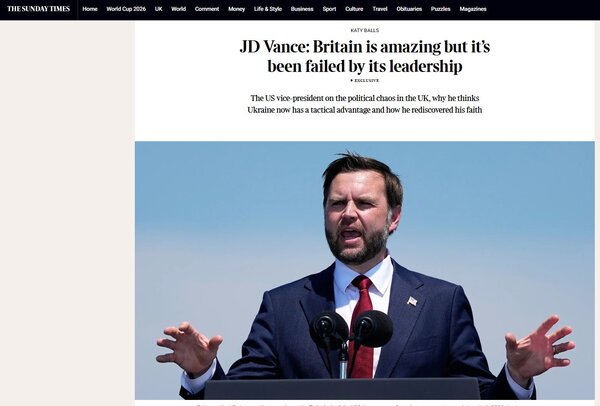
The Sunday Times, the weekend edition of the British newspaper The Times, reported on the 6th that Vice President Vance remarked in an interview, "Britain has had six prime ministers in the last few years," adding, "That tells you that something is fundamentally broken in the political system." He struck a direct chord, stating, "Great Britain is a truly great country, but it has been failed by its political leadership for a long time."
On the surface, this might seem like standard political news about a high turnover of prime ministers. However, the underlying message Vance delivered is far more profound. At what point does a nation begin to decline? His answer was clear: It happens when politics begins to take precedence over the nation itself, long before any external enemy strikes.
[Six Prime Ministers in Six Years: Politics Shifts from Governance to a Mere Power Struggle]
The statistic Vance highlighted—six prime ministers in six years—is not just a trivia point. It serves as a stark symbol that the British political system has lost its long-term national strategy.
According to the Brookings Institution, Prime Minister Theresa May stepped down amid internal Conservative Party strife over Brexit, while Boris Johnson was forced out by a succession of scandals. Liz Truss resigned after just 44 days when her sweeping tax-cut proposals shattered the confidence of financial markets. Rishi Sunak similarly failed to heal the divisions within the Conservative Party. Even the current Prime Minister, Keir Starmer, who took office next, is already facing pressure for an early exit due to internal party friction and plummeting approval ratings.
The primary driver behind these leadership changes was not a failure of national strategy, but rather internal party power struggles. While shifting administrations is a natural feature of democracy, a critical problem arises when national strategy and industrial policy are upended with every change in leadership. Businesses invest with a ten-year horizon, but politics looks only as far as the next election. As this gap widens, a nation begins to lose its long-term competitiveness. This is precisely the path Britain has trodden.
[How Politics Wrecked the Economy: Britain’s Choice of Consumption Over Industry]
Intriguingly, the core focus of Vice President Vance's interview was not politics, but the economy. "You can't build a consumption-led economy, watch your manufacturing disappear, and then act surprised," he diagnosed, asserting that "the failure of politics ultimately dismantled the industrial base." This statement goes beyond a simple call to revive manufacturing; it implies that today’s Britain is the direct result of a political landscape focused on short-term popularity and boosting consumption over long-term national competitiveness.
Indeed, according to the UK's Office for National Statistics (ONS), British GDP contracted again in April, marking a downturn after eight months. Growth in the services sector stalled, while the production sector, which includes manufacturing, essentially flatlined. Manufacturing now accounts for a mere 8% or so of the UK's total gross value added. The nation that spearheaded the world’s first Industrial Revolution has transformed into an economy overwhelmingly reliant on the service sector.
To be sure, a robust service industry is not inherently negative. The issue lies in attempting to sustain growth through consumption alone while the foundation of national competitiveness—manufacturing and technology industries—has withered. Consumption can only be sustained when backed by production; once the production base crumbles, consumption cannot hold out for long.
Rather than addressing this structural flaw, the political establishment clung to short-term, populist policies. The left-leaning Labour government raised the National Insurance Contributions (NIC) for employers to fund welfare spending, but this burden directly eroded corporate investment capacity and led to job cuts. The Office for Budget Responsibility (OBR) projected that the bulk of this tax burden would ultimately hit citizens in the form of lower wages and higher inflation, a reality that has already begun to disrupt productive sectors like manufacturing and hospitality.
The crucial takeaway here is not the tax hike itself, but the lens through which politics views the economy. When politics repeatedly prioritizes immediate fiscal demands and approval ratings over industrial policies designed to foster national competitiveness, businesses defer investment, productivity stagnates, and manufacturing moves overseas. As industry weakens, economic growth slows, triggering a vicious cycle where welfare funds fall short once again. This is exactly the "consumption economy trap" that Vance pointed out.
[The Deeper Crisis: The Unraveling of the Political System Itself]
The crisis does not stop at economic woes. As economic hardships mounted, public disillusionment with the political establishment grew, shaking Britain's traditional two-party system to its core.
The era where the Conservative and Labour parties took turns governing and leading British politics is rapidly drawing to a close. Reform UK, led by Nigel Farage, sent shockwaves through the political landscape during local elections by dismantling the traditional strongholds of both major parties. Recent opinion polls even showed Reform UK overtaking Labour. On the other end of the spectrum, the Green Party is also rapidly gaining ground, further unsettling the established political order.
This phenomenon signifies more than just the emergence of new political parties; it is a clear signal that the public has lost faith in the political system itself. When mainstream politics fails to solve national problems, voters seek out more radical political forces. However, these new factions are highly likely to deepen polarized confrontation. Consequently, governments will change hands even more frequently, and national strategies will become increasingly short-sighted.
Ultimately, politics ceases to be a mechanism for national stability and instead becomes a source of perpetual instability. This is the true meaning behind Vance's assertion that the "political system is broken."
[Changing the Politics Matters Far More Than Who Becomes Prime Minister]
In his interview, Vice President Vance remarked on Andy Burnham, who is being floated as a potential future prime minister: "I don't know Andy Burnham well, but whoever is prime minister, I hope they get the UK back on the right track." It was a principled stance, signaling that because Britain is America's closest ally, the U.S. stands ready to cooperate with whoever leads it.
Yet, this comment carries an even more critical message: the issue is the system, not the individual. Replacing a single prime minister does not transform a nation. If politics remains tethered to partisan self-interest and prioritizes the next election over long-term national strategy, the same systemic failures will inevitably repeat themselves, regardless of who holds the office of prime minister.
Britain has repeatedly changed its prime minister over the past decade, yet its structural issues—stagnant productivity, a declining manufacturing base, and low growth—have remained largely unchanged. Instead, heightened political uncertainty has only prompted businesses to delay long-term investments. There was no shortage of regime changes, but there was a total absence of national strategy. Vance’s warning to Britain targets this exact vulnerability.
[Why Times Insight]
When does a nation fall? History has invariably yielded the same answer. Viewing Vice President Vance’s remarks as mere "criticism of Britain" misses the core message. The question he raised is far more fundamental: "Why do nations decline?"
Many believe that the collapse of a state begins with external shocks, such as wars, foreign invasions, or sudden economic crises. Yet, history repeatedly demonstrates the exact opposite.
The Roman Empire weathered external invasions only until prolonged internal power struggles and political fragmentation left it thoroughly hollowed out. The British Empire possessed the world’s most powerful navy and financial prowess, yet it entered a path of decline when it lost its industrial competitiveness and its politics began prioritizing partisan interests over national ones. It was not an external enemy that brought the nation down; rather, internal politics exhausted the nation’s vitality from within.
When politics serves the nation, democracy becomes its greatest competitive advantage. However, when politics begins to put itself ahead of the nation, the paradigm shifts. Every change of government brings a reversal of policy, long-term industrial strategies vanish, businesses postpone investments, and society becomes obsessed with immediate political wins rather than the future. The inevitable results are declining productivity, weakened industrial competitiveness, and economic stagnation. When the economy falters, public discontent turns back toward the political establishment, driving politics into even more extreme polarization. This is the vicious cycle that dismantles a nation from the inside out.
Vance's critique is by no means unique to Britain. South Korea is far from immune to this very question. The country boasts world-class manufacturing competitiveness and holds leading positions in semiconductors, shipbuilding, defense, nuclear energy, and information and communications technology (ICT). Its human resources and democratic maturity are globally recognized. Nevertheless, if political confrontation begins to override long-term national strategy, and if foreign policy, national security, and industrial strategy become mere fodder for partisan warfare, that vast potential will inevitably be chipped away.
What determines a nation's future is not the transition of political power, but the continuity of its policies. Elections occur every four to five years, but industrial competitiveness must be nurtured with a vision spanning twenty or thirty years. Neither semiconductors, artificial intelligence, energy security, nor demographic challenges can be solved by a single administration in a short term. If crucial national tasks are shaken every time power changes hands, the ultimate casualty is not a specific political party, but the entire nation.
Thus, Vance's warning is not meant for Britain alone. Through the lens of the British Empire's decline, he poses the exact same question to all democratic nations: Does politics exist for the nation, or does the nation exist for politics?
The moment a society loses its answer to this question, no amount of outstanding industry, economic might, or abundant potential can protect it indefinitely. Before a nation crumbles to an external enemy, it declines from its internal politics. That is the heaviest lesson that the British Empire, which once ruled the world, leaves us with today.


-중국 푸단대학교 한국연구원 객좌교수
-전 EDUIN News 대표
-전 OUR NEWS 대표
-제17대 대통령직인수위원회 정책기획팀장
-전 대통령실 홍보기획비서관
-사단법인 한국가정상담연구소 이사장
-저서: 북한급변사태와 한반도통일, 2012 다시우파다, 선거마케팅, 한국의 정치광고, 국회의원 선거매뉴얼 등 50여권