
Update2026.07.24 (금)

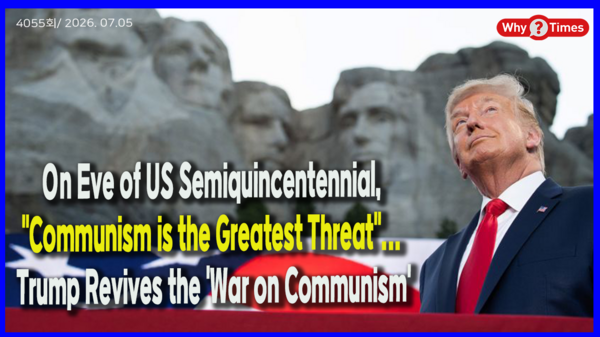
[The 250th Anniversary: Why Did the US Cry Out 'Communism' Once Again?]
On July 3 (local time), the eve of the 250th anniversary of American independence, U.S. President Donald Trump visited Mount Rushmore National Memorial in South Dakota—one of the most symbolic locations for Americans. Set against the backdrop of the granite cliff carved with the faces of four presidents who symbolize the founding and development of the United States—George Washington, Thomas Jefferson, Abraham Lincoln, and Theodore Roosevelt—he unexpectedly fired a direct volley not at China, but at "communism."
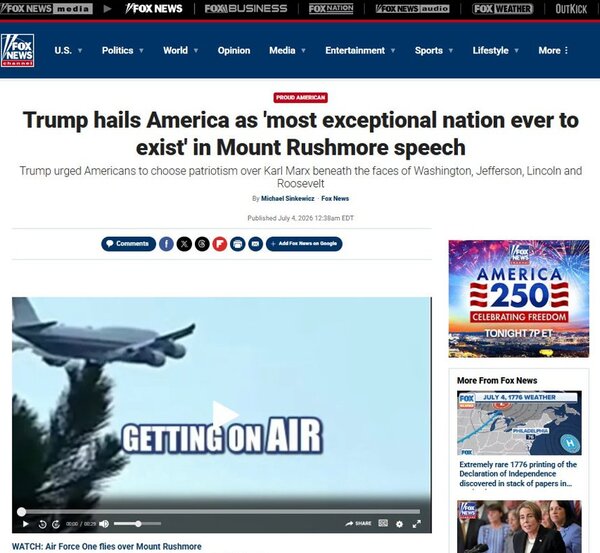
On July 4, Fox News reported that “in a speech lasting approximately 30 minutes, President Trump defined communism as the ‘greatest threat facing America,’ calling it a ‘greater threat to our country than World War I, World War II, Pearl Harbor, or 9/11.’” The network further noted that “President Trump declared, ‘Communism is the enemy of free people everywhere. It is the enemy of the Constitution. Above all, it is the enemy of July 4th, 1776.’”
The rhetoric escalated even further. President Trump defined communism as "the exact opposite of Life, Liberty, and the Pursuit of Happiness—it is death, tyranny and the pursuit of evil," before drawing a hard line: “You can be loyal to Karl Marx, or you can be loyal to America. You can be a communist, or you can be a patriot. You cannot be both.”
On the surface, this reads as a fiery anti-communist speech. However, interpreting this address merely as a "critique of communism" misses the core message. The far more critical elements are why it was delivered on the 250th anniversary, why it took place at Mount Rushmore, and why he specifically used the phrase "the enemy of 1776."
In American politics, "1776" is not just a year. It is the historic date of the Declaration of Independence and a political code symbolizing the very identity of the United States. Within American conservative circles, 1776 is viewed as the genesis of the American founding spirit, encompassing individual liberty, private property, limited government, constitutional order, and a free-market economy. Therefore, stating that "communism is the enemy of 1776" is less about mere rhetoric and more akin to a declaration that America's founding principles and communism are fundamentally incompatible.
Consequently, interpretations arguing that the speech was less about announcing a specific policy and more of a political message aimed at redefining national identity carry significant weight. On the milestone of America's semiquincentennial, Trump effectively delivered his own answer to the question, "What kind of country should America be?"
The venue itself symbolically reinforced this. For American conservatives, Mount Rushmore is not just a tourist attraction; it is closer to a "sacred ground of the founding," bearing the likenesses of presidents who built, expanded, and unified the nation. It is hardly a coincidence that Trump returned here following his 2020 visit. By standing in this iconic American space, he sent a simultaneous message to both domestic and international audiences that he intends to bring America's founding ideology back to the absolute forefront.
[The Real Target: An Internal 'Ideological War' Within the United States]
What makes the speech particularly intriguing is that its primary target was not the Chinese Communist Party, but rather the internal landscape of the United States. International observers actually paid much closer attention to this dynamic.
NBC News analyzed that “while President Trump did not explicitly equate democratic socialists with communism in his speech, he used the occasion to double down on his political messaging criticizing the recent strides made by democratic socialist candidates.” In other words, this anti-communist address was an ideological declaration aimed squarely at domestic friction rather than a pivot in foreign policy.
Indeed, the influence of politicians running on a Democratic Socialism platform has been steadily expanding within the progressive wing of the Democratic Party. In New York, progressive candidates like Claire Valdez and Dariella Rodriguez Avila-Chevalier secured victories in democratic primaries, while Melahat Kiros triumphed in Colorado. Many of these figures are rising as a formidable new force within the progressive camp, backed by endorsements from figures like New York City mayoral contender Zohran Mamdani.
Highlighting this trend, ABC News noted that “the White House had made the nature of this address clear well in advance.” Prior to the speech, White House Press Secretary Karoline Leavitt teased that “President Trump will deliver a speech defending the very ideas that made America the greatest nation in human history,” adding that it would "serve as a fierce rebuke to Communism." Essentially, the address was not a standard Independence Day greeting, but an "ideological manifesto" concerning the foundational values upon which the country should be run moving forward.
President Trump made his political undercurrents even more explicit by referencing the upcoming November midterm elections. ABC News reported that “Trump asserted there is no reason for the Republican Party to lose the midterms ‘unless they do something stupid,’ and claimed that if they abolish the Senate filibuster and pass the so-called 'SAVE America Act,' Republicans 'will not lose an election for the next 100 years.'”
ABC News further highlighted Trump's closing vows: “As we march into our 250th year of American Liberty, we resolve and swear for all to hear that the Citizens of the United States of America will vanquish Communism from our shores... America will never be a communist country!”
The key takeaway here is that Trump framed communism not as an external diplomatic entity to be managed, but as a corrosive political ideology threatening the U.S. from within. While Cold War-era politics focused on fighting an external adversary in the Soviet Union, the battle lines Trump is drawing today are set along the collision of values taking place internally.
For this reason, framing this anti-communist speech as an outright declaration of war against China deviates somewhat from the factual context. The Congressional Research Service (CRS) reports updated this year explicitly clarify that while current U.S. National Security and National Defense Strategies heavily emphasize strategic competition with China, they do not aim for regime change. The policy focus remains anchored on "managed competition" and "maintaining stable relations."
That is not to say this anti-communist rhetoric is entirely disconnected from Beijing. Since his first administration, Trump has consciously separated the Chinese Communist Party (CCP) from the Chinese people, emphasizing that America's competition is with the communist regime rather than the nation itself. While this speech did not explicitly name China, it possesses more than enough leverage to fiercely re-awaken anti-communist vigilance within the American conservative base.
However, this remains a projection of future political trends; it is still premature to assume that this rhetoric will translate into an immediate, hardline shift in Washington's official policy toward China.
[Why Times Insight]
Some observers have rushed to interpret this speech as "Trump declaring a fresh ideological war on China" or signaling that "the New Cold War has begun in earnest." While those dimensions exist, a sober analysis requires recognizing that the immediate target was the domestic leftist ideological shift rather than the CCP itself.
Yet, one must not downplay the significance of the address as merely a piece of domestic political theater. What matters immensely is that Trump used the historical weight of the 250th anniversary to fundamentally re-interrogate the question: What kind of country should America be?
The United States is currently moving past a phase where the Democratic and Republican parties simply compete for administrative power. It is entering a foundational debate over the very national identity and value systems it has maintained for 250 years since its inception. American society is heading into a head-on collision over whether to preserve a nation anchored in free markets, limited government, individual liberty, and constitutional primacy—or whether to transition toward a new value framework that prioritizes expanded government intervention and social equity.
Viewed through this lens, Trump's recurring invocation of "1776" is far from a casual historical citation. In conservative circles, 1776 transcends a calendar date; it is a political code representing the bedrock philosophy of the founding, the spirit of the Constitution, and the birth of constitutional republic and liberty. Declaring that "communism is the enemy of 1776" is an ultimatum that the American founding philosophy and communism can never coexist, signaling a fierce intent to anchor America's national identity back to its foundational baseline.
Choosing Mount Rushmore as the stage operates on the exact same wavelength. George Washington, Thomas Jefferson, Abraham Lincoln, and Theodore Roosevelt represent the birth, expansion, preservation, and development of the United States. By delivering an anti-communist manifesto beneath their monolithic shadows, Trump staged a powerful visual alignment connecting his political trajectory directly to the founding fathers. This was no mere media stunt; it was a rallying signal to his base that "we must return to who we originally were."
Naturally, there is no immediate evidence to suggest this speech will trigger a sudden overhaul of U.S. policy toward China. The Trump administration continues to operate on a highly realist approach—maintaining strategic competition with Beijing while simultaneously engaging in summits and trade negotiations. Extrapolating a sudden "return to maximum hawkishness toward China" from this address would be an overreached assumption.
However, one shift is undeniably clear: the political discourse in Washington, which had been dominated by economic survival, welfare, and sticky inflation, is swinging back toward an overt ideological battleground—"Freedom vs. Communism" and "The Founding Spirit vs. Socialism." This serves as a potent signal that anti-communist discourse, which had faded into the background since the end of the Cold War, is reclaiming center stage in American politics.
Should this momentum widen through the upcoming midterm elections and the next presidential cycle, the domestic political pressure inside the U.S. to squeeze the CCP will inevitably intensify. Furthermore, it will likely exert considerable pressure on the political landscapes of key allies—most notably South Korea—acting as a stern warning against shifting leftward. In short, while the weapon Trump is wielding is aimed at an internal ideological war, the blast radius can expand into foreign policy at any given moment.
Ultimately, the core subject of the Mount Rushmore address was not China, but America itself. Capitalizing on the historic milestone of the U.S. Semiquincentennial, Trump challenged Americans with a vital question: What kind of country will we hand down to our posterity? He then unequivocally declared that the answer lies in reviving the "Spirit of 1776." Whether this speech dissolves into temporary campaign rhetoric or marks the genesis of a massive political current pulling American society back to its founding era will become profoundly clear as the midterms and the presidential race unfold.
-중국 푸단대학교 한국연구원 객좌교수
-전 EDUIN News 대표
-전 OUR NEWS 대표
-제17대 대통령직인수위원회 정책기획팀장
-전 대통령실 홍보기획비서관
-사단법인 한국가정상담연구소 이사장
-저서: 북한급변사태와 한반도통일, 2012 다시우파다, 선거마케팅, 한국의 정치광고, 국회의원 선거매뉴얼 등 50여권