
Update2026.07.24 (금)

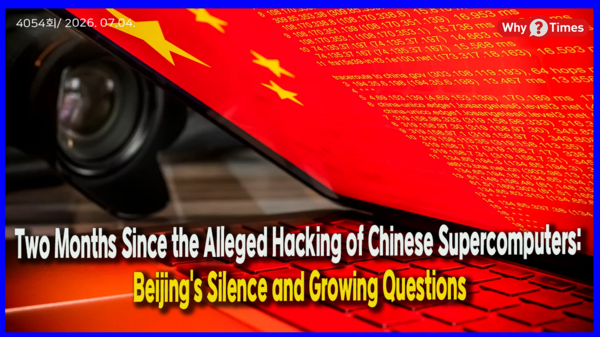
[Two months have passed, yet China remains tight-lipped]
Nearly three months have passed since allegations surfaced that the National Supercomputing Center (NSCC) of China was hacked, resulting in the potential leak of up to 10 petabytes (PB) of core research data. Yet, the Chinese government has still not released any official statement.

In April, our Why Times channel provided an in-depth analysis of the suspected breach involving up to 10 PB of data at the NSCC. At the time, the hacker group "Flaming China" claimed to have secured core strategic technology data spanning military research, aerospace, nuclear fusion, and bioinformatics. The international community quickly took notice, eyeing what could potentially be the largest data breach in Chinese history.
Regarding this, CNN reported, "Samples released by the hackers reportedly include data linked to the Aviation Industry Corporation of China (AVIC), the Commercial Aircraft Corporation of China (COMAC), the National University of Defense Technology (NUDT), and Northwestern Polytechnical University." The report added, "The allegedly leaked files include missile blueprints, explosion simulation videos, and defense equipment renderings, with some documents bearing the Chinese marking for 'Confidential' (机密)."
So, two months later, what new details have emerged? Surprisingly, the answer is simple: almost none. The Chinese government has yet to release any official investigation results. Silence has prevailed ever since CNN reported immediately after the incident that it received no official response from inquiries sent to the relevant institutions.
However, this very silence is drawing even greater interest from the international security community. Typically, when a massive security breach occurs at a core national research facility, governments will at least announce the launch of an investigation or security reinforcement measures, even if they attempt to downplay the extent of the damage. In this case, however, virtually no such movement has been detected externally.
What is fascinating is that over the past two months, what has truly come to light is not new "facts," but new "meanings." When the incident was first reported, the world was stunned by the figure of 10 PB. Now, international security experts are focusing not on the volume of data, but on the venue itself—the National Supercomputing Center.
[Why National Supercomputers Have Caught the Attention of Global Intelligence Agencies]
The National Supercomputing Center (NSCC) is fundamentally different from a standard data center. It serves as a vital national research infrastructure where universities, national research institutes, state-owned enterprises, and defense contractors across China collectively utilize ultra-high-performance computing resources. Most of the cutting-edge research in sectors China actively fosters as strategic industries—such as aerospace, AI, semiconductors, nuclear fusion, and biotechnology—is known to leverage the computing power of these centers.
CNN also noted at the time that "the National Supercomputing Center in Tianjin is one of China’s largest supercomputing hubs, providing computing resources to over 6,000 institutions." For this reason, this incident carries implications on an entirely different level compared to a breach at a private corporation.
Security experts who reviewed some of the leaked samples offered a cautious assessment, stating they are "data that would not be out of place if generated by a national supercomputing center." Of course, this does not verify the authenticity of the entire dataset. It does mean, however, that the international security community views this incident as a matter well worth continuous analysis.
This is precisely the point Why Times is focusing on. While many people are preoccupied with the question, "How much data was leaked?" international security experts are asking a different question:
"What does that data reveal about China?"
For instance, far more important than a single document on hypersonic missile research is identifying which institution conducted that research, which universities collaborated on it, which state-owned enterprises participated, and how it connects to other technological fields.
What they are looking for is not a single blueprint, but the system that produces that blueprint. Consequently, two months later, the focus of the international security community has shifted from the scale of the leak to China's R&D framework and research ecosystem.
[What China Lost Was Not Just Data, But Trust]
Much remains unverified about this incident. Exactly how much data was exfiltrated, how much more data the hackers have withheld, and how much of their claims are true have still not been independently verified.
However, one shift has become undeniably clear over the past two months: the international community's trust in China’s core national research infrastructure has begun to falter. Despite US semiconductor sanctions, China has consistently emphasized technological self-reliance, asserting that its "AI and supercomputer technologies continue to advance." The NSCC was one of the premier symbols of China's rise in technology.
Yet, separate from the actual scale of damage, this incident has cast a shadow of doubt over the security systems of the very research infrastructure China prided itself on most. This is why the international security community is paying such close attention. In a security breach, what matters is not just whether a hack occurred; how a nation responds in the aftermath is also a critical metric of evaluation.
China has still not disclosed any official investigation results. It has offered no external explanations regarding how it has reinforced its security framework, whether internal audits have concluded, or to what extent potential leaks have been confirmed.
Granted, no country can fully disclose matters directly tied to national security. However, the longer the silence drags on, the more questions the international community will harbor regarding China's advanced research infrastructure. This may well be the heaviest burden the incident leaves behind for Beijing.
[Washington's Focus Is Not the Data, But the R&D System]
This incident aligns closely with the strategy the United States has pursued in recent years to contain China's advanced technology. The US has continuously tightened export controls on AI chips, advanced GPUs, Electronic Design Automation (EDA) software, and supercomputer technology. The ostensible reason is to curb the development of advanced weaponry by the Chinese military.
A closer look, however, reveals that what the US is targeting is not just a specific product, but China's entire R&D system. AI chips are more than just semiconductors. Most cutting-edge research—from hypersonic missiles and next-generation fighter jets to nuclear fusion and quantum technology—requires massive computational power.
Ultimately, supercomputers serve as the core foundational infrastructure of modern scientific and technological competition. Therefore, understanding what research is being conducted at the NSCC and which institutions are interconnected holds profound significance in the long-term struggle for technological hegemony.
To be sure, one cannot definitively conclude that a specific nation has acquired or is currently analyzing the actual data from this incident. Yet, one fact remains clear: over the past two months, the interest of the international security community has shifted from "how much was leaked" to "what it reveals." And this is the most significant shift the incident has generated.
[Intelligence Warfare in the AI Era: A New Competition Has Begun]
A final conclusion regarding this incident has not yet been reached. The Chinese government has not released an official investigation, and the scale of the leak claimed by the hackers remains fully unverified.
Nonetheless, this incident has demonstrated one critical reality: intelligence warfare in the AI era is no longer a race to secure a few classified documents. Instead, the competitive edge now lies in how quickly an adversary can analyze vast amounts of data to map out and comprehend a nation's R&D architecture and technological ecosystem. Thus, this incident is being recognized as a symbolic event that transcends a mere hacking allegation, signaling where the US-China tech rivalry is headed.
[Why Times Insight]
Over the last two months, there have been few new revelations. However, those two months were more than enough time to reshape the meaning of this event. What initially began as "allegations of the largest hack in Chinese history" has now expanded into a broader debate on how to protect national R&D systems and technological security.
Intelligence warfare during the Cold War was a competition to capture classified paper documents. In contrast, intelligence warfare in the AI era has evolved into a race to decode an adversary's R&D system as swiftly as possible.
The controversy surrounding the hacking of China's National Supercomputing Center is far from over. Yet, the greatest lesson it leaves behind is already clear: the future battle for technological hegemony will likely be decided not by how many semiconductors a nation possesses, but by how securely it protects its own research ecosystem and how quickly it can decipher the technological framework of its competitors.

-중국 푸단대학교 한국연구원 객좌교수
-전 EDUIN News 대표
-전 OUR NEWS 대표
-제17대 대통령직인수위원회 정책기획팀장
-전 대통령실 홍보기획비서관
-사단법인 한국가정상담연구소 이사장
-저서: 북한급변사태와 한반도통일, 2012 다시우파다, 선거마케팅, 한국의 정치광고, 국회의원 선거매뉴얼 등 50여권