
Update2026.07.24 (금)

[Negotiation Envoys Placed in the Crosshairs: U.S. and Israel—'Same Alliance, Different Wars']
Eliminating an enemy's military command structure is a common wartime strategy. However, the calculus shifts entirely when negotiation envoys become targets while diplomatic talks are actively underway. Such an action transcends a mere military operation; it becomes a political strike designed to dismantle the peace process itself.
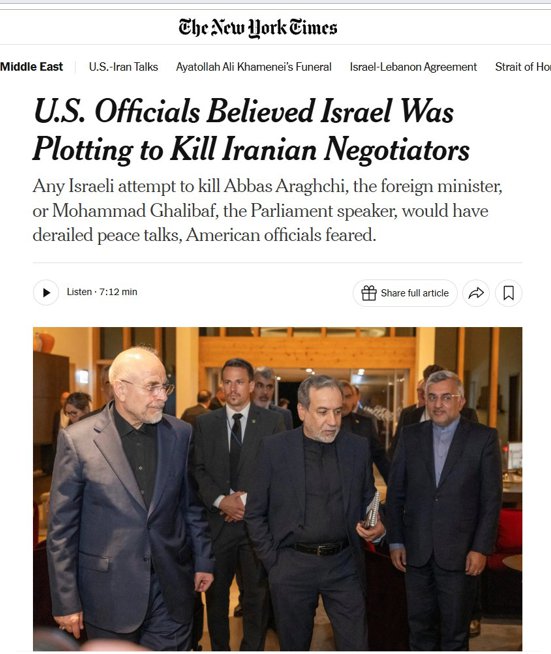
Recent revelations by The New York Times (NYT) regarding assassination threats against core Iranian negotiators underscore this ruthless reality of international politics. What demands closer attention, however, is that the United States viewed this as a severe crisis and utilized intermediaries—including Pakistan and Qatar—to relay the danger to Iran. This serves as a critical clue that the U.S. and Israel, despite being staunch allies, harbored fundamentally divergent strategies regarding the manner and timing of ending the war.
On July 3, The New York Times, citing multiple former and current U.S. officials, reported: “A serious security threat emerged as Mohammad Bagher Ghalibaf, the Speaker of the Iranian Parliament, and Foreign Minister Abbas Araghchi were returning to Iran after concluding meetings with the U.S. delegation.” The report further detailed that “at the time, Iranian intelligence intercepted information indicating that two Israeli fighter jets were approaching from the direction of Iraq with the potential intent to attack the delegation's aircraft. Consequently, the plane was unable to proceed to its destination of Tehran and instead made an emergency landing in the northeastern city of Mashhad, from which the delegation traveled overland.”
The NYT added that “the U.S. took this risk with utmost seriousness at the time and ensured that warnings were conveyed to Iran through regional allies and intermediaries in the Middle East.” Prior to this, Reuters had also published a report citing an anonymous Pakistani official, stating that “the U.S. requested restraint from Israel to ensure the continuation of the negotiations.”
[If Negotiators Become Targets, the Negotiations Themselves Vanish]
The most critical takeaway from this report is not whether an actual strike materialized, but why diplomatic envoys became potential targets. Striking military infrastructure or frontline commanders during wartime falls under conventional military logic. Envoys tasked with diplomacy, however, belong to an entirely different dimension.
Negotiations are driven by individuals, not just institutions. If negotiators who have painstakingly built a baseline of mutual trust are eliminated, it can take months just to seat successors—a window during which military tensions are highly likely to spiral out of control once again.
This was precisely the overriding concern for Washington. The NYT noted that “U.S. officials assessed that any attack on the negotiators could completely derail the ceasefire discussions and trigger a resumption of hostilities.” In other words, the U.S. was not acting to protect the individual Iranian officials, but rather to safeguard the diplomatic channel itself.
Historical precedents of international conflict demonstrate that when key negotiating figures are removed mid-process, disputes almost invariably become protracted. For the U.S., the ultimate nightmare scenario was seeing hard-won dialogue collapse back into open armed conflict.
[The U.S. and Israel: Allied by Treaty, Divided by War Aims]
This disclosure also illuminates the strategic chasm between the U.S. and Israel. While both nations align on the necessity of deterring Iran’s military threats, analyses suggest they differed sharply on how and when to conclude the war.
The U.S. has traditionally leaned toward using military pressure as leverage to maximize negotiating power. Washington's core priorities centered on managing the nuclear issue, de-escalating regional friction, and securing the stability of the Strait of Hormuz. Prolonged military tension in the Middle East directly translates into higher global oil prices, economic volatility, and an increased burden on the U.S. military.
Conversely, Israel has consistently prioritized the direct and absolute elimination of security threats. Tel Aviv has long voiced concerns that allowing negotiations to proceed before Iran’s military capabilities and regional proxy networks are thoroughly degraded leaves a far more dangerous threat looming in the long run.
The NYT corroborated this by reporting that “there was an assessment within Israel that subsequent agreements between the U.S. and Iran failed to sufficiently satisfy Israel's security objectives.” This vividly illustrates that even within the framework of a shared alliance, the two nations were running entirely different calculations for their wartime exit strategies.
[Why Is This Intelligence Surfacing Now?]
The timing of this report—surfacing only after negotiations reached a specific benchmark stage—is also highly telling. In diplomacy, clandestine contacts or critical crises that occurred during the fog of negotiation are frequently declassified after the fact. Rather than a mere historical retrospective, this disclosure likely serves as a calculated message aimed at influencing the current diplomatic landscape.
For the U.S., airing this information underscores the diplomatic capital it spent to keep the talks alive, thereby highlighting its foreign policy achievements. Simultaneously, by revealing that highly volatile disruptors genuinely existed, Washington strengthens the justification for maintaining open channels of communication moving forward.
On the flip side, it cannot be ruled out that Israel remains disgruntled, feeling its core security apprehensions were sidelined. This subtle divergence in perspective will likely persist as a volatile variable in Middle Eastern diplomacy.
[The Battle Beyond the Negotiating Table Will Intenisify]
Moving forward, the diplomatic process is highly unlikely to conclude with a few signatures on a piece of paper. Highly sensitive friction points remain unresolved, including the enforcement of the ceasefire, mutual verification protocols, the lifting of sanctions, and the containment of regional militant groups.
More importantly, the geopolitical landscape is currently split between factions pushing for a diplomatic resolution and those frustrated by the pace and terms of the talks. Consequently, the future trajectory of the Middle East will likely be shaped less by formal communiqués issued from summit halls, and far more by under-the-radar maneuvering and shifts in state-level strategies surrounding the talks.
[Why Times Insight]
The core message of the NYT report does not lie in the sensationalism of an "assassination plot." The true significance is that the moment negotiations commenced, the nature of the war fundamentally pivoted from a kinetic military conflict to a high-stakes diplomatic chess match.
The U.S. determined that shielding the negotiators was the most pragmatic path to ending the war, actively moving to prevent the collapse of diplomatic channels. In contrast, Israel maintained its stance that absolute military pressure must be sustained to achieve definitive security objectives. This case study perfectly illustrates how even the closest allies can diverge in execution when national interests and strategic priorities drift apart.
Ultimately, the future of the Middle East cannot be gauged simply by whether the gunfire has ceased. The real determinant of the new regional order will be how the forces scrambling to preserve the negotiating table clash with the diverse interests seeking to upend it. This remains the most vital signal embedded in the disclosure.

-중국 푸단대학교 한국연구원 객좌교수
-전 EDUIN News 대표
-전 OUR NEWS 대표
-제17대 대통령직인수위원회 정책기획팀장
-전 대통령실 홍보기획비서관
-사단법인 한국가정상담연구소 이사장
-저서: 북한급변사태와 한반도통일, 2012 다시우파다, 선거마케팅, 한국의 정치광고, 국회의원 선거매뉴얼 등 50여권