
Update2026.07.24 (금)


[The EU Begins to View China as an 'Economic Security Risk' Rather Than a 'Trading Partner']
Brussels has finally laid out an "October" timetable. This is the deadline set by the European Union (EU) for China to address their trade imbalance. Crucially, this was not mere rhetoric. Just three days after negotiations concluded, the EU swung into action by implementing new customs duties on ultra-low-cost e-commerce goods direct from China.
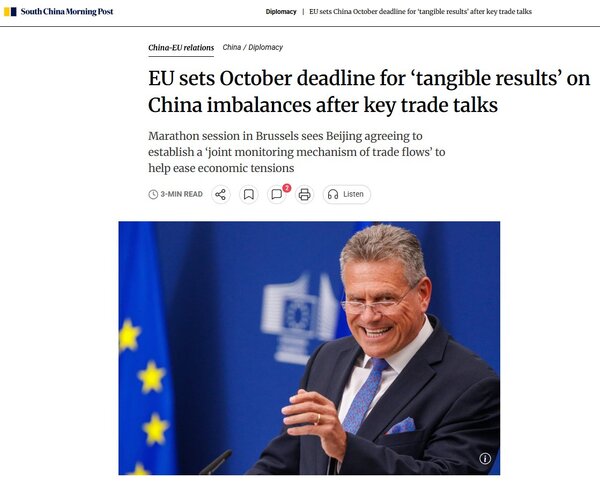
This symbolic move signals a new phase in European policy, shifting from a dialogue-first approach to a dual-track strategy of simultaneous negotiation and pressure. The latest measure extends far beyond a simple trade friction. It carries much deeper significance, marking a fundamental shift for Europe: after long viewing China as a massive market and vital production hub, the bloc now regards it as a "strategic risk" capable of threatening its supply chains and industrial security.
On June 30, the Hong Kong-based South China Morning Post (SCMP) reported, "Following an all-day negotiation in Brussels on June 29 between EU Trade Commissioner Maroš Šefčovič and Chinese Commerce Minister Wang Wentao, the two sides adopted a joint statement for the first time since 2019." The report added, "Both parties agreed to establish four new working groups to discuss trade and investment, export controls, intellectual property rights, and WTO reform."
On the surface, this appears to be a standard, successful negotiation. However, the true core of this meeting lay not in the joint statement, but in the fact that the EU presented China with a clear, definitive timeline: bring substantive results by October.
During the negotiations, Commissioner Šefčovič told reporters, "Not all problems will be solved, and not everything will be fixed," but emphasized that "from now until October is sufficient time to produce tangible results." Though couched in diplomatic phrasing, it was effectively a final warning.
The choice of "October" as the deadline merits closer scrutiny. This timeframe is rooted in a reality where the prevailing sentiment among EU member states has completely shifted. Šefčovič explained, "Ten days ago, leaders of the 27 EU member states discussed trade policy toward China exclusively for the first time in three years," adding, "What member states demanded was no longer principled dialogue, but swift and visible results."
This underscores a fundamental paradigm shift within Brussels. In the past, Europe sought to maintain economic cooperation while minimizing conflict with Beijing. Recently, however, as China's overcapacity and subsidy policies threaten European manufacturing—and as Beijing increasingly leverages its supply of rare earths and critical raw materials as diplomatic leverage—Europe has begun to view China not merely as a trading partner, but as an economic security variable.
Indeed, António Costa, President of the European Council, openly criticized Beijing, stating, "We can no longer tolerate a trade deficit that reaches 1 billion euros a day," and noting that "China has failed to show any substantive results so far."
Data confirms that Europe's frustration is far from mere political rhetoric. Last year, the EU's goods trade deficit with China hit a record high of approximately €360 billion. More symbolically, for the first time in history, all 27 EU member states registered a deficit in goods trade with China. From Europe's perspective, this is no longer seen as an isolated issue for specific nations, but as a structural challenge facing the entire European economy.
Furthermore, Brussels views the structure of this deficit as far more alarming than its sheer volume. Because a significant portion of the supply chains required for strategic industries—such as semiconductor raw materials, rare earths, and core battery components—is concentrated in China, European leadership assesses that Beijing can utilize this dependence as a bargaining chip at any moment. China has already demonstrated multiple times that it can weaponize supply chains as strategic assets through its export controls on rare earths.
Consequently, one of the most eye-catching agreements in this negotiation was the "Joint Trade Flow Monitoring Mechanism." Under this new system, both sides will share identical trade data; if imports of specific items enter a pre-determined risk threshold—the so-called "Red Zone"—political consultations will trigger immediately. This serves as an early-warning mechanism designed to defuse disputes before they escalate, rather than acting as a simple tool for statistical sharing.
More importantly, China accepted the implementation of this framework. Historically, Beijing has dismissed Western concerns over overcapacity or trade imbalances as politically motivated attacks. This time, however, it has agreed to a framework to co-manage the issue. Whether this will translate into a genuine shift in China's stance remains to be seen.
Indicating the friction below the surface, Yuyuantantian, a social media account affiliated with Chinese state media, warned ahead of the talks: "China can withstand and does not fear a situation where economic and trade relations deteriorate further." A fierce battle of nerves had already begun outside the negotiating room.
[The EU Moves to Action in Just Three Days… First Target: Ultra-Low-Cost Direct Imports from China]
Proof that the "October deadline" issued by Brussels was no diplomatic bluff came immediately after the talks. On July 1, just three days after negotiations wrapped up, the EU played its first pressure card by implementing new customs duties targeting ultra-low-cost e-commerce shipments originating from China. While pledging to maintain dialogue during negotiations, the EU executed policy immediately on the ground. This reflects a shift in its future strategy toward China: engage in dialogue, but do not delay action.
Reporting on the measure, Reuters noted, "Starting July 1, the EU began imposing a provisional customs duty of €3 per item category on e-commerce goods valued below €150." The agency added, "Low-cost parcels from China, which previously reached European consumers mostly duty-free via direct shipping, now face an effective new financial burden for the first time." While institutionally classified as a temporary measure, its market implications are substantial.
The EU's objective is not to generate tax revenue; the true target is the business model of Chinese platforms. Companies like Shein, Temu, and AliExpress have maintained their price competitiveness by shipping products directly from Chinese factories to consumers. Once the new duties take effect, that edge will inevitably erode. In an ultra-low-cost market where consumer choices pivot on minor price fluctuations, even a small cost increase imposes a significant burden.
In recent years, Europe has increasingly concluded that cheap direct imports from China are disrupting its domestic market order. The European Commission pointed out, "Last year, the number of low-cost parcels under €150 entering Europe reached approximately 5.8 billion." It noted that "this represents a more than fourfold surge in just two years compared to 1.4 billion in 2022, translating to nearly 16 million parcels passing through European customs daily."
The European Commission further criticized the trend, stating, "This surge in volume has not only paralyzed customs operations but has consistently drawn criticism for creating an environment where small and medium-sized European retailers find it difficult to survive the price competition."
Dirk Hoetink, an MEP who has spearheaded customs reform in the European Parliament, criticized the previous framework: "The duty exemption system was exploited on an industrial scale, resulting in Chinese platforms gaining an unfair advantage over European companies." His remarks signal that this measure is less about tax adjustment and more about an attempt to rewrite the rules of market competition itself.
[Why October Matters: Three Clocks Are Ticking Simultaneously]
This context explains why Brussels designated October as its negotiating deadline. October is not just a random date on the calendar; it represents a strategic nexus where three crucial timelines concerning China converge.
First: Rare Earths
While China expanded its export controls on rare earths last year, it deferred certain measures until November of this year under a U.S.-China agreement. By setting the negotiation deadline for October, the EU intends to verify China's stance just before this exemption expires. If Beijing attempts to weaponize rare earths as leverage once more, the EU is highly likely to respond with stronger countermeasures.
Second: U.S.-China Relations
Chinese President Xi Jinping’s scheduled visit to the United States this coming September is viewed as a critical watershed that will determine the trajectory of U.S.-China relations. Should relations between Washington and Beijing chill further, the EU will likely harden its stance toward China. Conversely, if a degree of rapprochement is achieved, Brussels will gain more room to maneuver in its negotiations.
Third: The EU's Internal Political Calendar
October marks the evaluation period for reviewing the EU's trade policy toward China for the second half of the year. In short, if Beijing fails to demonstrate concrete changes by then, Brussels will secure the political mandate necessary to officially consider additional sanctions and market access restrictions.
[Why Times Insight: This Battle Is About Economic Security, Not Trade]
Viewing the recent Brussels negotiations purely as a trade dispute misses the core issue. The true transformation lies in how the EU perceives China.
Only a few years ago, Europe viewed China as a vast market requiring cooperation, believing that disputes could be resolved through dialogue. Today, however, Brussels approaches China’s overcapacity, supply chain dominance, rare earth controls, and ultra-low-cost platform expansion collectively as a single economic security threat. The primary goal is no longer merely narrowing the trade deficit; it is reducing dependence on China and restoring the autonomy of European industry.
In this regard, the EU's strategy is increasingly aligning with the "de-risking" policy pursued by the United States. While it does not amount to total decoupling, the direction—extricating strategic industries and critical supply chains from Chinese influence—is virtually identical. The recent e-commerce import duties represent only the starting point of this shift. Follow-up measures, including government procurement restrictions, regulations on Chinese solar panels and telecommunications equipment, and the diversification of critical raw material supply chains, are highly likely to follow.
Ultimately, October is more than just a negotiating deadline. It is poised to be the first true litmus test determining whether China can maintain its traditional approach to the European market, or whether Europe will formally join the United States on the "economic security front." The clock set by Brussels has already begun to tick, and it is China that must now watch the time.

-중국 푸단대학교 한국연구원 객좌교수
-전 EDUIN News 대표
-전 OUR NEWS 대표
-제17대 대통령직인수위원회 정책기획팀장
-전 대통령실 홍보기획비서관
-사단법인 한국가정상담연구소 이사장
-저서: 북한급변사태와 한반도통일, 2012 다시우파다, 선거마케팅, 한국의 정치광고, 국회의원 선거매뉴얼 등 50여권