
Update2026.07.24 (금)

[The Moscow Rear is No Longer a Safe Zone]
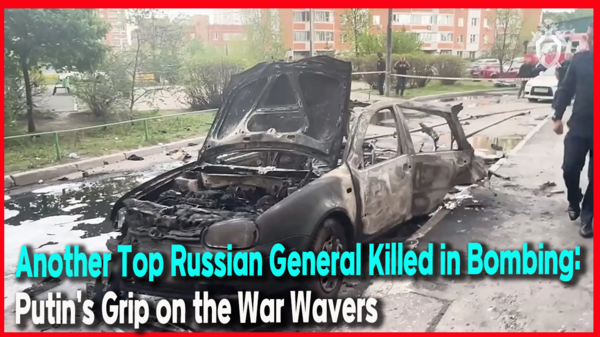
A key figure anchoring the Russian military’s war effort was killed by a car bomb near Moscow. This is no ordinary assassination of a general. The shock reverberating through the Kremlin is substantial, as it exposes a harsh reality: Russia, already struggling on the Ukrainian front lines, can no longer protect its highest-ranking military commanders even deep within its capital's rear. Furthermore, the fact that similar assassinations are recurring in the exact same region raises fundamental questions about Russia's security apparatus and state control.
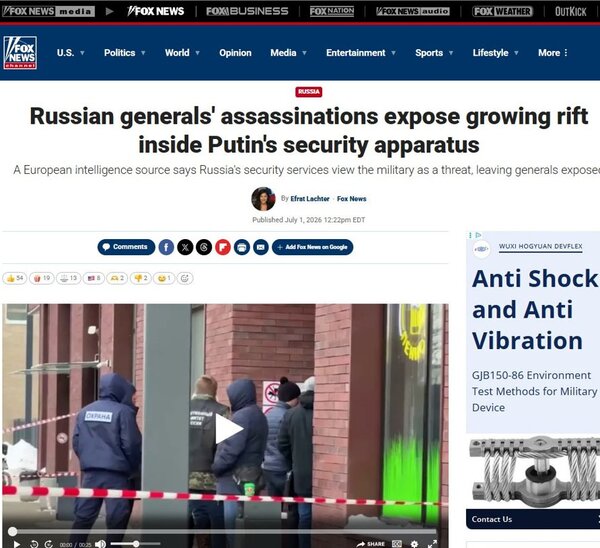
On July 1 (local time), Fox News reported that "on the morning of June 9, Damir Davydov (Дамир Давыдов), head of the Main Missile and Artillery Directorate (GRAU) under the Russian Ministry of Defense, was killed when an explosive device planted under his BMW X3 detonated in a parking lot in Balashikha, an eastern suburb of Moscow."
The GRAU is a critical organization that oversees the procurement and supply of missiles and artillery ammunition for the Russian military. In the prolonged war in Ukraine, it essentially serves as the "blood vessel" maintaining the frontline's firepower. Davydov was not merely an administrative director but a vital figure managing the supply chains for Russia's missiles and artillery shells.
Fox News notably highlighted that “the blast site was a mere 400 meters away from where Lieutenant General Yaroslav Moskalik was killed in a car bombing last year.” The Russian daily Kommersant, citing investigative sources, also reported that "an explosive device equivalent to approximately 500 grams of TNT, planted underneath the vehicle, detonated."
What makes this incident draw even more attention is its location rather than the assassination itself. The repetition of attacks using the same method in the metropolitan area, not far from the Kremlin, demonstrates that the rear—which Russia believed to be the safest—is no longer a safe zone. While casualties on the front lines can be anticipated to some extent, the reality of the military leadership being repeatedly exposed in the capital area is highly likely to place a significant burden not only on Russia's war-fighting capabilities but also on its state control system.
[Repeated Assassinations of Generals Target the Russian Chain of Command]
The Balashikha explosion is no isolated incident. Over the past two years, assassinations and precision strikes targeting the top brass of the Russian military have formed a distinct pattern. Analysts suggest this reflects a strategic calculus: disrupting the chain of command yields a far greater impact than merely wearing down troops on the front lines.
Mediazona, an independent investigative media outlet, reported that “at least 15 Russian generals have been confirmed killed in action since the full-scale war began in February 2022,” adding that "this figure includes not only those who perished on the front lines but also high-ranking generals assassinated via bombs and shootings in Moscow and the capital region."
Lieutenant General Igor Kirillov (Commander of the Russian Nuclear, Biological, and Chemical Protection Troops): Killed in late 2024 by an explosive device planted on a scooter.
Lieutenant General Yaroslav Moskalik (Main Operational Directorate of the General Staff): Killed in 2025 by a car bomb attack.
Director Damir Davydov (GRAU): The latest casualty, losing his life in the same area of Balashikha.
Although the locations and methods varied, they share one common denominator: key figures in the Russian military's chain of command are not guaranteed safety, even in the capital region.
The situation on the front lines is not much different. Mediazona noted that "Lieutenant General Oleg Tsokov, deputy commander of the Southern Military District, was killed in a Storm Shadow missile strike, and a strike on the headquarters of the 155th Naval Infantry Brigade killed several high-ranking officers at once, including Vice Admiral Mikhail Gudkov." This demonstrates that Ukraine is evolving its strategy beyond simply targeting personnel or hardware toward continuously pressuring Russia's command network and decision-making system.
Indeed, many analysts evaluate that the focus of the current war is shifting from a "war of attrition" to a "war of command paralysis." As long-range drones and precision strike capabilities advance, rear command centers and supply networks are emerging as far more critical targets than frontline trenches. The underlying calculation is that eliminating a single general can induce greater chaos than destroying thousands of artillery shells.
This trend was also observed two months ago during the attack on Lieutenant General Vladimir Alekseyev, deputy head of the Russian Main Intelligence Directorate (GRU). ABC News reported that "Alekseyev was seriously injured after being shot by an unidentified assailant near his Moscow home last February, and Russian authorities subsequently arrested the suspect abroad." CNN also introduced him as "a figure who played a key role in defending the Kremlin during the Wagner Group rebellion," pointing out that "both the shooting incident and the recent Balashikha explosion exposed the exact same vulnerability: 'near the home in Moscow.'"
Ultimately, this explosion is not an incident that ends with the sacrifice of a single general. Its significance is substantial in that it reaffirms the reality that the Russian military leadership is under continuous pressure not only on the front lines but also in the rear, and that even Moscow is no longer an absolute safe zone.
[A Country Where the FSB Outweighs the Military: Putin’s Weakening Control]
Some analyses suggest that the repeated targeting of high-ranking generals cannot be explained solely by the success of Ukrainian operations. Fox News, citing European intelligence sources, reported that “the successive killings of generals once again expose the long-standing friction between the Russian military and the Federal Security Service (FSB).”
Fox News stated, "The Russian military wants the FSB to handle the personal protection of generals, but the FSB does not view this as its role," adding that "the mutual distrust between the two sides is a structural issue carried over since the Soviet era." It noted that "consequently, the security of generals is handled by the protective agency under the Presidential Administration, but the gap between the military and intelligence agencies shows no signs of narrowing."
Russian opposition politician Maksim Katz offered a similar diagnosis. In an interview with Fox News, he said, “The most powerful power institution in Russia is not the military, but the FSB, and President Putin himself hails from that organization,” adding, "Even if the war continues, the military's political influence will not grow."
In fact, since Putin took power, the center of authority in Russia has been concentrated in security apparatuses such as the Presidential Administration and the FSB, rather than the Ministry of Defense. While the military wages the war, power is managed by the intelligence agencies. Under this system, no matter how many military exploits generals achieve, it is difficult for them to secure an independent political base; conversely, they have no choice but to be constantly monitored and checked by the security apparatus.
Katz remarked, "What Russian generals fear more than the Ukrainian military might be the FSB." This is because "while Ukraine targets specific generals, the FSB can investigate the military leadership or turn them into targets for purges at any time." Although this statement carries a political interpretation, it is evaluated as reflecting the reality that the military struggles to grow into an independent faction within the Russian power structure.
Such internal tension is highly likely to become a heavier burden as the war drags on. A European intelligence source stated, "Putin is also concerned that the repeated losses of high-ranking generals could demoralize the military." With the upcoming general election in September adding to the burden surrounding the stability of the regime, the Kremlin finds itself in a position where it must manage both the front lines and internal cohesion simultaneously.
Of course, the mastermind behind the Balashikha explosion has not yet been confirmed. Russian investigative authorities are conducting an inquiry, and Ukraine has not released an official stance. Therefore, caution is required before drawing conclusions about who is behind the incident.
However, one thing is certain: the repeated targeting of high-ranking generals in Moscow demonstrates that the Russian rear is no longer an absolute safe zone. And that insecurity is drawing more attention because it is intertwined not just with external attacks, but with the structural distrust that has long accumulated between the military and intelligence agencies. Ultimately, the biggest message delivered by this incident is not the death of a single general. What Putin is currently striving to protect may not be the generals, but the very control of the state that has sustained the war.
[Why Times Insight]
The repeated targeting of the Russian military's highest-ranking generals is not a simple security failure. In modern warfare, strategies that disrupt the chain of command and supply networks ahead of troop elements increasingly dictate the course of the conflict, and this incident needs to be viewed in that context.
At the same time, the long-standing tension between the military and intelligence agencies is emerging as another burden the Putin regime must bear amid a prolonged war. Ultimately, what Russia must defend is not just its territory, but the control of its state system.


-중국 푸단대학교 한국연구원 객좌교수
-전 EDUIN News 대표
-전 OUR NEWS 대표
-제17대 대통령직인수위원회 정책기획팀장
-전 대통령실 홍보기획비서관
-사단법인 한국가정상담연구소 이사장
-저서: 북한급변사태와 한반도통일, 2012 다시우파다, 선거마케팅, 한국의 정치광고, 국회의원 선거매뉴얼 등 50여권