
Update2026.10.24 (토)


[Ukraine's New Strategy: Targeting the Rear Rather Than the Frontlines]
Ukraine is shifting the center of gravity in the war. Rather than launching frontal offensives to reclaim territory, Kyiv appears to be focusing on a strategy to weaken Russia’s overall capacity to wage war by precision-striking its military, communications, and energy infrastructure. In fact, Russia's largest gas chemical complex, located more than 1,200 kilometers away from the frontline, was attacked, while core satellite communication facilities and drone control hubs were also hit in succession. With assessments emerging that Russian troop casualties continue to accumulate on the frontlines, analysis within NATO suggests that this sustained pressure could ultimately impact President Vladimir Putin’s political standing.
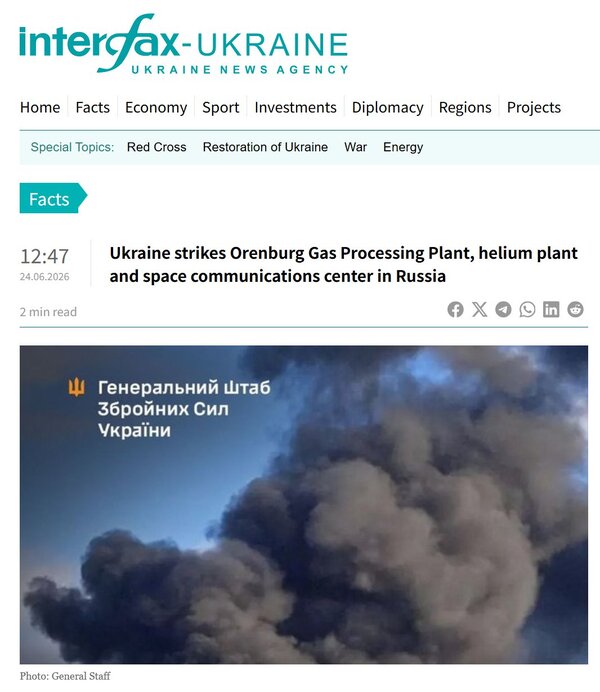
On the 25th, Interfax-Ukraine, a local Ukrainian news agency, drew significant attention by reporting, "The General Staff of the Armed Forces of Ukraine announced on the 24th (local time) that the 'Deep Strike' unit under its Special Operations Forces (SOF) struck a gas chemical complex in Orenburg, southwestern Russia." The report noted, "In a statement released via Telegram, the General Staff explained that the Orenburg gas processing plant and Russia’s sole helium plant form a single massive complex. Orenburg Oblast, where this complex is located, is situated in the southern Urals bordering Kazakhstan, more than 1,200 kilometers away in a straight line from the frontline."
Interfax-Ukraine continued, "According to the General Staff, the targeted facility is a massive complex that includes the Orenburg gas processing plant and Russia’s only helium factory," pointing out that "Orenburg Oblast, where this facility is located, is in the southern Ural Mountains bordering Kazakhstan, over 1,200 kilometers in a direct line from the Ukrainian frontline."
[Why Russia’s Largest Gas Processing Facility Was Targeted]
Ukraine targeted this facility because it is not a mere energy production site, but a strategic hub deeply intertwined with the Russian military industry. Interfax-Ukraine explained, "The Orenburg gas processing plant produces refined natural gas and sulfur, with sulfur being a core raw material used in manufacturing explosives and gunpowder." It further noted, "The helium factory utilizes refined gas to produce helium, which is used in rocket propulsion systems and guidance equipment, as well as ethane, a necessity for the military industry."
The scale of the facility is also substantial. Interfax-Ukraine stated, "This plant is one of the largest facilities in Russia, capable of processing up to 45 billion cubic meters of gas annually," adding, "It is evaluated as a core asset responsible for approximately 60% of the total gas volume processed by Gazprom Pererabotka, a subsidiary of Gazprom."
Interfax-Ukraine also pointed out, "Its helium production volume is the highest in Russia," noting that "The Orenburg helium plant produces 8.8 million cubic meters of helium annually, playing a critical role in the aerospace, precision industry, and military sectors."
The Kyiv Post reported, "This is not the first attack," adding that "the facility was previously attacked in 2025, which caused a fire, and Gazprom reported disruptions in gas supply at the time." This demonstrates that Ukraine is employing a strategy of inflicting sustained, cumulative damage on Russia's rear logistics network, rather than relying on one-off strikes.
[Simultaneous Strikes on Satellite Communication Networks and Drone Hubs]
A distinct feature of this operation is that it did not target a single objective, but simultaneously aimed at Russia's rear infrastructure. The Associated Press (AP) reported, "Ukraine also attacked the Dubna Space Communications Center near Moscow and satellite communication facilities in the Vladimir region," adding, "The Dubna Center is evaluated as one of Russia's largest ground-based satellite communication facilities." The Ukrainian General Staff announced, "Two buildings at the Vladimir Space Communications Center were damaged, and a fire broke out."
The Russian military’s drone operation systems were also targeted. Interfax-Ukraine reported, "A number of UAV control hubs in the Donetsk, Kursk, and Zaporizhzhia regions, including a drone storage facility in Alekseyevka, Belgorod Oblast, were hit," adding, "Furthermore, two Russian uncrewed surface vessels (USVs) were confirmed destroyed in the northwestern waters of the Black Sea."
While Russian authorities acknowledged that a fire had broken out at the Orenburg gas processing plant due to an attack, they did not disclose the specific scale of the damage or the means used in the assault.
[The Donbas Frontline Faces Claims of "Brigade-Level Losses"]
Apart from the rear strikes in Orenburg, on-the-ground testimonies from the Donbas frontline indicate that Russian personnel losses are spiraling out of control. The Times, reporting from the ground in Rodynske near the fiercely contested area of Pokrovsk, noted, "Lieutenant Colonel Vadym Krykun, commander of Ukraine's 20th Lubart Brigade, stated that the Russian 9th Independent Motorized Rifle Brigade, which is engaging his unit, was forced to withdraw to the rear as its personnel were nearly wiped out." He added, "While it is true they achieved some tactical localized gains, the resources they spent to achieve those gains are completely disproportionate."
The Times went on to report, "The scale of losses across the entire Donbas frontline means that they are losing personnel equivalent to a brigade-level unit every day," describing it as "truly catastrophic human loss." The Times pointed out, "Considering that a Russian military brigade structure typically ranges from 1,500 to 4,000 personnel, this statement, as an on-site estimate by a field commander, implies a substantial intensity of losses," while cautioning, "However, this is a reflection of the frontline experience by a single brigade commander and does not represent official statistics for overall Russian military losses."
Separately, official assessments from Western intelligence agencies point in a similar direction. The Times reported, "General Christopher Cavoli, former Supreme Allied Commander Europe (SACEUR) of NATO, assessed that 'the Russian military is suffering 30,000 to 35,000 casualties per month, which exceeds the level that can be replenished on the battlefield,' and Kyiv aims to increase this to 50,000 per month by the end of the year." The Times stated that according to General Cavoli’s tally, Russian casualties throughout the entire war have reached 1.5 million. Furthermore, The Telegraph cited NATO assessments stating that 500,000 Russians have been killed in the war.
The qualitative decline in troop replenishment is also stark. The Times noted, "Recently, a decline in the training levels of Russian troops has become noticeable," adding, "They are often sent directly from training grounds to combat zones, and the average survival period for such infantrymen is a mere two to three months from the time they sign their contracts." The Times also added, "To make up for the losses in assault units, drivers, cooks, and signallers are being forcibly reassigned, and deployment to assault units has become the most common form of punishment even for minor infractions."
The Putin regime’s methods for troop replenishment are growing increasingly coercive. The Times reported, "There are growing instances of the Kremlin rounding up civilians on the streets and using violence and intimidation to force them into 'voluntary enlistment,' and videos of police enforcement roundups for conscription are spreading on Russian social media." It also noted, "The number of soldiers from African nations is on the rise within the Russian military, some of whom testified after being captured that they were deceived into participating in combat."
["A Threat to Putin’s Throne"… Assessments by High-ranking NATO Officials]
In addition to frontline losses, assessments have emerged from within NATO that Ukraine's intensified airstrikes directly targeting Moscow are impacting President Vladimir Putin’s domestic political foundation. The Telegraph reported, "Senior NATO officials believe that Ukraine’s strikes on Moscow are threatening Vladimir Putin's power base, and the Russian President is facing significant domestic pressure due to drone attacks that have neutralized Russian air defenses." The newspaper pointed out, "This assessment is unusual, given that high-ranking NATO officials typically refrain from making public comments regarding Russian domestic politics."
Air Marshal Johnny Stringer, Deputy Commander of NATO Allied Air Command, spoke to The Telegraph at the Royal United Services Institute (RUSI) Land Warfare Conference in London, saying, "If I were him (Putin), I’d be looking at options. The outlook is not good." He assessed that "Russia has suffered a series of setbacks in this war, which has dragged on for over four years."
British Prime Minister Keir Starmer also remarked at the E5 (European Five) Summit, "As Russia loses territory on the frontline and its economy suffers, there are clear signals that the mood in Moscow is turning against Putin's war," emphasizing that "now is a critical moment to step up economic pressure on Russia, impose further sanctions, and provide more military assistance to Ukraine."
[Pressure Expands to the Crimean Peninsula and Belarus]
During the same period, Ukraine focused its firepower on the Russian-occupied Crimean Peninsula. The Telegraph reported, "A blackout occurred early in the morning in Sevastopol, the largest city on the Crimean Peninsula, and the Kremlin-appointed governor of Sevastopol, Mikhail Razvozhaev, confirmed that a Ukrainian drone struck a major substation in the city," while warning that "power might not be restored in some areas until the evening of the 25th."
Ukrainian Defense Minister Mykhailo Fedorov explained at the RUSI conference that "this series of drone attacks is part of a strategy to exhaust the Russian military and drag them to the negotiating table," stating, "We are seeing Ukraine regain the initiative in this war."
Furthermore, Belarus is emerging as a new variable. President Zelenskyy warned that "if equipment used to support Russian attacks is not dismantled, relevant facilities within Belarus could be directly targeted." This implies that Ukraine is expanding its scope of pressure beyond the Russian mainland to encompass surrounding support networks.
Ultimately, the core of the recent war situation lies not in securing territory, but in weakening Russia's capacity to wage war itself. Ukraine is shaking the Russian rear by launching a chain of attacks on gas chemical complexes, satellite communication networks, drone operation systems, and power infrastructure. With the war of attrition on the frontline and strategic strikes in the rear continuing simultaneously, assessments indicate that the burden of the war is gradually accumulating against the entirety of the Putin regime.


-중국 푸단대학교 한국연구원 객좌교수
-전 EDUIN News 대표
-전 OUR NEWS 대표
-제17대 대통령직인수위원회 정책기획팀장
-전 대통령실 홍보기획비서관
-사단법인 한국가정상담연구소 이사장
-저서: 북한급변사태와 한반도통일, 2012 다시우파다, 선거마케팅, 한국의 정치광고, 국회의원 선거매뉴얼 등 50여권