
Update2026.10.24 (토)

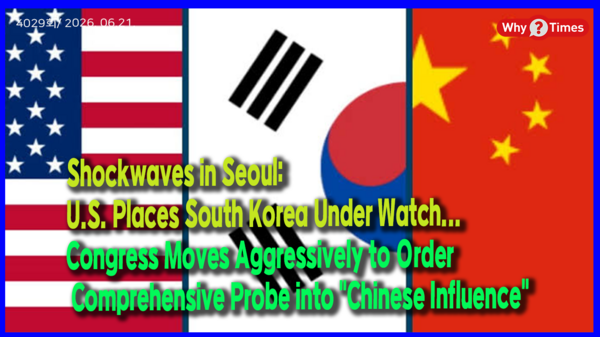
[U.S. Congress Includes South Korea on "Chinese Influence Monitoring List" for the First Time]
The United States Congress has, for the first time in history, directed the Department of Defense (DoD) to conduct an official assessment of the Chinese Communist Party's (CCP) influence within South Korea. This is far from a routine intelligence-gathering exercise. The mandate explicitly targets the safety of U.S. Forces Korea (USFK), the ROK-U.S. military supply chain, and the expanding footprint of Chinese tech firms.
Crucially, this directive aligns precisely with Seoul's push to accelerate the transition of Operational Control (OPCON). This overlap signals a fundamental shift in Washington's strategic perception of the Korean Peninsula—pivoting its primary security focus away from the "North Korean threat" and toward the "China risk."
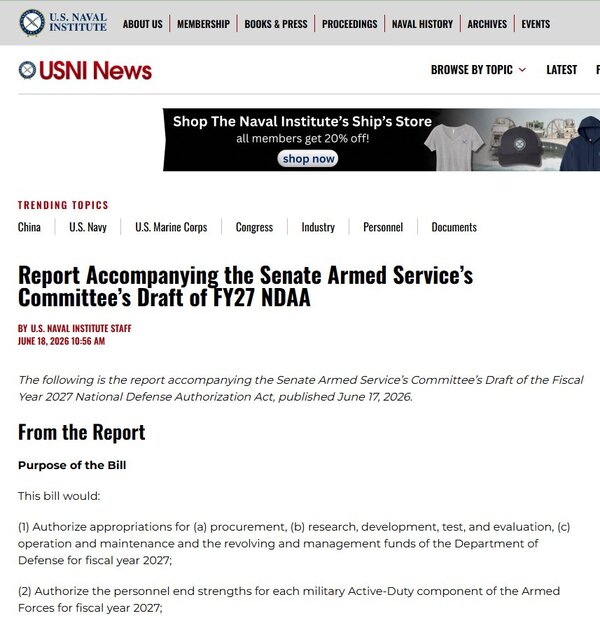
On June 19, USNI News, published by the U.S. Naval Institute, reported that the Senate and House Armed Services Committees inserted provisions into the committee reports accompanying the Fiscal Year 2027 National Defense Authorization Act (NDAA). These provisions direct the DoD to assess the CCP's influence in South Korea, marking the first time an NDAA report has singled out South Korea to evaluate the risks of Chinese infiltration.
In the report released by the Senate Armed Services Committee, a dedicated section titled "Malign Influence of the Chinese Communist Party in South Korea" makes its debut. The committee requires the Secretary of Defense to submit a comprehensive report by May 1, 2027, detailing the scope of the CCP’s influence operations in South Korea and their ramifications for U.S. national security and economic interests.
The Senate’s mandate outlines a highly specific and granular scope of evaluation. The DoD is tasked with assessing:
The direct risks posed by Chinese influence to USFK operations.
The impact on supply chains for dual-use materials essential for ROK-U.S. security cooperation.
China's broader economic and industrial leverage within South Korea.
This goes significantly deeper than merely tracking pro-Beijing groups or political lobbying. It signals that Capitol Hill has begun scrutinizing South Korea’s industrial supply chains and technological ecosystems through a strict national security lens.
[Senate Targets USFK, House Zeroes In on Chinese Tech Firms]
While the Senate focuses heavily on USFK and supply chain vulnerabilities, the House of Representatives goes a step further. The House Armed Services Committee has directed the DoD to provide a separate briefing by December 1 of this year, assessing how the growth of Chinese technology companies within South Korea poses a direct threat to U.S. national security.
Furthermore, the House has requested actionable insights on how South Korea can better support the growth of U.S. tech firms, alongside measures Seoul can implement to mitigate Chinese threats impacting the security of USFK.
This demonstrates that Congress views the operations of Chinese tech companies in South Korea not as a standard economic matter, but as an acute security vulnerability. It reflects Washington's broader, ongoing campaign to treat China's dominance in cutting-edge industries—such as semiconductors, artificial intelligence (AI), telecommunications equipment, and battery supply chains—as a critical national security threat. The new NDAA provisions are a direct extension of this strategic posture.
[Why Now? The Intersection with Frictional Signals in the ROK-U.S. Alliance]
What makes these provisions particularly striking is their timing. Seoul and Washington are currently engaged in highly sensitive consultations regarding the transition of OPCON. While the South Korean government has made reclaiming OPCON a top national priority, the U.S. military and Congress have consistently maintained a highly cautious approach.
On the same day, during a Tri-Forum event held in Washington, U.S. foreign policy and defense heavyweights poured cold water on an accelerated transition. Robert O’Brien, who served as National Security Advisor during the first Trump administration, noted that while the transition is "a fine idea," it must be handled "very carefully." He emphasized that when politicians intervene in matters akin to military withdrawals, such moves must be strictly "conditions-based" and remain firmly within the domain of military expertise rather than political expedience.
Reflecting on the Biden administration's 2021 withdrawal from Afghanistan, O’Brien recalled that Washington pursued a rigid, timeline-based approach, and ultimately, "it was the people of Afghanistan who paid a heavy price." He added, "The people of South Korea are certainly capable of defending themselves," expressing hope for a "prudent transition overall." He repeatedly stressed that the alliance must not "leave a vacuum that can be exploited by China, North Korea, Russia, or other adversaries of our two nations."
David Wilezol, former Deputy Assistant Secretary of State for Northeast Asian Affairs, echoed this stance, stating that a "conditions-based approach" has been a consistent message conveyed to their South Korean ally. He expressed confidence that the U.S. and South Korea would eventually reach an agreement on the final architecture of the OPCON transition, noting that the U.S. would place deep trust in the judgment of military commanders. "Nobody understands the operational realities on the ground better than the soldiers themselves," he explained.
This aligns with comments made in April by USFK Commander Gen. Xavier Brunson during a congressional hearing, where he warned that "political convenience must not outpace conditions." Brunson revealed that he had submitted a roadmap to the DoD outlining the fulfillment of relevant conditions by the first quarter of 2029—effectively signaling that the U.S. military does not view an OPCON transfer prior to early 2029 as viable. Similarly, Secretary of Defense Pete Hegseth noted last month that a balance must be struck where U.S. operational plans and the decades-long commitments of American servicemembers are fully respected.
[Washington’s Shifting Paradigm on the Korean Peninsula]
Amid these developments, the recently passed NDAA language reinforces the U.S. military's stance regarding command and control dynamics on the peninsula. The FY2027 NDAA, which recently cleared the Senate Armed Services Committee, features significantly strengthened provisions compared to last year to ensure that an OPCON transition does not occur without fully incorporating the U.S. military's assessments. Conversely, the South Korean government is reportedly aiming to reclaim OPCON by the end of next year. This creates a strategic gap of over a year between the U.S. military's timeline (Q1 2029) and Seoul's target (late 2027).
The core takeaway of this NDAA mandate extends far beyond a single legislative report; it underscores a profound shift in how the U.S. Congress views South Korea. Historically, Washington's focus on the peninsula revolved almost exclusively around North Korea's military provocations. In this latest report, however, Chinese influence, supply chain dominance, technological infiltration, and the operational environment of USFK have eclipsed traditional concerns to take center stage.
By officially designating Chinese influence in South Korea as an object of formal assessment, Congress is signaling that it no longer views South Korea simply as a traditional treaty ally, but as a primary battleground in the U.S.-China strategic competition. Washington's concern is not limited to conventional espionage. Rather, it fears a scenario where Beijing leverages technology, industry, supply chains, and telecommunications infrastructure to establish long-term structural leverage inside an ally's borders—ultimately constraining the operational capabilities and strategic flexibility of the U.S. military. This mandate marks the first time such anxieties have been formally codified into congressional documentation.
[A New Question Confronting Seoul]
Ultimately, the fundamental question posed by the FY2027 NDAA is not about the mechanics or timing of the OPCON transition itself. Washington has begun prioritizing a different metric: it is less concerned with how quickly South Korea can achieve military autonomy, and far more focused on how insulated South Korea actually is from Beijing’s strategic gravity.
The concurrent demands from both the Senate and the House to investigate Chinese influence in South Korea are no coincidence. They serve as a clear bellwether that the criteria by which the U.S. Congress evaluates peninsular security have fundamentally transformed.
Moving forward, the critical flashpoint in the ROK-U.S. alliance may no longer be the calendar date for the OPCON transfer. Instead, the alliance will face a new testing ground: how Washington evaluates South Korea’s strategic reliability, and how effectively Seoul can manage and mitigate the national security risks emanating from Beijing.

-중국 푸단대학교 한국연구원 객좌교수
-전 EDUIN News 대표
-전 OUR NEWS 대표
-제17대 대통령직인수위원회 정책기획팀장
-전 대통령실 홍보기획비서관
-사단법인 한국가정상담연구소 이사장
-저서: 북한급변사태와 한반도통일, 2012 다시우파다, 선거마케팅, 한국의 정치광고, 국회의원 선거매뉴얼 등 50여권