
Update2026.10.24 (토)

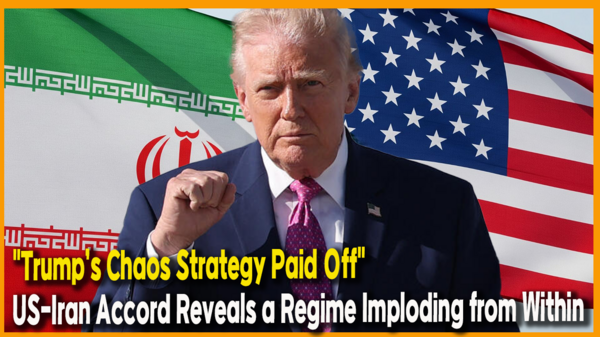
[The Truce is Not the End, But the Beginning: The True Change Lies in a Weakened Regime]
The 106-day war between the United States and Iran has ground to a tentative halt following a truce agreement. While some major South Korean media outlets have poured out critical coverage—questioning the purpose of the conflict with headlines like "No Change in Hormuz or the Nuclear Front... A Ceasefire Leaving Only Questions"—prominent Western outlets such as ABC, NPR, and Reuters have uniformly hailed the development as a "historic breakthrough." In particular, experts with a profound understanding of Iran's internal dynamics are lauding the agreement from a completely different perspective than that of the Korean press.
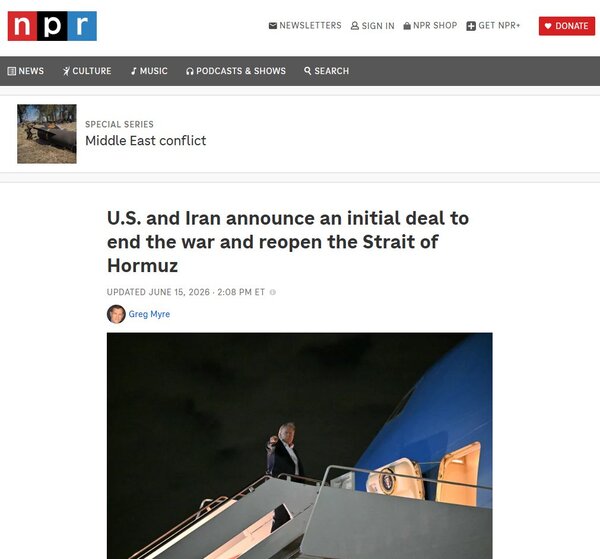
On June 16, US public broadcaster NPR reported that "President Trump and Iran have reached an initial agreement to end over three months of warfare and reopen the Strait of Hormuz." The network characterized the deal, which is slated for an official signing in Switzerland, as a "major breakthrough" in a conflict that had threatened to engulf the wider Middle East and severely disrupt the global economy.
Al Jazeera also noted the immediate reaction from financial markets: "The response was instantaneous. The S&P 500 rose 1.9%, while international oil prices plummeted by approximately 5%. Asian markets rallied concurrently, with Japan’s Nikkei 225 surging 5.5%, South Korea’s KOSPI jumping up to 5.7%, and Taiwan’s TAIEX advancing 2.7%."
However, Western analysts are focusing less on the text of the accord itself and more on the staggering price Iran had to pay to get to this point.
[The Aftermath of a 106-Day War: What Did Iran Lose?]
Beneath the celebratory tone of Western media, geopolitical experts are zeroing in on the actual toll exacted on Iran—a critical dimension where certain South Korean outlets have severely distorted the reality.
The conflict, which erupted on February 28, was far from a routine military skirmish. During the hostilities, Iran’s Supreme Leader Ali Khamenei passed away, leading to the swift election of his son, Mojtaba Khamenei, as his successor. This sudden transfer of power at the absolute apex of the Iranian revolutionary apparatus mid-war marks one of the most profound political shocks to hit the country since its founding.
Assessing the physical damage, CNN reported that "the military devastation was both extensive and structural." The network detailed that "in just 12 days of concentrated airstrikes, Iran lost the vast majority of its air defense networks, missile stockpiles, launch pads, and production facilities. Key figures within the military command structure were eliminated, and critical nuclear facilities were heavily damaged alongside leading nuclear scientists."
The US Department of Defense corroborated this view, stating that "Iran’s ballistic missile launch capabilities have been drastically degraded compared to pre-war levels." The Pentagon further estimated that "the Natanz nuclear facility suffered severe structural damage, resulting in the destruction of thousands of centrifuges."
CNN added specific figures regarding the nuclear setbacks: "The damage to the nuclear infrastructure is profound. The primary enrichment facility at Natanz suffered 75% damage, with over 6,000 centrifuges obliterated." The network continued, "Out of a pre-war stockpile of roughly 5,800 kg of enriched uranium, an estimated 2,600 kg was destroyed in the strikes. However, the Fordow facility, buried deep within a mountain complex, sustained only 30% damage, suggesting its core infrastructure may still be intact."
The economic fallout of the war has been equally crippling. The International Energy Agency (IEA) classified the blockade of the Strait of Hormuz as one of the most severe supply shocks in the history of the global oil market. Paradoxically, the ultimate victim of this blockade was Iran itself. By shutting down the strait, Tehran choked off its own economic lifeline—oil exports—turning its primary weapon into a devastating economic boomerang.
[An Iranian Pundit’s Direct Verdict: "Trump’s Chaos Was the Strategy"]
Against this backdrop, the insights of Ida Turan (@iranidaturan / ایده توران), an Iranian diaspora analyst active on X (formerly Twitter) since 2014, have gained significant traction in Anglo-American political circles. Boasting a following of over 42,100, Turan describes herself as a "proud Iranian, patriot, monarchist, and classical liberal." Raised in a Muslim household, she is an R&D engineer who now calls the West her second home. While not a professional journalist or academic, her vivid, on-the-ground understanding of domestic sentiment in Iran and her sharp systemic critiques have frequently caught the attention of conservative American political media.
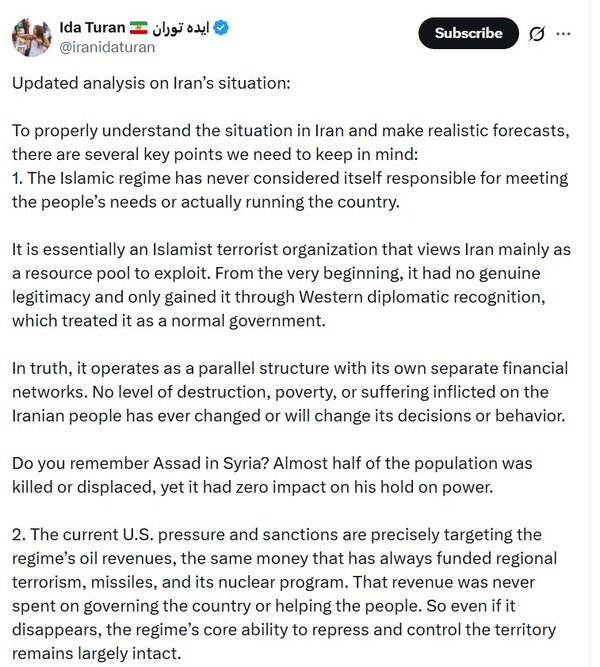
Around June 12, as negotiations reached a critical juncture, Turan offered an unusually positive appraisal of the Trump administration's approach. Operating on the premise that "a bully only backs down when confronted by someone stronger," she defined the Iranian mullah regime as an inherently chaotic, lawless system that uses diplomacy merely as a tool for deception and concealment. Consequently, she argued, "Trump’s unpredictable methodology was precisely what worked against this regime."
Turan had articulated a similar rationale in an earlier post cited by HotAir, a prominent American conservative political news site and blog, back in April. At the time, she wrote:
"The regime actually welcomes external clashes. A war they can brand as 'forced' or 'defensive' is a blessing to them. This is exactly why they continue to provoke and reject any meaningful cooperation; they know that even if they are weakened, they will survive. Domestic protests can be crushed even more brutally under the fog of war. Conversely, the true benefit of sanctions and sustained pressure lies in deepening the fractures within the regime."
The crux of Turan’s argument is that this conflict operates as a "soft war." Her analysis suggests that Trump is executing a strategy designed to incrementally disarm and weaken the Iranian regime at a minimal cost. She predicts that even if a formal treaty is signed, the administration will not ease the pressure until the regime is fragile enough for the Iranian people to successfully confront it themselves. She pointedly remarked that "the Iranian leadership realized they could not handle Trump the way they handled President Obama."
[A Fundamental Shift in Iran's Political Landscape: The Fragile Authority of the Mojtaba Regime]
Turan’s perspective carries weight because it is mirrored by the stark realities facing Iran's leadership. As early as March, The New York Times reported that "the Iranian leadership is suffering from severe functional paralysis," noting that "disruptions to communication infrastructure have triggered intense paranoia and internal power struggles, profoundly crippling the regime’s decision-making apparatus."
ABC News also highlighted that the issue of legitimacy surrounding the newly minted Supreme Leader, Mojtaba Khamenei, came to the fore during the negotiation process. When asked whether Mojtaba had personally signed off on the agreement, a US official deflected a direct answer but noted: "Both civilian and military officials have testified that the Supreme Leader expressed comfort with the current direction of the negotiations. What is certain is that within their system, absolutely nothing moves without the Supreme Leader’s explicit authorization."
The Atlantic Council, a renowned US think tank, offered a more direct diagnostic of this structural vulnerability:
"Given his memory of Trump’s 2018 withdrawal from the JCPOA—and the fact that a joint US-Israeli operation targeted and eliminated his father, mother, wife, and son—Mojtaba Khamenei may lean toward small-scale, transactional arrangements rather than any sweeping, high-stakes treaty with the United States. Furthermore, US officials acknowledge that while certain hardliners in Tehran are trying to derail the accord, the majority desire a deal but are desperate to frame it as a victory for their domestic audience."
[Terms of the Agreement and Unresolved Challenges]
According to the Memorandum of Understanding (MOU) cited by Reuters via a senior Iranian official, the preliminary terms stipulate that "Iran will immediately reopen the Strait of Hormuz, in exchange for the US lifting its blockade on Iranian ports. Washington will unfreeze $25 billion in Iranian assets, refrain from imposing new sanctions, and grant oil sanctions waivers pending a final agreement. In return, Iran pledges not to develop or acquire nuclear weapons, will halt all new uranium enrichment, and must dilute its existing stockpiles of highly enriched uranium."
Limitations of the accord, however, remain conspicuous. Iran’s ballistic missile program and its financial and logistical support for regional proxies like Hezbollah were explicitly excluded from the scope of these talks. Furthermore, restoring normalcy to the Strait of Hormuz will not happen overnight. Following a 107-day blockade that saw commercial tanker traffic plunge by 95%, internal Pentagon estimates suggest that even with three dedicated minesweepers deployed, clearing the naval mines could take up to six months.
[The 'Boiling Frog' Strategy: The Iran Accord and Chinese Energy Security]
Interestingly, Chinese-language dissident analysis channels, such as Bannedbook.org (禁闻), have advanced an entirely different interpretation. Commentator 'Mr. Taomiao' posits that the true beneficiary of this accord is not Iran, but the United States. "By maintaining de facto control over the Strait of Hormuz, Trump has effectively seized a stranglehold on the Chinese Communist Party's energy supply lines," he argues. From this perspective, the deal is a "boiling frog" strategy—depriving Beijing of an immediate pretext to retaliate while quietly maintaining a long-term chokehold on its energy security.
[Conclusion: The Illusion of "No Change" vs. The Structural Reality]
The argument voiced by some South Korean media outlets—dismissing the accord as an "empty-handed end to the war" because the nuclear and maritime dynamics appear unchanged on paper—is a myopic view that focuses strictly on the incomplete clauses of a tentative agreement.
However, Turan and other veteran Iran analysts are looking at a much deeper structural shift. The Carnegie Endowment for International Peace warned: "Through this war, the revolutionary regime has lost its supreme leader, seen a massive portion of its nuclear infrastructure dismantled, and devastated its own economy by self-inflicting a blockade on Hormuz. The new leader, Mojtaba Khamenei, suffers from a severe deficit of legitimacy. Paradoxically, this vulnerability may reinforce a conviction within the leadership that a nuclear deterrent is the only definitive guarantee of their survival."
Consequently, the upcoming 60-day window of follow-up negotiations will force Tehran to navigate a grueling, simultaneous trifecta of pressure: nuclear curbs, missile restrictions, and economic sanctions.
Experts at the Council on Foreign Relations (CFR) similarly forecast that "future negotiations over core issues, including the nuclear program, will be long and treacherous." The true takeaway is not that a single piece of paper will transform Iran overnight; rather, the Iranian revolutionary regime is already fracturing from within, and this agreement is merely a provisional signpost along that trajectory. While Trump has declared to the markets, "World, turn your engines on," the true geopolitical trajectory is only just beginning to take shape.
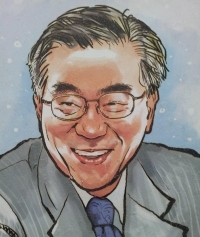
-중국 푸단대학교 한국연구원 객좌교수
-전 EDUIN News 대표
-전 OUR NEWS 대표
-제17대 대통령직인수위원회 정책기획팀장
-전 대통령실 홍보기획비서관
-사단법인 한국가정상담연구소 이사장
-저서: 북한급변사태와 한반도통일, 2012 다시우파다, 선거마케팅, 한국의 정치광고, 국회의원 선거매뉴얼 등 50여권