
Update2026.10.24 (토)

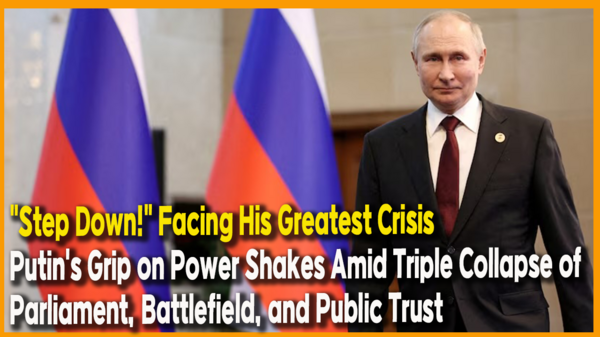
["The Illusion is Over" – First Open Warning Errupts from Within the Kremlin]
Four years and four months into the war in Ukraine, Russian President Vladimir Putin faces his gravest multifaceted crisis in his 25-year rule. Inside parliament, lawmakers are publicly pressuring him to step down; the Crimean Peninsula was isolated overnight by the Ukrainian military's precision paralysis warfare; and 231 drones set the heartland ablaze on Russia Day. As the battlefield, the economy, and public sentiment collapse simultaneously, the Kremlin’s clock is rapidly ticking backward.
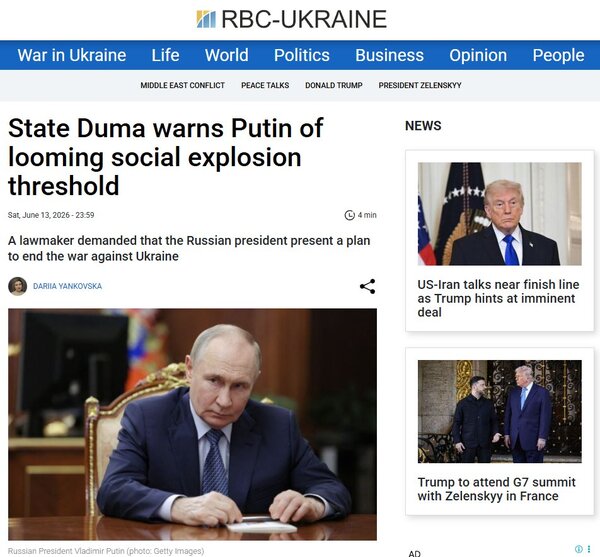
RBC-Ukraine, a leading independent Ukrainian news agency, reported on June 14 that "the cracks first exploded within the State Duma (the lower house of parliament), a space the Kremlin once considered safest." The agency noted that "Vyacheslav Markhayev, a State Duma deputy from the Russian Communist Party, demanded that Putin immediately submit a public plan to end the war in Ukraine, declaring that Russia is on the brink of a social explosion."
RBC-Ukraine further highlighted Markhayev’s direct criticism: "The era of illusions is over. The country is on the verge of a social explosion, and the entrenched leadership bears full responsibility for this." He listed corruption scandals, oligarchy, a massive exodus of youth, and Ukrainian drone strikes on the Russian mainland as chronic ailments of wartime Russia.
"The severity of his rhetoric did not stop there," RBC-Ukraine stated. "Markhayev warned that if this situation continues, the likelihood of social unrest and chaos will grow, which the West will inevitably exploit to destroy what remains of the Russian state system." The agency analyzed that this warning—that internal division soon becomes an external blade—paradoxically marks the first time the realistic possibility of regime collapse has been formalized within the Kremlin.
Commenting on the matter, The Moscow Times noted, "Markhayev strongly condemned the political system, stating that the same forces have been running it for 25 years but have become completely detached from the needs of ordinary people. This was not mere dissatisfaction with policy, but a direct strike aimed at the 25-year Putin regime itself." The report added that he likened the corruption of the ruling elite and the ill-gotten wealth of the oligarchs to "external aggressors who seize resources, plunder manufacturing, raise utility bills, and build private mansions."
The Moscow Times continued, "He fired a direct shot, stating that taxpayers' money is flowing into yachts, palaces, and foreign assets rather than repairing aging infrastructure." The 71-year-old Markhayev demanded an immediate freeze on utility rate hikes and a clear, public plan to end the special military operation based on Russia’s national interests, effectively making an indirect call for a leadership change.
"Markhayev is by no means alone," The Moscow Times pointed out. "Last May, Renat Suleymanov, a fellow Communist Party lawmaker, also stepped forward to urge 'the earliest possible end to the SVO,' arguing that the economy 'cannot sustain' the continuation of the war. It was an unprecedented case of a Russian lawmaker publicly admitting the limits of the country’s capacity to wage war."
Furthermore, The Moscow Times reported, "In March, Ilya Remeslo, a long-time pro-Kremlin blogger and supporter, abruptly shifted his stance, publicly calling Putin a 'war criminal and a thief' and demanding he be brought to trial. The cracks within the system are no longer sporadic departures but are hardening into a structural trend."
[Approval Rating Hits Record Low of 29.5% – Kremlin Hides the Numbers Entirely]
Behind this rebellion lies a rapidly crumbling public sentiment. In response, the Kremlin’s strategy was not to lower the figures, but to erase the metrics entirely.
VTsIOM (the Russian Public Opinion Research Center), a state-run polling agency, abruptly halted the publication of its "open-ended trust" survey, which asks respondents to freely name the politicians they trust. Putin’s trust rating measured through this method plummeted to 29.5% in early April, marking its lowest level since the full-scale invasion. This figure stands in stark contrast to the "closed-ended" survey (73.8%), where names are provided beforehand—a gap of over 44 percentage points. This raw data reveals that Russians no longer spontaneously think of Putin as a leader they trust. The figure has shrunk by 5.5 percentage points compared to the beginning of this year, by 19.5 percentage points from its peak in March 2024, and to less than half of his historic 68% approval rating in 2014.
Regarding this move, The New Voice of Ukraine pointed out, "The last public announcement was on April 5, containing the March results. Since then, the April and May figures vanished without notice." The outlet added, "Signs were visible even before that. VTsIOM, which recorded a decline for seven consecutive weeks, delayed the release of its figures by two hours when they dropped further on April 24, and subsequently halted weekly publications altogether." When a state-controlled polling station conceals unfavorable numbers, that silence speaks volumes.
The Moscow Times also noted that "economic indicators are even more brutal." It reported, "The Russian government sharply downgraded its 2026 GDP growth forecast from 1.3% to 0.4%. The economy already contracted by 0.3% in the first quarter, while inflation shows no signs of slowing down."
"Defense and security spending for 2026 is projected at 16.84 trillion rubles (approximately $236.7 billion), marking the highest proportion of military expenditure since the Cold War," The Moscow Times pointed out. "The more money poured into tanks and shells, the faster the public livelihood collapses—Russia is finding no exit from this vicious cycle."
[An Island Isolated Overnight – Paralysis Warfare Suffocates the Crimean Peninsula]
While cracks widened from within, Ukraine shook Russia’s southern strategic axis with a single blow on the battlefield. Instead of a frontal breakthrough at the frontline, it chose to starve out Russia's combat capability by severing supply lines.
The New Voice of Ukraine reported, "On the night of June 7, units from the Phalanx Multidomain Operations Center of Ukraine’s 1st Separate Assault Regiment and CODE 9.2 of the 475th Separate Assault Regiment carried out a precision strike on the Chonhar Bridge—a critical supply route linking occupied Crimea to the mainland—using FP-2 attack drones and the newly deployed 'Behemoth' kamikaze drone." This bridge is the heart of the R-280 highway, which Russia connected to Crimea via the occupied Donbas region, serving as the logistical artery for all Russian forces stationed on the peninsula.
"The operation was a meticulously designed trap," The New Voice of Ukraine noted. "When the Chonhar Bridge was blocked, the Russian occupation authorities rerouted the transport flow to the Armyansk and Perekop checkpoints—and the Ukrainian military was waiting right along that detour."
Indeed, a commander of the 475th Regiment, call sign 'Flint,' stated, "This bridge was the sole supply route for transporting personnel, ammunition, and fuel to the 37th Motorized Rifle Brigade. We decided to strike specifically to cut off the supply of fuel and lubricants." The Russian military logistics vehicles funneled into the narrow detour were like rats in a trap. The drone fleet's first strike collapsed the bridge ahead, blocking the retreat, while a second strike hit the rear of the convoy, sealing the exit. Subsequent kamikaze drones directly impacted fuel tankers and ammunition trucks, triggering a chain of explosions that ripped through the night sky.
The consequences were immediate. Most sea ferries had already been destroyed by Ukrainian missiles and uncrewed surface vessels (USVs), and the Crimean Bridge remains incapable of transporting heavy military logistics due to structural damage from previous airstrikes. In Sevastopol, a secondary QR-code system for fuel rationing was activated but suspended on the same day because the supply vehicles themselves could not enter. Over the course of a single night, staples like sugar, buckwheat, and flour vanished from supermarket shelves. Several cities introduced emergency rationing, limiting purchases to three items per person. The strategic stronghold that Putin once called an "unsubmergible aircraft carrier" exposed its logistical limits to a handful of precision drone strikes.
[Ukraine's 231 Drones – Heartland Military Logistics Centers Engulfed in Flames]
Amidst this, before the shock in Crimea could even subside, Ukraine launched a strike targeting the heartland of the Russian mainland, precisely timed for 'Russia Day' (June 12), the nation’s founding holiday.
The Kyiv Post reported, "On the night of June 12, Ukrainian forces simultaneously struck the TANEKO and TAIF-NK oil refineries in Tatarstan, as well as the Tolyattikauchuk chemical plant in the Samara region. The General Staff of the Ukrainian Armed Forces confirmed fires at all three locations, while the Russian Ministry of Defense announced it had shot down 231 drones across 15 regions, annexed Crimea, and the Azov Sea waters."
"In Tolyatti, Samara region, residents reported hearing continuous explosions for at least 40 minutes," The Kyiv Post continued. "The Russian Federal Air Transport Agency urgently restricted flights at airports in eight cities, including Volgograd, Kazan, Nizhnekamsk, Penza, and Samara. Two large refining complexes are concentrated in the Nizhnekamsk area of Tatarstan, and a thick column of smoke rose over the city following the attack. The sound of explosions and columns of smoke echoing on a national holiday served as a stark reminder to the Russian public that the war leaves no safe rear."
The Kyiv Post further analyzed, "Following the complete shutdown of the Kuibyshev refinery in Samara by destroying its core processing units AVT-4 and AVT-5, Ukraine is systematically tightening its grip on the Russian military’s entire fuel supply chain through a multidimensional strategy targeting mainland refineries, inland pumping stations, and Black Sea export ports. Ukraine’s Unmanned Systems Forces hit approximately 180,000 verified targets in May 2026 alone, marking a 27% increase from the previous month."
Four years and four months ago, Putin invaded Ukraine, confident of a swift and decisive victory. Now, his lawmakers are publicly pressuring him to step down, his military's supply lines are severed by drones, and his state polling agency is hiding his diminished approval ratings. As the parliament, the battlefield, and public trust collapse simultaneously, this is no longer a crisis of war—it is a crisis of the regime. And time is no longer on Putin's side.


-중국 푸단대학교 한국연구원 객좌교수
-전 EDUIN News 대표
-전 OUR NEWS 대표
-제17대 대통령직인수위원회 정책기획팀장
-전 대통령실 홍보기획비서관
-사단법인 한국가정상담연구소 이사장
-저서: 북한급변사태와 한반도통일, 2012 다시우파다, 선거마케팅, 한국의 정치광고, 국회의원 선거매뉴얼 등 50여권