
Update2026.10.24 (토)

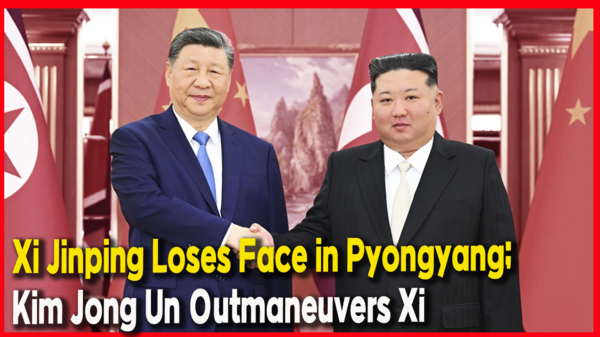
[Nikkei: "Kim Jong Un Emerges as Winner in Summit with Xi Jinping"]
A veteran Japanese journalist and leading expert on Chinese politics summarized Xi Jinping’s first visit to Pyongyang in seven years in a single line: “The winner was Kim Jong Un.” His diagnosis was clear—this was not a triumphant tour by a major power, but rather a humiliation.
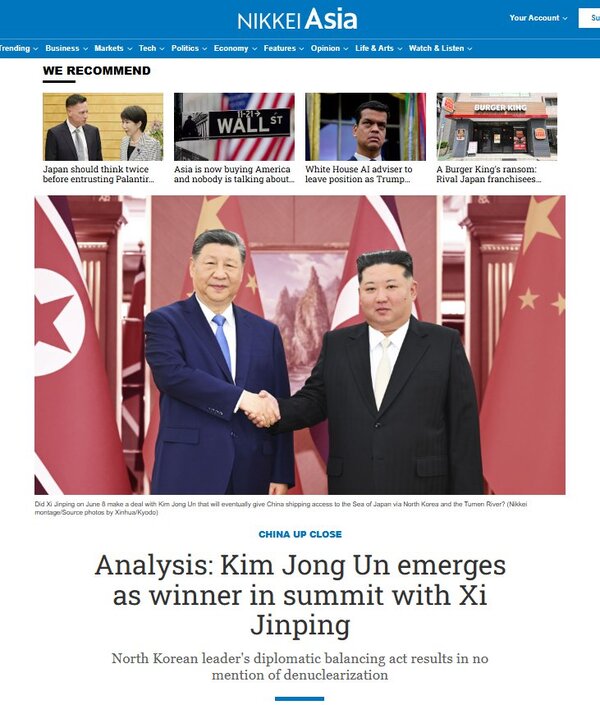
On June 11, immediately after Chinese President Xi Jinping’s visit to Pyongyang concluded, Japan’s Nikkei Asia published an analytical piece that captured the core nature of the summit with pinpoint precision. Written by Katsuji Nakazawa, a veteran journalist who has tracked the inner workings of Chinese power for over three decades, the article was titled "Kim Jong Un emerges as winner in summit with Xi Jinping."
The subheadings were even more explicit. Nikkei Asia noted that "Xi’s visit to North Korea culminated in a diplomatic balancing act by the North Korean leader and the complete disappearance of any mention of denuclearization," highlighting that "while it was Xi who traveled to Pyongyang for the first time in seven years, it was Kim who walked away with the spoils of the meeting."
Particularly noteworthy in Nakazawa’s analysis is the possibility that Xi did not just return empty-handed, but may have actually "conceded" something significant. Nikkei opened its article with a provocative question: "Did Xi Jinping strike a deal with Kim Jong Un on June 8 to grant China maritime access to the East Sea via North Korea and the Tumen River?"
Nikkei pointed out that "securing access to the sea via the lower reaches of the Tumen River has been a century-long aspiration for China’s Jilin Province." It added that "in the past, Beijing would have demanded this as a 'grant' from Pyongyang, but now, Xi finds himself in a position where he must pay a price to purchase it from Kim Jong Un."
Foreign Policy echoed this sentiment in its pre-summit analysis, noting that "the recent joint statement during Putin’s visit to China explicitly mentioned the Tumen River issue and the need for consultations with North Korea," which indicates that "this issue remains unresolved, and Pyongyang holds all the cards."
On what grounds did Nikkei declare a "victory for Kim Jong Un"? The answer lies entirely in the factual timeline of the week surrounding the summit. Nikkei revealed that "the agenda was blocked before Xi even landed in Pyongyang, China’s decades-old official stance vanished from the joint statements, and just three days after Xi’s departure, Kim proclaimed an 'alliance' with Moscow." A chronological review of these events provides a clear picture of the current state of China-North Korea relations.
[Evidence ①] Before Xi Even Landed, Kim Jong Un Set the Rules of the Game
The first move in what Nikkei termed a "diplomatic balancing act" was made before Xi’s presidential plane even took off. Kim Yo Jong, the vice department director of the Workers' Party, issued a statement through the Korean Central News Agency (KCNA) ahead of President Xi’s arrival, declaring, "North Korea will never back down from its status as a nuclear-weapon state and will tolerate no threats whatsoever." She firmly drove the point home by stating, "The policy of strengthening the self-defensive nuclear war deterrent declared by our head of state is an irreversible and final conclusion that must be executed unconditionally."
Action quickly followed words. Just prior to the visit, North Korea unveiled a new nuclear material production facility, where Kim Jong Un ordered an "exponential expansion of nuclear forces." He also visited major munitions factories, commanding them to "increase missile production capacity by 2.5 times over the next five years." Furthermore, accompanied by his daughter Kim Ju-ae, Kim boarded the 5,000-ton destroyer Kang Kon to discuss strengthening the navy's nuclear deterrence and plans to build a 10,000-ton destroyer.
This series of moves can be interpreted as a deliberate attempt to dictate the terms of the summit before Xi even landed, making it crystal clear that any discussion of denuclearization was strictly off the table. It also demonstrates an unprecedented level of confidence from Pyongyang, likely backed by its deepening alignment with Russia and enhanced nuclear production capabilities. Despite inviting the top leader of China—the "big brother" country in their 65-year alliance—the host pre-emptively banned the very topic the guest wanted to raise. Pyongyang drew the boundaries of negotiation before the summit even began; this was the first piece of "protocol" Pyongyang extended to Beijing.
[Evidence ②] 'Denuclearization' Vanishes from Statements: Silence Equals Acquiescence
Pyongyang’s pre-emptive warning was mirrored precisely in the outcomes of the summit. In the official statements released by both Pyongyang and Beijing regarding the June 8–9 summit, any mention of denuclearization or the situation on the Korean Peninsula was entirely absent. This marks a stark departure from Xi’s 2019 visit to Pyongyang, when China publicly reaffirmed its commitment to pursuing denuclearization. Instead, Xinhua News Agency reported that "President Xi proposed aligning development strategies, fully reopening border trade ports, and expanding people-to-people exchanges, while also mentioning the strengthening of exchanges in diplomatic, judicial, and military fields"—but denuclearization was never uttered.
American think tanks quickly noted the weight of this silence. The American Enterprise Institute (AEI) analyzed in a June 9 report that "Xi’s failure to mention denuclearization may signify China’s tacit acceptance of North Korea’s status as a nuclear-weapon state."
The timing makes this even more painful for Beijing. Just weeks prior, the U.S. readout of the Trump-Xi meeting in Beijing explicitly stated that "the denuclearization of North Korea remains a common goal for both countries." Yet, a goal promised in front of Trump could not even be brought up in front of Kim Jong Un. As Foreign Policy put it, "In the end, Beijing had no choice but to tacitly accept North Korea's nuclear possession." This diplomatic retreat is precisely what Nikkei Asia was referring to in its sub-headline, "No Mention of Denuclearization."
[Evidence ③] Three Days Post-Summit, Kim Proclaims an 'Alliance' to Putin
The definitive blow in North Korea’s equidistant diplomacy—what Nikkei called a "balancing act"—came immediately after Xi returned to Beijing. Just three days later, on June 12, marking Russia’s National Day, Kim Jong Un sent a congratulatory telegram to President Vladimir Putin, stating, "It is the unwavering will of myself and the government of our Republic to fully support Moscow’s domestic and foreign policies and to always stand with Russia."
Kim emphasized that "today, DPRK-Russia relations are opening a new chapter in history, further strengthening into a relationship of genuine, dedicated comradely trust and an alliance." The full text of this telegram was splashed across the front page of the Rodong Sinmun, with the sixth page dedicated to an article introducing Russia's National Day.
The choice of words speaks volumes. While Kim maintained a tone of "traditional friendship" with Xi Jinping, he used the superlative term "alliance" for Putin. Before the ink could even dry on the lavish welcome extended to Xi—complete with a 21-gun salute and white horse cavalry—Pyongyang publicly signaled its coordinates: it will not be subordinate to either Beijing or Moscow. Ultimately, this telegram confirms that immediately following Xi's visit, Kim moved to play the two powers against each other by reaffirming a "strengthened alliance" with Putin. The message Pyongyang sent in return for Xi’s major diplomatic investment—his first visit in seven years—was effectively a notification that "China is merely one of multiple patrons."
["China Has Never Dealt with Such a Confident North Korea"]
Nikkei’s diagnosis of a "Kim Jong Un victory" is far from an isolated opinion. NBC News assessed that "Kim Jong Un met Xi Jinping from a position of rare strength," noting that "his support for Russia’s war has paid dividends, his nuclear program has solidified a de facto nuclear state status, and an economy once crushed by sanctions has rebounded."
The assessment by Bob Carlin, a former chief of the Northeast Asia Division at the U.S. State Department's Bureau of Intelligence and Research, cited by CBS News, was even more biting. Carlin, who has analyzed North Korea for over 50 years, asserted bluntly, "China has never had to deal with a North Korea that is swaggering like this," pointing out that "since 2023, Kim Jong Un has completely shifted the axis of North Korea’s strategic policy."
Overseas Chinese-language media reached the exact same conclusion. Creaders.net (萬維讀者網) commented in a June 10 op-ed: "Even though Xi Jinping’s first overseas trip of 2026 was to Pyongyang, this move failed to yield strategic benefits for China; the true winner was Kim Jong Un." The commentary noted that "the North Korean state media's nuclear declaration right before Xi’s arrival eliminated any room for negotiation, and the disappearance of denuclearization from the summit was a de facto acquiescence by China." It concluded by invoking a famous idiom from the Romance of the Three Kingdoms: "Losing both the wife and the soldiers" (meaning to suffer a double loss in an attempt to gain an advantage).
Similarly, the Voice of America (VOA) pointed out that "Xi Jinping completely avoided raising the North Korean nuclear issue during his visit," quoting Joseph Bosco, former China country director in the U.S. Office of the Secretary of Defense, who chided, "China had the capability to stop North Korea's nuclear program but chose not to act."
[Why Xi Still Had to Go: 'Fear of Russia' Drives Defensive Diplomacy]
Knowing it was a summit with little chance of success, the reason Xi Jinping chose to visit Pyongyang anyway lies squarely with Russia. VOA reported that "since the 2022 invasion of Ukraine, the very dynamics of China-North Korea relations have shifted." It noted that "North Korea has provided Russia with weapons, artillery shells, and troops, and South Korea's Institute for National Security Strategy (INSS) estimates that North Korea earned between $7.67 billion and $14.4 billion in foreign currency through military supplies and troop deployments from August 2023 to December 2025."
North Korea, which previously relied on China for 95% of its legal trade, has secured an alternative patron. Oriana Skylar Mastro, a fellow at Stanford University, remarked during a CSIS seminar on June 5, "The moment Putin visited North Korea and rebuilt their close ties, you could clearly see the Chinese beginning to panic about their own position."
Patricia Kim, a senior fellow at the Brookings Institution, summarized the situation in a way that aligns perfectly with Nikkei's headline. She noted that "in this evolving strategic triangle, North Korea is the biggest beneficiary," adding that "both Moscow and Beijing have strong motivations to keep Pyongyang anchored to their side."
CNN also observed that "Xi's visit was an attempt to reaffirm China's status as North Korea's most critical economic and diplomatic partner amid deepening North Korea-Russia ties," while Adam Gallagher, an analyst at CSIS, stated, "Russia is clearly a more reckless actor in Northeast Asia, and Beijing is anxious." In short, Xi’s visit to Pyongyang was not a display of leverage, but rather a piece of defensive diplomacy (守城外交) born out of the fear of losing influence.
[Analysis & Outlook: Nikkei's Bottom Line — "A Reversal of Roles in the 78-Year Relationship"]
Nikkei’s single line—"The winner was Kim Jong Un"—goes beyond a mere evaluation of a summit; it is a historical diagnosis that the power dynamic in the 78-year relationship between China and North Korea has reversed for the first time. Xi Jinping could not bring himself to utter China's decades-long official stance on denuclearization on North Korean soil, effectively tearing up the "common goal" he had agreed upon with Trump right in front of Kim Jong Un. Conversely, Kim blocked the agenda by declaring nuclear possession prior to the meeting and denied China’s exclusive status by professing an "alliance" to Putin immediately afterward. Even China's long-held dream of accessing the Tumen River has now become a commodity priced by Pyongyang.
This reversal carries dual implications for South Korea:
The end of the "China Role" theory: Seeking a solution to the North Korean nuclear issue by relying on China’s leverage over the North has effectively run its course. With Beijing itself now tacitly accepting Pyongyang’s nukes, pressuring North Korea via China has become a hollow demand.
Rising stakes for Pyongyang: The more successful Kim Jong Un’s equidistant diplomacy becomes, the higher North Korea’s geopolitical value rises, driving up Pyongyang’s asking price in any future negotiations.
Xi Jinping’s visit to Pyongyang was not a showcase of China-North Korea friendship. Instead, it served as the opening ceremony for a new Cold War order in Northeast Asia, where a minor power armed with nuclear weapons successfully plays two superpowers against each other. And as to who the protagonist of that opening ceremony was, Nikkei has already answered in its headline.

-중국 푸단대학교 한국연구원 객좌교수
-전 EDUIN News 대표
-전 OUR NEWS 대표
-제17대 대통령직인수위원회 정책기획팀장
-전 대통령실 홍보기획비서관
-사단법인 한국가정상담연구소 이사장
-저서: 북한급변사태와 한반도통일, 2012 다시우파다, 선거마케팅, 한국의 정치광고, 국회의원 선거매뉴얼 등 50여권