
Update2026.10.24 (토)

[Zelensky’s Peace Proposal Completely Upends Putin’s Pride]
An unexpected wave of shockwaves is rippling through the international community following an open letter sent by Ukrainian President Volodymyr Zelensky to Russian President Vladimir Putin. While superficially framed as an offer for a ceasefire and direct negotiations, the text launched a direct assault on Putin’s political vulnerabilities by highlighting his dependence on North Korea and China and exposing the failure of his war efforts. Compounded by drone strikes surrounding the St. Petersburg International Economic Forum (SPIEF) and AI-driven battlefield innovations, Russia now finds itself under combined diplomatic, military, and psychological pressure. The core issue is that Putin is slipping deeper into a quagmire where he can neither conclude the war nor secure a victory.
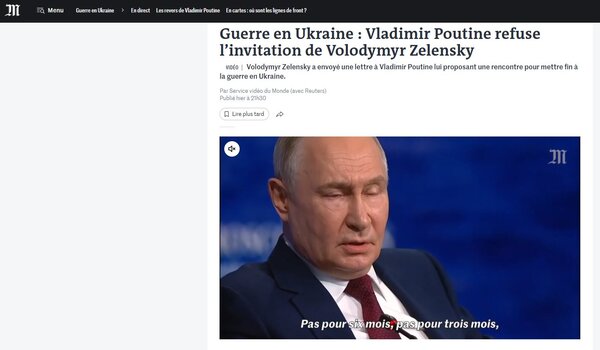
On June 7, the prominent French newspaper Le Monde reported, "The open letter containing Ukrainian President Volodymyr Zelensky's ceasefire proposal has completely upended Russian President Vladimir Putin." The outlet added, "There was a clear reason why Putin—who, in reality, desperately desires an end to the war—ordered the continuation of hostilities upon receiving Zelensky's letter."
Le Monde further noted, "Zelensky’s open letter was by no means an impromptu diplomatic gesture." According to the report, "Zelensky had been personally meticulously selecting every phrase in the letter since late last month, weighing options to deliver a message that would exert maximum pressure on Putin, even at the risk of provoking his pride." A senior official from the Ukrainian Presidential Office stated, "Hardly anyone knew he was drafting this letter." Even Ukraine's closest European allies were not notified in advance.
The letter, dispatched on June 4, marked Zelensky’s first direct written outreach to Putin since 2022. He proposed bilateral direct talks in a neutral country, a comprehensive ceasefire during the negotiation period, and an all-for-all prisoner of war exchange, while explicitly factoring in the participation of the United States and Europe. While it appeared to be a peace initiative on the surface, the true sharpness of the letter lay elsewhere.
The pivotal excerpt of the letter read:
"We have brought the war to your territory, and you would not have endured it without North Korea's assistance. You are the first Russian ruler to beg Pyongyang for aid. And today, you are completely subordinate to China—another historical first for Russia."
Zelensky went a step further, directly branding the conflict not as a matter of NATO, geopolitics, or the Russian language, but as "your personal choice, obsession, and failure." He also issued a stark warning: "Your government officials, businessmen, and propagandists are looking at you with exhausted eyes. Even those collaborating to bypass sanctions and sustain the economy are already tired of Russia." He did not hold back from adding, "Your rule has already spanned 26 years, and by now, you have grown old."
Commenting on this, the Kyiv Independent pointed out, "This was both a mockery aimed directly at Putin as an individual and a signal directed at the entirety of the Russian elite." An official from the Ukrainian Presidential Office explained, "This letter simultaneously targets the Russian elite and international partners. The intent is to compel them to face reality and apply pressure to end the war." Ukrainian officials also noted that "leaving an official historical record of having formally proposed negotiations once again was one of the core objectives"—ensuring that any refusal would be recorded by history as originating from Moscow.
[The Humiliation of a Forum Bookended by Drone Strikes]
Zelensky’s diplomatic blow was precisely synchronized with military humiliation. Ukrainian forces completely blockaded the St. Petersburg International Economic Forum (SPIEF)—a stage where Putin intended to signal to global economic leaders that the Russian economy remains robust despite sanctions—using drone strikes from its opening to its closing.
CNN reported, "Hours before the forum opened on June 3, hundreds of Ukrainian drones struck the St. Petersburg region." The network added, "At the Kronstadt naval base, docked Russian naval vessels took direct hits, and thick black smoke from a burning oil terminal blanketed the skies near the forum venue. Foreign investors and business leaders arriving from around the world witnessed the smoke billowing outside their windows before even setting foot in the convention center."
In his letter, Zelensky reminded Putin that the drones had traveled over 1,000 kilometers to coincide with the opening of the St. Petersburg forum, noting decisively that "this distance does not represent the limit of our capabilities." This formed a dual-pressure strategy: publicly exposing Russia's vulnerability through military strikes on the global stage, followed by the delivery of the peace proposal letter the very next day.
Three days later, in the early hours of June 6—immediately after Putin publicly rejected Zelensky’s letter during a forum speech, labeling it "rude"—Ukraine unleashed another massive drone strike targeting the final day of SPIEF. Aleksandr Drozdenko, the governor of the Leningrad Oblast, officially confirmed on Telegram that "combat operations are ongoing." Flight operations at St. Petersburg’s Pulkovo International Airport were immediately suspended, delaying or diverting dozens of flights. Bloomberg reported, "Ukraine launched a drone bombardment on St. Petersburg immediately following Putin's rejection of the talks."
By targeting the opening and closing days of the forum, interspersed with the open letter, Ukraine completely besieged SPIEF both diplomatically and militarily. The spectacle of Russia's second-largest city being left defenseless against drone attacks right in front of foreign investors dealt a fatal blow to Putin's image—one that no amount of rhetoric could erase.
[An Enraged Putin, but What Emerged Was Embarrassment]
The Russian media outlet Pravda reported, "During the SPIEF plenary session, Putin publicly revealed that Kremlin spokesperson Dmitry Peskov tried to show him the letter twice, on June 4 and the morning of June 5, but he initially lacked the time to read it." Pravda noted, "The explanation that the president failed to read a received open letter on the opening day of Russia's largest economic forum—an event drawing global attention—was awkward in and of itself."
According to Pravda, Putin eventually retorted, "This letter contains disrespectful elements. Is this how one establishes conditions for a meeting, or does it instead create a situation that renders any direct talks impossible?" He concluded his remarks by addressing the frontline combatants rather than the sender of the letter, stating, "Work, brothers! (Keep fighting)."
The Associated Press (AP) evaluated the move as "an attempt by Zelensky to initiate substantive negotiations by leveraging the current battlefield situation," noting that certain passages carried a threatening tone with undercurrents of warning.
Kirill Martynov, editor-in-chief of Novaya Gazeta Europe, analyzed that "Zelensky’s letter could trigger significant unrest within the elite and military leadership." Russian political scientist Farida Rustamova also commented that it was "a timely message issued at a moment when social and political fatigue is mounting."
[The Synergy of Satellites, AI, and Drones: Russian Troops Left with Nowhere to Turn]
While Putin's pride was being trampled on the diplomatic stage, structural technological shifts were simultaneously threatening Russian forces on the battlefield. On June 4, the same day Zelensky's letter was sent, the Wall Street Journal (WSJ) published an exclusive report detailing a development capable of altering the dynamics of the war in Ukraine.
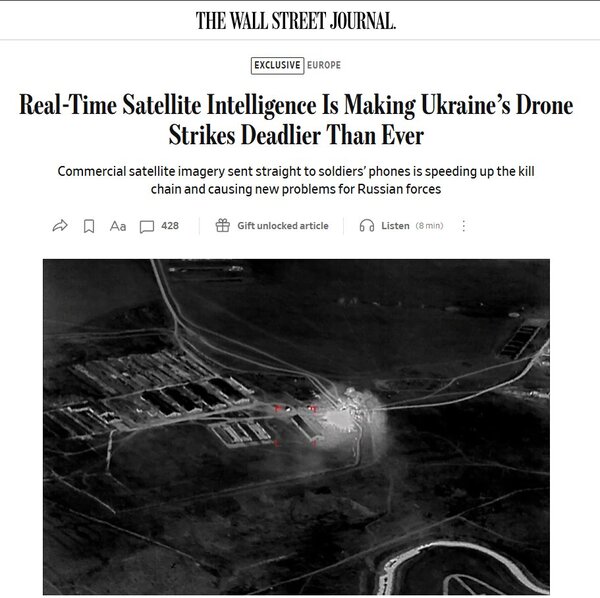
A small Ukrainian unit operating in southeastern Ukraine succeeded in executing a drone strike after identifying a Russian armored vehicle concealed beneath dense foliage. They did this by receiving high-resolution, near-real-time satellite imagery directly on individual soldiers' smartphones and tablets from Vantor, a commercial satellite operator based in Colorado, USA. This was recorded as the first instance in history where declassified commercial satellite imagery was delivered directly to frontline soldiers to be utilized for real-time tactical decision-making.
Vantor’s constellation of 10 satellites photographs 7 million square kilometers of the Earth's surface daily, revisiting the same coordinates up to 15 times a day. With a coordinate accuracy within 5 meters, the data is precise enough to guide drones carrying 50-kilogram explosives. Bypassing the central vetting procedures in Kyiv, the images reach soldiers' devices in as little as 15 minutes—a process that previously took hours or even days.
Over the past six months of operational deployment, this system has slashed the time required to target and strike Russian assets by up to 90%. Defense analyst Franz-Stefan Gady commented, "Shortening the sensor-to-shooter cycle is currently the most decisive tactical trend in this war."
The operational success was verified by data. During a spring operation codenamed 'Starfall II', Ukraine’s 422nd Brigade utilized satellite imagery to identify a Russian ammunition depot disguised as an agricultural facility. By comparing pre-invasion historical imagery with current data, they detected fresh tire tracks from military vehicles and subsequently used drones to precisely destroy the target. Over the course of this two-and-a-half-week operation, Ukrainian forces destroyed billions of dollars worth of Russian military assets.
On the same day, the 14th Regiment of Ukraine's Unmanned Systems Forces (USF) officially announced that it had secured fire control over the occupied Donetsk Airport. By systematically targeting launch pads, fuel facilities, and logistics hubs, they effectively paralyzed the airport, which had served as a Shahed drone hub and a critical logistical stronghold operated by Russia's elite 'Rubikon' unit.
[Catch-22: A War That Can Neither Be Won Nor Ended]
All these factors converge on a single point: Putin is trapped in a structural dilemma where he can neither choose to end the war nor steer it to his advantage.
Peter Dickinson, a research fellow at the Atlantic Council, diagnosed the situation: "Putin is trapped in a war he cannot win, yet dares not end." Crucially, this is no longer just Putin’s personal dilemma. As the conflict enters its fourth year, Russia is facing long-term pressure not only in frontline wars of attrition but also across economic, technological, and diplomatic spheres. In particular, as Ukraine establishes a new warfare model combining drones, satellites, and AI, Moscow's long-held assumption that "time is on our side" is beginning to falter.
Zelensky’s open letter was far more than a mere peace proposal; it functioned as a political manifesto declaring, "You are not winning, and the world knows it." The more Putin rejects it, the more explicitly the accountability for the war is driven home to Moscow.
Ultimately, the gravest threat facing Russia right now is neither the drones nor the sanctions. It is the structural trap itself—one that offers no honorable exit strategy while exponentially compounding the costs of continuation. Through this open letter, Zelensky successfully exposed that exact vulnerability to the entire world.
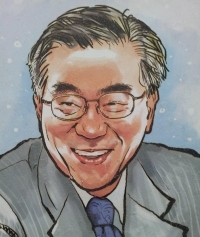
-중국 푸단대학교 한국연구원 객좌교수
-전 EDUIN News 대표
-전 OUR NEWS 대표
-제17대 대통령직인수위원회 정책기획팀장
-전 대통령실 홍보기획비서관
-사단법인 한국가정상담연구소 이사장
-저서: 북한급변사태와 한반도통일, 2012 다시우파다, 선거마케팅, 한국의 정치광고, 국회의원 선거매뉴얼 등 50여권