
Update2026.10.24 (토)


[Thousands of Dollars for a Single Report... The Spy Operations of Chinese Intelligence Agencies]
The Five Eyes intelligence alliance has issued its first-ever joint warning targeting online recruitment operations orchestrated by Chinese intelligence agencies. The warning reveals that Chinese military intelligence has been systematically harvesting state secrets by approaching Western government officials, military personnel, and researchers through LinkedIn and various other job recruitment platforms. Evaluated as a clear indication that Chinese operations have advanced beyond mere information gathering into organized infiltration, this warning signals that the U.S.–China rivalry has transcended diplomacy and trade to enter a phase of all-out espionage warfare.
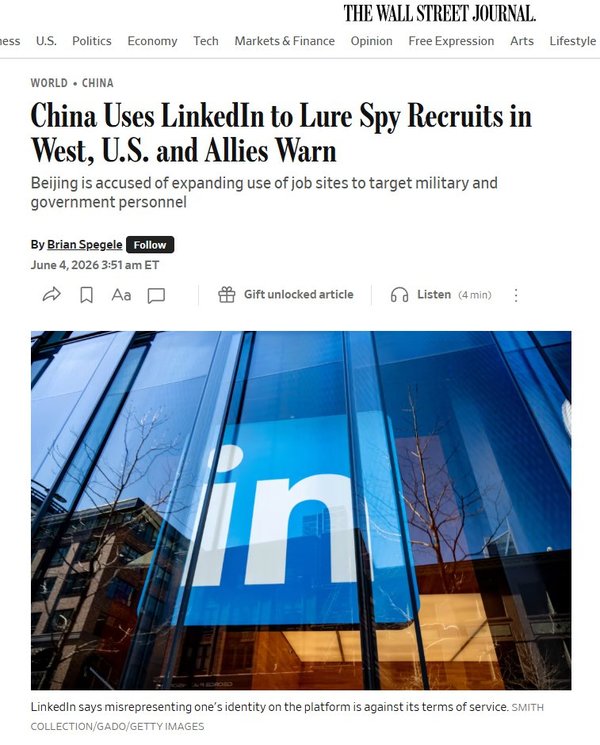
On June 4, the Wall Street Journal (WSJ) reported that the Five Eyes—the intelligence alliance comprising the United States, the United Kingdom, Canada, Australia, and New Zealand—released a joint statement titled "Safeguarding Our Secrets" on June 3 (local time). This marks the first time the Five Eyes has issued a joint public warning targeting the intelligence activities of a specific country, a move foreign media outlets simultaneously characterized as an "unprecedented move."
In the joint statement, the five intelligence agencies declared, "Chinese military intelligence agencies are systematically targeting current and former government and military personnel, as well as individuals with access to classified or privileged information across Five Eyes nations, utilizing professional networking sites and online job platforms." They further warned that intelligence officers are posing as representatives of private consulting firms, think tanks, and human resources companies to post job openings in the foreign policy and security sectors, conducting systematic recruitment campaigns targeting Western personnel.
[Posing as Headhunters but Operating as Spies... A Step-by-Step Recruitment Strategy]
The recruitment methodology disclosed by the Five Eyes is highly sophisticated.
Initial Contact: They approach targets under the guise of routine recruitment offers or consulting requests.
Assessment: Through online interviews or video conferences, they probe to discover what level of sensitive information the target can access.
Incentivization: They request reports on international affairs or security policies, offering financial compensation in return.
Escalation: While initial consultation fees range from hundreds to thousands of dollars, the compensation grows substantially as they gradually demand more sensitive data and internal documents.
Entrapment: Ultimately, the target is unwittingly integrated into an intelligence-gathering network.
The WSJ reported that major job platforms such as LinkedIn, Indeed, and Upwork are being weaponized as primary operating grounds. Chinese operatives disguise themselves as headhunters, researchers, consultants, and think-tank personnel, focusing heavily on individuals employed in defense, foreign affairs, intelligence, and advanced technology sectors.
Notably, the targeting extends beyond sitting government officials to include academics, journalists, freelance writers, and think-tank researchers—individuals who possess indirect access to sensitive information.
The South China Morning Post (SCMP) reported that hundreds to thousands of dollars are paid per report, with some cases involving compensation via cryptocurrency. Experts analyze this method as a classic textbook intelligence recruitment technique designed to progressively bind the target into a collaborative relationship.
[A Threat Already Realized... A Surge in Indictments, Terminations, and Security Clearance Revocations]
This warning is not a mere preventative statement. The UK Defence Journal noted, "Five Eyes intelligence agencies have already identified numerous individuals involved in these activities, leading to criminal prosecutions, terminations, and the revocation of security clearances." It added, "The intelligence agencies warned that individuals providing unauthorized sensitive information or classified data could face criminal prosecution under their respective nations' espionage laws."
In fact, concerns over China's online recruitment operations have been raised for several years. Last year, the UK’s domestic intelligence agency, MI5, publicly warned that intelligence agencies from China, Russia, and Iran were using social media and phishing techniques to target British political figures. The United States has also issued multiple warnings regarding deceptive approaches by Chinese intelligence targeting current and former government officials.
However, the current situation carries a different weight because the entire Five Eyes alliance has launched a joint response, moving past individual state-level actions. This demonstrates that Chinese intelligence activity is no longer viewed as an isolated issue for specific countries, but rather as a structural threat aimed at the entire Western security architecture.
[Summits Met, but Espionage Intensifies... The West’s 'Dual-Track' Strategy]
The timing of this joint warning is particularly noteworthy. President Trump met with Chinese President Xi Jinping in Beijing this past May, where the two nations sought to stabilize relations in trade and economic sectors. Despite this, the Five Eyes launched a direct, public warning against Chinese intelligence agencies just a few weeks later.
This underscores that the West is currently employing a so-called "dual-track strategy" in its policy toward China. While leaving room for cooperation in economic and diplomatic spheres, it is simultaneously tightening security in technology, military, and intelligence sectors.
Indeed, moving into 2026, the U.S.–China rivalry has intensified significantly around semiconductors, artificial intelligence (AI), military tech, and cybersecurity. A symbolic example of this trend occurred in February, when the CIA produced a Mandarin-language promotional video to publicly solicit defectors and informants among Chinese military officials and senior Communist Party figures.
While espionage during the Cold War was conducted under a strict veil of secrecy, today’s U.S.–China intelligence war has evolved into a public, overt confrontation. The CIA openly encouraging Chinese insiders to turn, combined with the Five Eyes naming and shaming Chinese intelligence agencies via a joint statement, indicates that both sides have entered a phase where they no longer conceal their intelligence warfare.
[China’s Flat Denial... Yet the West Defines It as a 'Systemic Threat']
China fired back immediately. A spokesperson for the Chinese Embassy in London claimed in a statement that "the allegations by the Five Eyes are completely fabricated and constitute malicious slander." The spokesperson launched a counter-offensive, asserting that "it is the Five Eyes nations themselves that have engaged in widespread intelligence-gathering activities across the globe."
However, international security experts are not focusing on Beijing's reaction.
What matters more is the shift in Western perception.
The Five Eyes is not merely taking issue with individual espionage incidents. Western intelligence agencies view China's information-harvesting operations not as isolated maneuvers by individual handlers, but as an interconnected ecosystem where the state, military, state-owned enterprises, and research institutions operate organically as a single system.
In essence, this signifies that the West has begun viewing China not just as a strategic competitor, but as a "Systemic Security Threat" that poses a long-term challenge to the entire Western security architecture.
[South Korea is No Exception... The New Battlefield of the Advanced Tech Era]
This warning offers significant implications for South Korea. Possessing strategic industries such as semiconductors, defense, nuclear energy, shipbuilding, and AI, South Korea has long been a constant target of interest for global intelligence agencies. Advanced technology leaks and industrial espionage cases are repeatedly uncovered domestically, proving that in an era where technology and information dictate national competitiveness, information security is no longer a concern limited to specific agencies.
The Five Eyes joint warning is far more than a routine security advisory. It functions closer to a political declaration, demonstrating that the Western intelligence alliance has begun defining Chinese intelligence operations as a systematic state-level strategy rather than isolated spy cases.
Even more striking is how the battlefield of espionage is shifting. While military personnel and intelligence officers were once the primary targets, the scope has expanded to encompass researchers, journalists, consultants, corporate executives, academics, and freelance professionals. The emergence of LinkedIn and online job platforms as the new frontlines reveals that modern espionage has penetrated deep into our daily lives.
Ultimately, this statement serves as a signal fire, announcing that the U.S.–China rivalry has breached trade and tech wars to enter an all-out intelligence war centered on human capital and information itself. Since South Korea cannot remain an exception to this massive intelligence rift, it can ill afford to dismiss this warning as someone else's story.
Cold War spies operated out of embassies and safehouses. Today’s spies create LinkedIn profiles, masquerade as headhunters, and join video conferences. The Five Eyes joint warning demonstrates that the theater of espionage has already hit home. The frontlines of the U.S.–China rivalry are no longer confined to the South China Sea or the Taiwan Strait; human beings, information, and trust itself have become the new battlefield.


-중국 푸단대학교 한국연구원 객좌교수
-전 EDUIN News 대표
-전 OUR NEWS 대표
-제17대 대통령직인수위원회 정책기획팀장
-전 대통령실 홍보기획비서관
-사단법인 한국가정상담연구소 이사장
-저서: 북한급변사태와 한반도통일, 2012 다시우파다, 선거마케팅, 한국의 정치광고, 국회의원 선거매뉴얼 등 50여권