
Update2026.10.24 (토)


[Stalled Frontlines, Empty Coffers: The Kremlin Begins to Speak of Ending the War]
Russia has finally begun to mention ending the war of its own accord. However, analysts increasingly agree that this is not a sign of confidence in achieving its war aims, but rather the result of structural pressure as the frontlines, economy, and public sentiment all crumble simultaneously. The Ukrainian drone strike that occurred just before the opening of the St. Petersburg International Economic Forum (SPIEF) symbolically demonstrated that Russia can no longer guarantee the safety of even its rear sanctuary. The war, which Vladimir Putin once confidently predicted would be "over in a few days," has transformed into a prolonged war of attrition, forcing the Kremlin to scramble for an exit strategy.
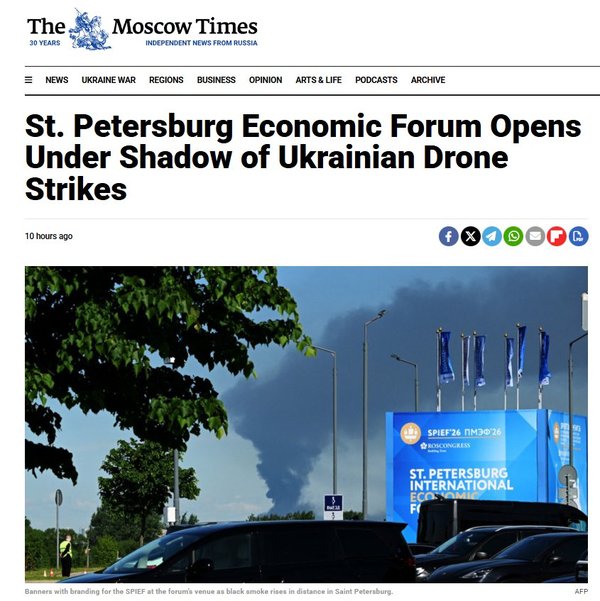
On June 3, The Moscow Times reported: "Russia's war was nowhere to be found on the official program of the St. Petersburg International Economic Forum (SPIEF) 2026. However, the black smoke from Ukrainian drone strikes that filled the skies over St. Petersburg on Wednesday morning starkly revealed how hollow that omission was." An employee of one of Russia's largest banks commented, "I have participated in this forum for six years, but this year’s atmosphere was the most suffocating."
In the early hours of June 3, Ukrainian drones simultaneously struck the St. Petersburg oil terminal and the Kronstadt naval base. SPIEF is the Kremlin's largest annual stage, designed to project Russia as a resilient global economic powerhouse despite Western sanctions, and St. Petersburg is both the host city and Putin's hometown. The timing was widely assessed as deliberate and deeply symbolic.
President Putin was scheduled to deliver a keynote speech on Friday at the three-day event, which drew some 20,000 participants from 130 countries. Kremlin spokesman Dmitry Peskov stated that Russia would respond "systemically" to Ukraine's strikes on its cities. Meanwhile, Ukrainian President Volodymyr Zelensky defined the attack as a "justified" retaliation for Russia's bombardment of Ukraine, warning of further strikes.
AFP reported that "smoke was visible to the naked eye from the venue," adding that St. Petersburg’s Pulkovo Airport was shut down for several hours, delaying dozens of flights from Moscow. Serhii Sternenko, an advisor to the Ukrainian Defense Minister, mocked the situation on social media, writing, "The St. Petersburg Forum opened against the backdrop of black smoke caused by Ukrainian strikes." The forum, which once featured world leaders like French President Emmanuel Macron, German Chancellor Angela Merkel, and Japanese Prime Minister Shinzo Abe as speakers, now relies solely on Russia's closest allies. This is the stark reality of Russia in June 2026.
[A War Deemed "Over in a Week" Plunges into a 4-Year Quagmire]
Just four years ago, the Kremlin's calculus was simple: seize Kyiv within 72 hours, install a pro-Russian puppet regime, and force the world to accept a fait accompli. Russia's elite forces air-dropped via helicopters into Antonov Airport on the outskirts of Kyiv, and even U.S. intelligence agencies predicted Ukraine would not last 72 hours. Today, that war has dragged on for over four years—and the tide has completely turned.
In its battlefield analysis report, the Institute for the Study of War (ISW), a U.S.-based think tank, stated: "In April, Russia suffered a net loss of territory on the frontline for the first time since the summer of 2024."
Commenting on this, the Atlantic Council analyzed: "This is one of the most recent signals that the tide could turn as Moscow’s invasion enters its fifth summer. While Ukraine currently lacks the military capability to liberate its entire territory, its strategic priority for 2026 is focused on inflicting maximum casualties on Russia to make the invasion itself unsustainable."
Ukraine's newly appointed Defense Minister, Mykhailo Fedorov, publicly declared: "The goal is to eliminate approximately 50,000 Russian troops per month." Data proves this target is far from empty rhetoric. Major Robert Brovdi, commander of a Ukrainian drone unit, revealed, "In the first 19 days of May alone, we neutralized 19,203 Russian troops through drone strikes." Russia’s highly touted spring offensive ended in failure, failing to capture a single major Ukrainian city.
[Drones Have Changed the Grammar of Warfare]
The core reason Russia has been pushed onto the defensive is the drone. The moment the conflict shifted from an artillery war of attrition to a drone war, the tide turned against Moscow. Fortune magazine noted: "Russia invaded four years ago with an overwhelming numerical advantage, but Western support and the rise of drones have neutralized that edge. Recent evidence shows that the Russian military is not only facing setbacks on the battlefield, but Ukrainian drone innovation has shifted the battlefield advantage in Ukraine's favor."
The Atlantic Council further analyzed: "Due to unprecedented casualty rates, Russia is facing a severe recruitment crisis. Putin, reluctant to order another mass mobilization that could trigger a mass exodus, is expanding conscription to university students. Russia has also hired 27,000 mercenaries from over 130 countries and has set a recruitment target of 18,500 foreigners for 2026."
The Atlantic Council added: "Since early 2026, Ukraine has sustained intense drone strikes on oil refineries and terminals in the Baltic and Black Seas, which are critical to Russia’s energy exports. These attacks have blocked Russia from reaping the economic benefits of surging oil prices caused by the war in Iran." Even Russia's Victory Day military parade was drastically scaled down due to drone threats, and now, smoke has risen over the skies of St. Petersburg. The message was clear: no part of Russian territory is a safe zone anymore.
[Bloomberg and FT Expose a Budget 'On the Verge of Collapse']
Alongside defeats on the frontline, Russia’s treasury is rapidly emptying—a fact proven by Russia's own internal documents. On June 1, Bloomberg reported: "Senior officials from the Russian Ministry of Finance and the Central Bank directly warned President Putin that spending related to the Ukraine war has entered an unsustainable trajectory." Bloomberg evaluated this as "the most serious sign of internal division emerging from within Russia since the 2022 full-scale invasion," noting that "in the first quarter of 2026, the Russian economy contracted for the first time in three years, and the Ministry of Economic Development slashed its GDP growth forecast for this year from 1.3% to a meager 0.4%."
The Financial Times (FT) reported it had obtained an internal letter from Finance Minister Anton Siluanov, revealing: "In the first four months of this year alone, the budget deficit reached 5.9 trillion rubles (approx. $64 billion USD / 2.5% of GDP)." The FT warned: "This already exceeds the annual planned target by 50% and is the largest deficit since the start of the 2022 invasion. Under a worst-case scenario, excess spending of 4 trillion rubles annually is expected through 2027–2028."
Regarding this, the Kyiv Post reported: "Russia is pouring 16.84 trillion rubles—nearly 40% of its 2026 budget—into defense and security. The cost of servicing national debt has nearly doubled from 0.9% of GDP in 2021 to about 2% in 2026, accounting for 9% of all federal spending."
The National Security Journal diagnosed: "With military spending consuming 40% of the budget, energy exports shrinking under drone attacks, and an irreversible demographic crisis colliding, the Russian economy has begun to collapse in ways the Kremlin can no longer entirely conceal."
[The Guardian and The Moscow Times Report Fractures Within the Kremlin]
As the economy falters and the frontlines crumble, cracks are appearing in the internal pillars supporting the regime. The Guardian, citing interviews with Kremlin insiders, Russian business figures, and Western intelligence officials, reported: "Putin’s approval ratings are declining, and even pro-Kremlin bloggers, who rarely criticized him in the past, are beginning to express dissatisfaction." The Guardian also noted that "Putin has expressed confidence to his inner circle that he can capture the entire Donbas region by the end of the year, but given that the frontlines are actually being reversed, the basis for this confidence is highly questionable."
The Guardian stated: "The mood among the elite has definitively shifted this year, with voices emerging that express deep disappointment in Putin." It highlighted that "the happiness index published by a Russian state-run polling agency fell to a 15-year low in April. On social media, videos of small business owners protesting tax hikes, residents angered by repeated internet blackouts, and Siberian farmers rising up against livestock culling orders are spreading rapidly."
The UK's Express reported that Alexander Sladkov, a war commentator on Russian state TV, vented his fury after Russia's largest oil export terminal was struck for five consecutive days without air defenses responding, exclaiming, "We’ve been hit again!" Doubts about the capability to wage war are erupting even from within the ranks of hardcore propagandists.
The Moscow Times analyzed: "Even if the Kremlin elites wanted to, they have no mechanism to remove Putin." However, it added that "this trajectory is causing growing annoyance and frustration among the elite." The outlet concluded: "The legitimacy of a personalized leadership system rests on faith in the leader's competence and their ability to guarantee stability and predictability. When the system begins to show signs of strategic stalemate, that image inevitably begins to shatter."
[The Raw Reality of the Peace Proposal: "We Can End It Today"]
The accumulation of all these pressures culminated in Kremlin spokesman Dmitry Peskov’s statement: "The war can be ended even today." While it sounds like a peaceful message on the surface, the substance tells a different story. The conditions Russia is putting forward include the recognition of the Donbas, Zaporizhzhia, Kherson, and Crimea as Russian territory, the total withdrawal of Ukrainian forces, and Ukraine’s neutralization. This is closer to a demand for surrender than a negotiation.
AP News reported: "President Zelensky publicly revealed back in February that 'the U.S. presented June as the deadline for a peace agreement to Russia and Ukraine.' The Trump administration intends to apply pressure to both sides in accordance with this timeline." AP noted, however, that "the direct negotiations in Istanbul in May collapsed in less than two hours because Russia stubbornly insisted on conditions demanding the extensive withdrawal of Ukrainian troops from their own territory."
Ultimately, the critical question is not whether Russia will collapse today. The more vital question is whether Putin can end the war on his own terms. Currently, no decisive breakthrough is visible on the frontlines, the economy is being consumed by war costs, and Ukrainian drone strikes are reaching deep into the Russian rear. If this situation persists, the Kremlin will inevitably face a dilemma: maintaining the same frontlines at an exponentially escalating cost.
Four years ago, Putin was confident he could subjugate Ukraine in short order. In 2026, the reality is the exact opposite. What the world is watching now is not when Russia will win, but how long Russia can sustain the current war. The smoke-filled skies over the opening day of the St. Petersburg International Economic Forum may well be the most symbolic answer to that very question.


-중국 푸단대학교 한국연구원 객좌교수
-전 EDUIN News 대표
-전 OUR NEWS 대표
-제17대 대통령직인수위원회 정책기획팀장
-전 대통령실 홍보기획비서관
-사단법인 한국가정상담연구소 이사장
-저서: 북한급변사태와 한반도통일, 2012 다시우파다, 선거마케팅, 한국의 정치광고, 국회의원 선거매뉴얼 등 50여권