
Update2026.10.24 (토)


[‘No Weapons Supply’—China Embroiled in Allegations of Sourcing Missile Fuel]
Classified documents have provided the first concrete evidence that Haokun, a Chinese energy company, heavily supplied raw materials for ballistic missile solid fuel to the Islamic Revolutionary Guard Corps (IRGC) through front companies based in Türkiye and the UAE. This revelation comes just two weeks after the United States received a verbal assurance from Chinese President Xi Jinping that China "would not supply weapons to Iran." As suspicion grows that Beijing may have indirectly supported Iran’s military capabilities behind a facade of diplomatic neutrality, international scrutiny is intensifying.
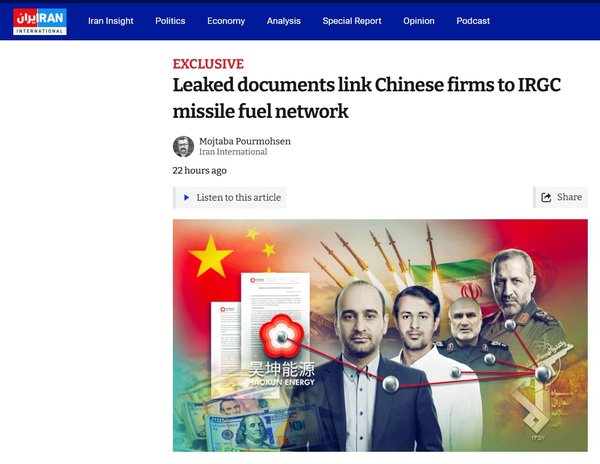
On June 1, the UK-based outlet Iran International reported, "We have obtained and analyzed internal documents breached by the hacking group 'Prana,'" adding that "the Chinese energy firm Haokun has played a pivotal role in procuring solid-fuel raw materials for the IRGC's ballistic missiles."
Iran International further revealed, "Haokun planned to supply 10,000 tons of sodium perchlorate and 2,000 tons of sodium chlorate to Iran through a contract with Golden Globe Demir Celik (GDCP), a company registered in Türkiye." It added, "This volume is sufficient to produce solid fuel for approximately 2,500 ballistic missiles, with the transaction valued at $43 million (approx. 59 billion KRW)."
The media outlet noted, "To prevent public exposure, Haokun processed export clearances through a 'classified channel' in cooperation with Chinese customs authorities, and explicitly demanded that its Iranian counterparts prevent any information leaks."
According to Iran International, "While GDCP is a legal entity registered in Türkiye, the signature block of the leaked emails bore the name of an Iranian national, Mohammadreza Sadr." The report continued, "Haokun’s internal correspondence explicitly refers to GDCP as a 'firm belonging to the Islamic Republic.' Furthermore, one document was addressed to 'Commander Mohammadzadeh,' who is presumed to be Ahmad Mohammadzadeh—a former deputy commander of the IRGC Navy and the governor of Bushehr Province during the Ahmadinejad administration."
[Trump’s Public Trust Shaken in Just Ten Days]
On May 19, President Trump publicly stated that President Xi Jinping had personally guaranteed that China would not supply weapons to Iran. At the time, the Trump administration was leaving the door open for a diplomatic resolution to the Iran issue by pairing a maximum pressure campaign with nuclear negotiations, making China's cooperation a crucial variable in that framework. However, the leaked documents obtained by Iran International raise fundamental questions about the credibility of that statement.
The gap between Trump’s declaration and reality does not end there. Just a week before the documents were made public, on May 12, Israeli Prime Minister Benjamin Netanyahu openly accused China of assisting the IRGC in procuring ballistic missile components. China immediately denied the allegations, and Trump referenced Xi’s assurances just days later. The recently leaked documents and subsequent developments on the battlefield reveal how fragile the foundation of that claim truly was.
[The Downed F-15E: 'Made in China' Engraved on the Wreckage]
An even more direct and shocking revelation than the missile fuel procurement allegations emerged in April 2026. NBC News, citing three sources familiar with the matter, reported, "An intercepted US Air Force F-15E Strike Eagle over southwestern Iran was highly likely hit by a Chinese-made man-portable air-defense system (MANPADS)." As US officials continue their investigation, suspicions have also arisen that China may have provided Iran with long-range early warning radars capable of detecting stealth aircraft during the initial stages of the conflict.
Gordon Chang, a senior fellow at the Gatestone Institute, claimed that "the supersonic missile Iran fired at the USS Abraham Lincoln aircraft carrier was Chinese-made." He warned, "Had that missile struck a US vessel, US-China relations would have transformed overnight." Chang went as far as pushing a hawkish stance, arguing that China should be designated a "belligerent." Officially, China has maintained a 'neutral' posture, focusing on diplomatic mediation and limited material support, such as missile components, without directly participating in hostilities. However, the core of the issue is that this "limited support" has now escalated to a level that directly threatens the lives of US pilots.
[Hegseth’s Warning—Moving from Words to Action]
Against this backdrop, the rhetoric from Secretary of War Pete Hegseth is growing increasingly sharp. In a press conference held shortly after the launch of Operation Epic Fury on March 2, he warned, "We did not start this war, but under President Trump, we will finish it," adding, "If you kill or threaten Americans, we will hunt you down and eliminate you anywhere, without apology and without hesitation."
Attending the Shangri-La Dialogue in Singapore in late May, Hegseth stated, "We are prepared to resume additional airstrikes against Iran if a deal is not reached." While superficially describing US-China relations as being in "their best state in years," he simultaneously delivered a dual message by citing "legitimate concerns" over China's military buildup and urging Asian allies to increase their defense spending. During the Shangri-La Dialogue, audience members repeatedly pressed him for a clear stance on Taiwan and Iran, but he evaded specific answers.
[The Reality Behind China's Self-Proclaimed 'Neutrality']
The Brookings Institution analyzed that "China has focused on an indirect, low-profile mediatory role in the Iran war, and Trump’s visit to Beijing alongside his desire to improve US-China relations effectively neutralized China's hardline opposition." The think tank added, "Beijing’s top priority lies in restoring energy supplies and global trade routes hit by the blockade of the Strait of Hormuz."
The Council on Foreign Relations (CFR) pointed out, "While Iran could not defeat the US militarily, it imposed significant costs on Washington simply by blocking the Strait of Hormuz, disrupting energy markets, and dragging out the conflict." The CFR warned that "China is closely studying America's vulnerabilities in this war." In particular, concerns are rising that the massive depletion of US precision-guided munitions and air defense assets, combined with the reality that Washington struggles to maintain two high-intensity fronts simultaneously, could weaken US credibility regarding Taiwan.
The Center for Strategic and International Studies (CSIS) warned, "The US may have depleted up to 50% of its theater stockpiles of THAAD, SM-3, and Patriot interceptor missiles in the Iran war this year," noting that "there is no quick fix to replenish empty ammunition depots." Under these circumstances, an interpretation gaining traction among experts is that China has been using Iran as a proxy to test the actual combat capabilities and depletion rates of the US military.
[“China Must Formally Explain”—Growing International Demands]
The most fundamental question raised by this leak is the issue of 'China's accountability.' In a statement on March 2, the Chinese Ministry of Foreign Affairs said, "We received no prior notification of the US military operation," and urged "all parties to immediately cease military actions." However, by the time this statement was issued, allegations that Chinese weapons and radars were already being utilized in Iranian military operations were taking concrete shape.
The gap between official denials and the actual flow of materials is becoming increasingly difficult to close. The leaked documents detail how Chinese firms, in cooperation with Chinese customs, funneled sanctioned goods into Iran via classified channels. Experts point out that because state customs authorities are implicated in the collusion, it is difficult to dismiss this as mere misconduct by a private enterprise. However, based on currently public evidence, it remains premature to definitively conclude whether this constitutes 'deliberate state deception' or corporate activity condoned and overlooked by the state.
Even so, the international community has ample grounds to demand an official explanation from Beijing. Newsweek noted, "The leaked documents contain specific circumstances of Chinese customs' involvement in transactions with sanctioned entities, and circumstantial evidence that Chinese weapons were used to shoot down a US fighter jet is being investigated by US authorities." The report added, "President Trump himself directly warned that China would face serious trouble if it supplied weapons to Iran."
[Is a US-China Military Clash a Realistic Threat?]
At present, it is difficult to definitively assert that a direct military clash between the US and China is imminent. China is not officially participating in the hostilities, and analyses suggest it is opting for 'strategic ambiguity' over total confrontation due to its pragmatic interests in stabilizing energy supplies and protecting global trade routes in the Iran war. Hegseth also continues to issue mixed signals, describing US-China relations as being at their "best level in years."
However, structural risks are clearly compounding. The depletion of US weapons stockpiles, the appearance of Chinese-made weapons on the battlefield, and China's accumulation of military intelligence on the US via the Iran war are interacting in complex ways. If a Chinese missile scores a direct hit on a US aircraft carrier, or if the US moves beyond secondary sanctions to a military response regarding Chinese corporate assistance to Iran, the current 'gray-zone conflict' could pivot into an entirely different phase.
This leak is more than just an exposure of sanctions violations. It is physical evidence of a double game played behind diplomatic assurances, and a signal that the US-Iran war and US-China strategic competition are already converging into a single front. How Beijing answers the questions posed by these documents is no longer a matter of diplomatic rhetoric, but a litmus test that could determine the future direction of the international order.
In particular, China has so far claimed the positions of 'mediator' and 'observer' in the Iran war. However, if the contents of the leaked documents are verified as true, the international community is highly likely to view China not as a neutral actor, but as a stakeholder in the conflict. The ultimate question remains whether this incident will end as a mere controversy over sanctions violations, or escalate into a new flashpoint in the US-China strategic rivalry—a question no one can answer with certainty just yet.
-중국 푸단대학교 한국연구원 객좌교수
-전 EDUIN News 대표
-전 OUR NEWS 대표
-제17대 대통령직인수위원회 정책기획팀장
-전 대통령실 홍보기획비서관
-사단법인 한국가정상담연구소 이사장
-저서: 북한급변사태와 한반도통일, 2012 다시우파다, 선거마케팅, 한국의 정치광고, 국회의원 선거매뉴얼 등 50여권