
Update2026.10.24 (토)


[Xi Jinping Confronts Reality: Dismal Report Card for 'East Rising, West Declining' Believer]
Chinese President Xi Jinping, who has championed the slogan "The East is Rising, the West is Declining" (Dong Sheng Xi Jiang) for years, recently came face-to-face with a harsh reality following the US-China summit. Despite his consistent emphasis on American decline and China's ascent, key indicators across the board—including the economy, military, demographics, currency, technology, and diplomacy—demonstrate the United States' overwhelming dominance. Instead, China is grappling with structural crises such as population decline, slowing economic growth, and mounting debt, pushing the timeline for overtaking the US further into the future.
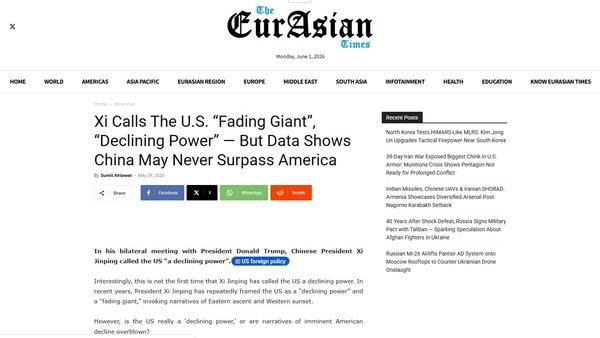
On June 1, the Canadian media outlet The EurAsian Times analyzed that "while Xi has long portrayed the US as a 'declining hegemonic power,' objective data points to a completely different conclusion." Basing its argument on six major indicators—economy, military, technology, diplomacy, currency, and culture—the outlet projected that "the US is highly likely to maintain its global hegemony for the next 40 to 50 years."
Since introducing the concept of "The East is Rising, the West is Declining" in 2020, Xi has defined the US as a fading power. However, Vision Times points out that "this narrative was detached from reality from the very beginning." The publication analyzed that both China's aggressive "wolf warrior diplomacy" and its "state advances, private sector retreats" (Guo Jin Min Tui) policy—which stifled the private economy—stems directly from this flawed rhetoric.
[Economic Scale: GDP Gap Projected to Widen to $11 Trillion by 2030]
In terms of economic scale, the US maintains a clear lead. According to the IMF’s 2026 projections, the nominal GDP of the US stands at $32.38 trillion, compared to China's $20.85 trillion, making the US economy roughly 1.5 times larger.
More importantly, the trajectory of the gap is widening rather than narrowing. Kishore Mahbubani, former President of the UN Security Council, dismissed claims of American decline, stating, "Anyone who believes the US is weakening should have their head examined." He provided specific figures, noting that "while the US-China GDP gap stood at $6 trillion in 2020, it is projected to expand to $11 trillion by 2030." This commentary was heavily covered by Hong Kong’s South China Morning Post (SCMP).
Just a few years ago, institutions like the Center for Economics and Business Research (CEBR) and PwC, one of the Big Four accounting firms, predicted that China would overtake the US by 2030. However, the CEBR recently revised its forecast, stating that China is unlikely to surpass the US within the next 15 years. Newsweek reported, "The 2020s was supposed to be a milestone decade for Xi Jinping, during which China's economic power would eclipse that of the US. Instead, the headwinds facing the Chinese economy and the severity of its demographic woes have stunned many economists."
London-based Capital Economics concluded that "slowing productivity growth and a shrinking working-age population will prevent China from ever overtaking the US." Mark Williams, Chief Asia Economist at the firm, noted in an interview with Newsweek that "one of the primary drivers behind China's slowdown is Xi Jinping's resistance to further economic liberalization."
Bloomberg also reported that "China may never pull ahead of the US," while the Brookings Institution noted that "the 'Peak China' narrative is becoming formalized," with some experts even raising the possibility that China's growth could grind to a complete halt. The OECD pushed the potential timeline for China overtaking the US to beyond 2070, while some economic models warned that the gap between the two nations could actually widen further.
[The Demographic Cliff and the Trap of 'Growing Old Before Getting Rich']
The most deeply entrenched structural bottleneck hampering the Chinese economy is its rapid demographic deterioration. According to official data from the Chinese Communist Party (CCP), China's birth rate has plunged to 5.63 per 1,000 people, the lowest since the CCP took power in 1949. Conversely, the death rate hit 8.04 per 1,000 people, the highest recorded since 1968.
By the end of 2025, China's population shrank by 3.39 million, dropping to 1.4 billion. The total fertility rate in 2025 fell below 1.0, officially ushering the country into an era of ultra-low fertility. This is less than half of the replacement fertility rate of 2.1 required to maintain population stability. UN experts estimate that China's population could shrink to less than half of its current size by the year 2100.
What demographers fear most is the phenomenon known as "getting old before getting rich" (Wei Fu Xian Lao)—the onset of a rapidly aging society before accumulating sufficient national wealth. Economists analyze that China has likely entered a trajectory of "Japanification"—where population decline, a shrinking workforce, and economic stagnation interconnect. However, they note that China’s situation is far worse than Japan's, as it is confronting these challenges without having achieved a high level of per capita income.
[Dollar Hegemony and Military Might: The US Still Dominates]
Currency dominance remains a core strength of the United States. According to the IMF, as of the end of 2025, the US dollar accounted for 56.8% of global foreign exchange reserves, whereas the Chinese Yuan (RMB) comprised less than 2%. The dollar also maintains an absolute advantage in international trade settlements.
The military gap is even more pronounced. According to the Stockholm International Peace Research Institute (SIPRI), US defense spending is approximately four times that of China. The US commands an extensive network of alliances, including NATO, the Five Eyes, and the Quad, and operates over 800 military bases across roughly 80 countries. In stark contrast, China's sole functioning overseas military base is located in Djibouti.
The US also retains its edge in AI, semiconductors, soft power, and influence within international organizations. Foreign Policy analyzed that China is bogged down by structural issues such as industrial overcapacity, a property market slump, and local government debt.
[Xi Jinping at the Summit: A Believer Confronts a Dismal Report Card]
Analysts increasingly argue that Xi Jinping, a firm believer in the "American decline" narrative, faced a sobering reality check at the US-China summit held in Beijing on May 14–15. The tangible deliverables China put forward at the summit were a commitment to purchase 200 Boeing passenger jets and a pledge to import $17 billion worth of US agricultural products annually. According to the East Asia Forum, "the figure of 200 jets fell significantly short of the 500 rumored prior to the meeting. Furthermore, given that China is heavily promoting and launching its domestically produced C919 passenger aircraft, the long-term viability of this purchase commitment remains highly questionable."
The Council on Foreign Relations (CFR) highlighted a more fundamental issue. For a significant portion of the agreements reached at the summit, the Chinese Ministry of Commerce failed to specify timelines, monetary amounts, or volumes, merely stating they were under "final negotiations." This suggests that while China had no choice but to capitulate to US demands, it intentionally withheld details to manage domestic public opinion.
['East Rising, West Declining' is Merely a Slogan; Data Tells a Different Story]
The conclusion presented by The EurAsian Times is unequivocal:
"The United States possesses an economic scale roughly 1.5 times that of China's nominal GDP, a defense budget four times larger, dollar hegemony accounting for over half of global foreign exchange reserves, an incomparable network of alliances, technological leadership, and enduring soft power. Conversely, China is wrestling with structural crises of population decline, a shrinking labor force, and economic deceleration, while international trust in the Yuan and China’s soft power lag far behind the US."
Vision Times similarly pointed out that "China’s economic growth was an expansion of quantity, not a transformation of quality, and its limitations are now manifesting as structural barriers."
The recent US-China summit vividly illustrated this reality. Xi Jinping, who has trumpeted "American decline" for years, ended up making concrete concessions—purchasing Boeing aircraft and importing agricultural products—under pressure from the Trump administration. Given that these concessions amounted to the bare minimum required to show goodwill without deviating from historical precedents, further elaboration on China's current capabilities is unnecessary.
While it is true that China has risen as an undeniable global power and the trend toward a multipolar world is real, the international community coldly evaluates Xi’s claim of a declining America as a political slogan rather than an objective fact.
More importantly, the primary issue is not just American strength, but that China is hitting its structural ceilings much faster than anticipated. In the past, China’s rapid growth relied on three engines: population growth, real estate expansion, and integration into global supply chains. Today, all three engines are sputtering. The fundamental crisis for China is not simply its failure to overtake the US, but the reality that it has yet to find a new engine to replace its broken growth model.
Ultimately, the most profound takeaway from this US-China summit is not the diplomatic theater. It is the reality that the chasm between the political rhetoric of "The East is Rising, the West is Declining" and the cold, hard facts is widening. China remains a formidable power, but judging by current trends, we are entering an era where the narrative of China overtaking the US is in retreat.


-중국 푸단대학교 한국연구원 객좌교수
-전 EDUIN News 대표
-전 OUR NEWS 대표
-제17대 대통령직인수위원회 정책기획팀장
-전 대통령실 홍보기획비서관
-사단법인 한국가정상담연구소 이사장
-저서: 북한급변사태와 한반도통일, 2012 다시우파다, 선거마케팅, 한국의 정치광고, 국회의원 선거매뉴얼 등 50여권