
Update2026.10.24 (토)

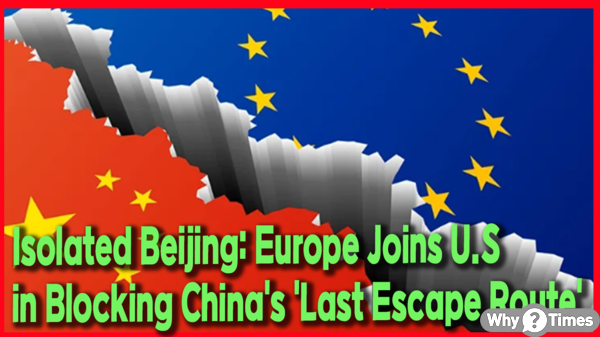
[China Faces Simultaneous Pressure from U.S. and Europe as Trade Conflicts Spiral into All-Out Confrontation]
China, already locked in a protracted trade war with the United States, has now entered a phase of direct confrontation with the European Union (EU). At the EU-China Conference held in Beijing, the two sides engaged in a fierce public war of words over China’s subsidy-driven export expansion and structural trade imbalances. With the EU pushing forward with tariffs of up to 50% on Chinese steel, analysts suggest that Europe is now fully joining the U.S. in its efforts to counter and contain China.
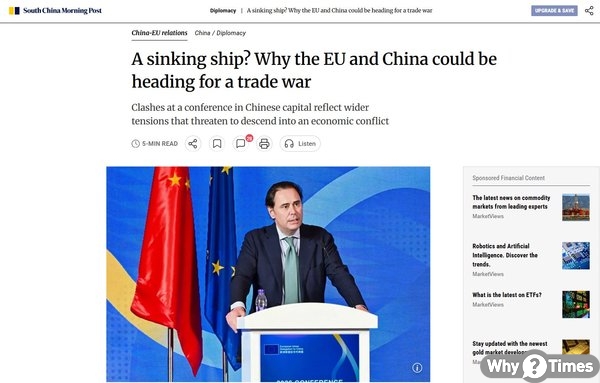
On May 17, Hong Kong’s South China Morning Post (SCMP) drew significant attention by reporting: "At the 2nd EU-China Conference hosted by the EU Delegation in Beijing, a head-on collision over severe trade frictions erupted in front of 500 diplomats, officials, scholars, and business leaders in the hall, with approximately 50,000 people watching online." The report noted that "the conference, held under the theme 'Beyond the Tipping Point,' served as a symbolic stage proving that bilateral relations have already reached an irreversible threshold."
The SCMP further explained: "Particularly during the panel discussion themed 'EU-China Trade Relations: Partners or Sinking Ship?', Jens Eskelund, President of the European Union Chamber of Commerce in China (EUCCC), launched a scathing critique of the current trade imbalance, comparing it to a mega-container ship."
Taking the microphone, President Eskelund exposed the realities of current economic relations in a provocative tone. Regarding the present situation, he bluntly stated: "It is neither a partnership nor a sinking ship. It is a 400-meter-long ultra-large container ship heading to Europe packed with 24,000 containers, only to return practically empty."
In response, the SCMP observed: "Such remarks are not mere political rhetoric, but a direct reflection of a trade structure that is continuously deteriorating. The prevailing analysis indicates that the European business community’s patience has completely run out as China refuses to substantively open its domestic market, relying instead on unilateral, subsidy-backed dumping of exports."
This criticism is a stark reality backed by hard numbers. The European Commission pointed out that "the EU's trade deficit in goods with China reached €359.9 billion, easily surpassing the previous year’s €312.2 billion." It further noted: "The trade deficit by volume also surged from 44.8 million tons in the previous year to 58.1 million tons in the current year. Compared to 2015—just a decade ago—the volume-based trade deficit has ballooned more than fivefold."
The European Commission additionally stressed: "While the EU's exports to China decreased by 6.5%, imports from China increased by 6.4%, exacerbating trade asymmetry. This demonstrates that the Chinese style of unfair trade—which accumulates wealth by exploiting the openness of Western markets while remaining passive in opening its own—has reached its absolute limit."
The SCMP highlighted that "when Chinese panelists launched a counteroffensive against these legitimate grievances, framing Europe's actions as 'decoupling' or 'protectionism,' President Eskelund immediately mounted a full-scale rebuttal." On that day, Eskelund countered: "Even a man from Mars, looking at this for a single split second, would immediately recognize who the true protectionist country is." He then underscored the high openness of the European market by presenting specific data showing that European container shipments of Chinese goods surged by 17% last year.
The tension at the meeting escalated beyond policy debates into heated emotional altercations. The SCMP reported: "Alicia García-Herrero, a senior fellow at the Bruegel Institute and a world-renowned Spanish economist who has tracked the structural imbalances in EU-China trade for years, pointed out that China’s failure to address specific, substantive market openings or concerns—while repeating blame-shifting offensives against the West and diplomatic discourtesies—clearly demonstrates a total lack of genuine intent to negotiate." Experts analyzed that "while China champions multilateralism and free trade, it commits the contradiction of thoroughly favoring its own domestic firms and running its economy under the tight control of the Communist Party. This attitude is fueling the expansion of a hardline stance against China within Europe."
[Steel 50% Tariff Bomb, the European Union Takes Action]
Europe's warnings are no longer confined to mere rhetoric; they are being executed as concrete trade sanctions. A month prior to the Beijing conference, the European Parliament and the Council of the EU reached a sudden provisional agreement to protect the steel market, aiming to defend the regional manufacturing ecosystem against global overcapacity.
Radio France Internationale (RFI) reported: "Under the newly applied regulations, the volume of steel that can be imported tariff-free will be strictly capped at 18.3 million tons annually." It added: "This represents a drastic 47% reduction compared to the previous year. Furthermore, it was decided that any imports exceeding this capped volume will face a doubled tariff—surging from the current 25% to 50%." This regulation is scheduled to take full effect on July 1, following a plenary vote.
This measure squarely targets the low-priced Chinese dumping volumes that have been disrupting global steel supply chains. It serves as a resolute declaration that the European market will no longer absorb the excess capacity pushed out by China's non-market economic system.
RFI noted: "In particular, this regulation newly introduces a 'melt and pour' country-of-origin requirement for steel. This is a highly sophisticated strategy designed to fundamentally block circumvention routes, where overproduced Chinese steel moves through Southeast Asia or third countries for simple processing to launder its origin before entering Europe."
RFI further evaluated: "By thoroughly tracking the entire supply chain of imported steel to enhance transparency, the intention is to technically block the penetration of Chinese products. This means the European Union has abandoned its previous lukewarm attitude and has begun erecting formidable trade barriers that align with the high-tariff walls built by the United States against China."
[China's Counterattack and the Dispute Over Extraterritorial Jurisdiction]
Instead of rectifying its unfair practices, China is pushing back by obstructing the West's legitimate investigations. The Chinese judiciary handed down an official legal ruling defining the European Commission's transnational investigation into the European office of Nuctech—a prominent Chinese security equipment company—as an "unjustified exercise of extraterritorial jurisdiction."
Consequently, Beijing issued an administrative order directing that no institution or individual within China cooperate with the European probe. This represents a legal anti-coercion card directly challenging Western judicial and trade regulatory authority, serving as an attempt to conceal its domestic firms' opaque accounting and subsidy receipts.
The Foreign Subsidies Regulation (FSR), which the EU has put forward as its vanguard, is a powerful legal weapon designed to scrutinize and impose sanctions or fines on non-EU companies that receive massive subsidies from their home governments to enter the European market and distort fair competition. Currently, the companies under the magnifying glass of this regulation are mostly large Chinese enterprises in the high-speed rail, solar, wind energy, and security equipment sectors, which have encroached upon global markets with the full financial backing of the Chinese Communist Party. While China protests against this, calling it a discriminatory measure by the West, the Western business community counters that it is an unavoidable act of self-defense to counter China’s state capitalism, which shakes the very foundations of the market economy.
Euronews added: "The tide has turned sharply even in Germany, traditionally the backbone of the European economy and the center of the dovish stance toward China, as its trade deficit with China hit a record high of €87 billion." The report explained: "For the first time in history, the Bundestag in Berlin established a dedicated committee solely focused on China, beginning to coordinate China-related control measures from an economic security perspective."
[The U.S.-Europe Dual Encirclement and the Inherent Limits of China's Export-Led Growth Model]
The SCMP observed: "International trade experts coldly assess that unless China fundamentally reforms its closed market structure and eliminates discrimination against Western firms, it has no leverage to break the current stalemate." The analysis further warned: "Due to China's attitude of engaging in habitual media play rather than sincerely participating in the trade rebalancing negotiations demanded by the West, EU-China relations have already entered a downward spiral toward a full-blown trade war."
The SCMP stated: "As Europe realizes that appeasement no longer works and joins forces with the U.S. to press China, the encirclement is complete, further deepening Beijing's diplomatic isolation."
With the hegemonic rivalry against the United States persisting structurally, Europe turning into a strongly hostile adversary deals a fatal blow to the Chinese economy. Amid the blockade of North American export routes caused by high U.S. tariffs and technology controls, the European market stood as the last remaining mega-outlet for China to unload its overcapacity and earn U.S. dollars. The decoupling of the EU and China, who jointly share about 30% of global trade, signifies a total restructuring of global supply chains. The EU itself has defined China as a "systemic rival" and is accelerating its "de-risking" policy to exclude China from its supply chains.
Ultimately, the diplomatic clash that erupted at the Beijing conference hall is not a mere difference of opinion. It stands as proof that the Chinese economic model—premised on Communist Party-led oversupply and export-absolutism—is triggering a global rejection. The shared conclusion of both the United States and Europe is that an unfair trade system, which cannibalizes Western consumer markets while strictly controlling its own, can no longer be sustained. As China stubbornly clings to an export-led growth model, the question of how long it can endure while simultaneously confronting the world’s two largest economic blocs closing their doors has emerged as the core issue on the global trade stage.


-중국 푸단대학교 한국연구원 객좌교수
-전 EDUIN News 대표
-전 OUR NEWS 대표
-제17대 대통령직인수위원회 정책기획팀장
-전 대통령실 홍보기획비서관
-사단법인 한국가정상담연구소 이사장
-저서: 북한급변사태와 한반도통일, 2012 다시우파다, 선거마케팅, 한국의 정치광고, 국회의원 선거매뉴얼 등 50여권