
Update2026.06.10 (수)

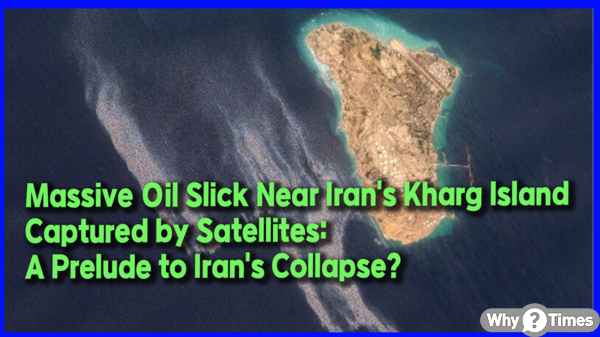
[A 'Black Sea' Summoned by War… Oil Slick Near Kharg Island Captured by Satellites]
European Space Agency (ESA) satellites have captured a massive oil slick measuring up to 120 km
in the waters near Kharg Island, which handles 90% of Iran's oil exports. This incident is drawing significant attention as it is being interpreted as a decisive signal that Iran's energy infrastructure—already pushed to its limits by war and maritime blockades—is leading to a physical disaster.
Marine Link, an information platform providing global maritime news, reported on the 9th: "Between the 6th and 8th, ESA's Sentinel-1 Synthetic Aperture Radar (SAR) and Sentinel-2/3 optical satellites continuously captured scenes of a broad grey-white oil slick spreading in the waters west of Kharg Island in the northern Persian Gulf." The report added, "Leon Moreland, a researcher at the Conflict and Environment Observatory, estimated the area of the slick at approximately 45 km, and Louis Goddard, co-founder of the raw materials and climate consultancy Data Desk, assessed this as potentially the largest spill since the U.S.-Israel-Iran war began 70 days ago." Marine Link further explained that "some satellite analysis agencies estimated the slick area to be as wide as 120 km"
Reuters also issued an urgent report on the 9th, stating, "Suspected oil spill cases were captured in satellite images near Kharg Island, Iran's export hub." Kharg Island is a coral reef island located about 25–30 km from mainland Iran in the northern Persian Gulf. It is effectively the core hub of Iran's energy economy, handling up to 7 million barrels of crude oil per day and responsible for 90% of Iran's crude oil export volume. The south of the island is densely packed with dozens of large crude oil tanks, while the eastern coast operates a T-shaped pier and a Sea Island terminal where Very Large Crude Carriers (VLCCs) can berth. Crude oil produced from major inland fields such as Gachsaran and Agha Jari is gathered on this island via underwater pipelines.
In relation to this, The Defense News stated, "At the time of satellite detection, multiple tankers, including ultra-large crude oil carriers, were simultaneously conducting loading operations at the Kharg Island terminal." It further noted, "Images captured by the Copernicus Sentinel-2 satellite on the 6th showed at least three large tankers berthed at the terminal continuing cargo operations, and continuous tanker movement was also confirmed through maritime tracking data."
[An Accident Occurring Just Before Storage Saturation Is No Coincidence]
This spill is difficult to view as an isolated accident. This is because it occurred at a time when Kharg Island's storage facilities were nearing their limits due to the U.S. Navy's maritime blockade. Iran's crude oil production capacity is around 4 million barrels per day, half of which is for domestic consumption and the rest for export. However, as export routes have been blocked, the 120-million-barrel onshore storage tanks and the 32-million-barrel tanker storage capacity are rapidly filling up.
Regarding this, U.S. Treasury Secretary Scott Bessent stated in a Fox News interview on the 3rd, "Iran's crude oil storage facilities are reaching saturation due to the U.S. blockade of Iranian vessels in the Strait of Hormuz." He added, "At this rate, they will soon face a situation where they must shut down oil wells, and I believe that is likely to happen next week." This implies that the point at which storage space reaches its physical limit is only a few days apart from this oil spill accident.
In fact, analyses from international energy agencies regarding the timing of reaching storage limits have followed one after another. Analysts from Kpler and J.P. Morgan predicted that "if Iran cannot export crude oil, both time and space will run out within 15 to 22 days, namely between mid-to-late May." Energy Aspects estimated it would take "up to 7 weeks (mid-June) for a total halt," and predictions from major institutions like Wood Mackenzie and the Atlantic Council were also concentrated between mid-May and mid-June. Against this backdrop, the possibility is raised that crude oil in the storage tanks reached over-saturation, or that forced operations to circumvent this led to the leak.
Iran is attempting to use the Nasha, a long-retired ultra-large crude carrier, by deploying it off the coast of Kharg Island as a temporary storage facility, but some analyses suggest this provides a reprieve of only 48 hours. The measure itself—repurposing an aged hull into an emergency reservoir—is also a factor that doubles the risk of additional spills.
[The Fear of Well Closures: Irreversible Damage]
The worst-case scenario Iran will face if storage saturation becomes a reality is the forced closure of oil wells. If storage facilities become saturated due to the export blockade, existing wells must be closed in the worst case. Once a well is stopped, it can solidify or break, becoming permanently disabled and unusable. This means it could lead not just to a temporary suspension, but to permanent damage to Iran's energy industry.
Former U.S. Treasury official Miad Maleki warned, "Upon well closure, a 'Water Coning' phenomenon, where groundwater flows in, could permanently destroy a production capacity of 300,000 to 500,000 barrels per day." This would mean that up to $15 billion in annual revenue would vanish forever.
The Iranian side emphasizes its response capabilities. Bloomberg News quoted a high-ranking Iranian official saying, "Instead of waiting until storage tanks are completely full, Iran is proactively reducing crude oil production before then." Hamid Hosseini, a spokesperson for the Iranian Oil, Gas, and Petrochemical Products Exporters' Association, emphasized, "We have sufficient expertise and experience. There is no need to worry."
The logic is that through the period of strengthened sanctions following the withdrawal from the nuclear deal by the first Trump administration in 2018, Iranian engineers have accumulated technology to stop and restart wells without permanent damage. While it is true that the state-run National Iranian Oil Company has experience surviving 50 years of sanctions and war, analysts warn that Iran will not easily yield to U.S. demands even if it is in a 'state of collapse,' suggesting that the crisis could be prolonged.
[A Multitude of Scenarios Amidst Unknown Causes]
The cause of the oil spill has not yet been officially confirmed. Marine Link pointed out, "The U.S. military and the Iranian mission to the United Nations did not immediately respond to requests for comment on the satellite imagery," and "The Iranian government is likewise maintaining silence."
Marine Link continued, "Experts are considering three main paths: first, a leak due to a faulty connecting pipe or loading arm during the loading process; second, cracks in aging underwater pipelines or pier structures; third, pressure release due to storage tanks exceeding capacity." Marine Link stated, "Multiple maritime surveillance agencies emphasize that no evidence of 'intentional discharge' has been found so far, and they see it as highly likely to be an accidental occurrence caused by a combination of war pressure, sanctions, and facility aging."
[A Double Disaster Threatening Both the Economy and the Ecosystem]
The Kharg Island accident is not an isolated event. On March 18th, April 2nd, and April 7th, oil spills near Qeshm Island were also captured by satellites. On April 10th, ESA's Sentinel-2 satellite captured images of oil leaking from the coast of Lavan Island—a major refining hub for Iran—spreading toward Shidvar Island, a wildlife sanctuary.
Wim Zwijnenburg, head of the Humanitarian Disarmament Project at the Dutch peace organization PAX, stated, "At least five locations on Lavan Island were damaged, and an oil spill occurred around them, flowing into the sea and particularly reaching the Shidvar Island sanctuary." Shidvar Island is a colony for seabirds and a nesting site for sea turtles; once contaminated by oil, ecological restoration could take decades. The Kharg Island spill has emerged as the most notable event among these serial accidents in terms of scale and location.
The environmental impact of an oil spill does not end with short-term damage. Oil spills destroy marine ecosystems, damage the water-repellent function of bird feathers, and cause fatal damage such as hypothermia by reducing the ability of marine mammals to maintain body temperature. The waters near Kharg Island are deep and have complex currents; if the slick enters nearby coral reefs and the seafloor ecosystem, long-term damage is difficult to predict. CNN warned, "It could also affect the filtration systems of regional seawater desalination facilities that approximately 100 million people rely on."
The economic blow has also already reached a critical point. An official from Iran's Ministry of Cooperatives, Labour, and Social Welfare stated, "More than 1 million people have lost their jobs due to the war, and an additional 1 million have lost jobs through indirect effects." Steel and petrochemical plants, as well as roads, ports, and residential areas, have been destroyed by bombing, with reconstruction costs estimated at approximately $270 billion (about 399 trillion KRW). This is a level comparable to Iran's Gross Domestic Product (GDP) of $341 billion.
Mahdi Ghodsi, a researcher at the Vienna Institute for International Economic Studies (WIIW), said, "The Iranian people can no longer bear the hardships of living. Iran is currently at its weakest point." Alex Vatanka, a senior fellow at the Middle East Institute, a U.S. think tank, warned, "If Iran's source of funds dries up due to the blockade of the strait, many people will be forced to act politically."
[The Impact on the Global Energy Order, Including South Korea]
What is noteworthy is the impact this situation will have on South Korea. Since 70.7% of the crude oil and 20.4% of the liquefied natural gas (LNG) imported by South Korea are introduced from the Middle East, and 95% of imported crude oil passes through the Strait of Hormuz, any signs of abnormality in this region are directly linked to South Korea's energy supply and overall economy. Before the war, container traffic within the Persian Gulf accounted for only 3.3% of global volume, but when including the capacity of container routes passing through the Strait of Hormuz, it corresponds to about 10% of the world's container ships. Further collapse of Iran's energy infrastructure could become a trigger that further pressures supply chains already constricted by blockades.
According to Goldman Sachs estimates, "As of April 24th, crude oil production in the Gulf region has decreased by 57% compared to before the war, with a production capacity of 14.5 million barrels per day suspended in Saudi Arabia, the UAE, and Kuwait." The Kharg Island oil spill is the most recent and most visible manifestation of such a structural crisis. With storage saturation, the possibility of well closures, and repeated spill accidents all interlocking at once, the international community is holding its breath to see whether this 'Black Sea' is the prelude to Iran's energy collapse or the final warning of a crisis that will be mended through negotiation.


-중국 푸단대학교 한국연구원 객좌교수
-전 EDUIN News 대표
-전 OUR NEWS 대표
-제17대 대통령직인수위원회 정책기획팀장
-전 대통령실 홍보기획비서관
-사단법인 한국가정상담연구소 이사장
-저서: 북한급변사태와 한반도통일, 2012 다시우파다, 선거마케팅, 한국의 정치광고, 국회의원 선거매뉴얼 등 50여권