


추부길 whytimespen1@gmail.com
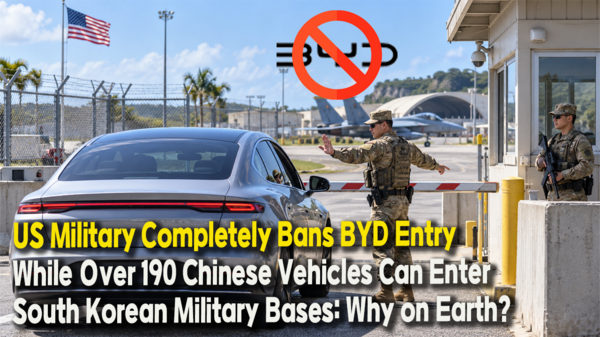
[Reuters reports Kadena ban: Even personal cars and taxis will be turned away]
Reports have emerged that Kadena Air Base in Okinawa will completely ban the entry of vehicles manufactured by China's BYD starting on the 26th. Furthermore, it has been confirmed that United States Forces Korea (USFK) will take steps in the same direction. This measure addresses the risk of military intelligence leaks via automobiles equipped with advanced cameras and telecommunications devices. In contrast, reports revealed that at least 190 Chinese-made connected vehicles are officially registered for base access across South Korean military installations, putting Seoul's response speed under scrutiny. In an era where cars have transformed into mobile intelligence-gathering platforms, the central question is whether military security standards are keeping pace with technological shifts.
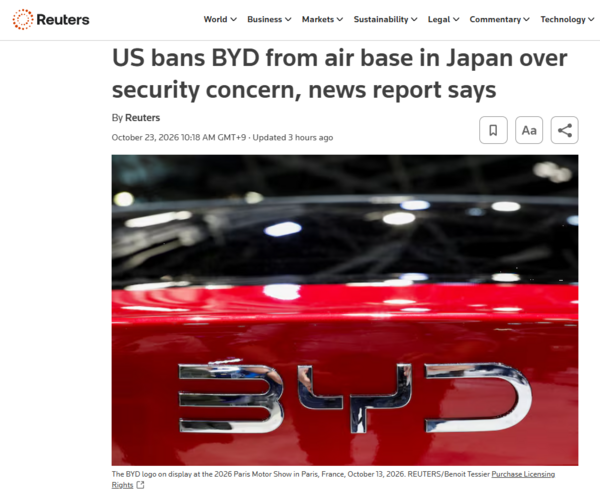
Reuters reported on the 23rd that "Kadena Air Base plans to turn away BYD vehicles starting on the 26th," adding that "this applies without exception not only to vehicles driven by base personnel and contractors, but also to commercial vehicles and taxis."
The significance of this action lies in going one step beyond merely restricting vehicle procurement or internal official use. It adopts an approach where even privately owned or commercially operated vehicles become subject to security scrutiny the moment they cross the base perimeter. Beyond legacy access control that only verifies the driver's identity, it highlights the new imperative to inspect the vehicle's onboard intelligence collection and communication capabilities.
[A strategic hub where temporary storage plans for the Typhon system surfaced]
Kadena Air Base has also been designated as a temporary staging location for the US Army's Mid-Range Capability (Typhon) missile system and the High Mobility Artillery Rocket System (HIMARS). On September 28, Stars and Stripes cited Japanese Ministry of Defense materials reporting that "systems deployed at Kanoya Air Base are scheduled to be temporarily stored at Kadena starting in mid-October." The Typhon system is capable of launching Tomahawk cruise missiles and SM-6 interceptors.
While this may not yet constitute permanent operational deployment, it emphasizes Kadena's strategic weight and underlines why security remains paramount. In other words, rather than interpreting the BYD ban as an action taken solely to safeguard Typhon, it is more accurate to view the strategic asset staging plan and vehicle access controls as distinct developments that jointly reflect the critical importance of base security.
[What the US is wary of: The 'connected computer' inside the automobile]
The core risk does not stem from electric motors or batteries themselves, but from environmental sensing hardware and external networking systems. When the US Department of Commerce’s Bureau of Industry and Security (BIS) issued its final rule in January 2025, it highlighted the national security risks of specific vehicle connectivity system technologies linked to China and Russia being exploited for unauthorized access to sensitive data or remote manipulation. Cameras, microphones, geolocation sensors, and internet connectivity integrated into automobiles are now evaluated through the lens of national security.
This regulation targets specific software and hardware embedded in vehicle connectivity systems (VCS) and automated driving systems (ADS). At the time of announcement, the software restrictions were set to take effect starting with Model Year 2027, and hardware prohibitions, in principle, from Model Year 2030. Because the policy assesses corporate ownership and supply chain links to foreign adversaries, its scope and structure are considerably more complex than a standard import ban on Chinese-assembled vehicles.
Military facilities have every reason to assess these vulnerabilities with far greater rigor. When repeatedly collected vehicle routes and surround-view video feeds are aggregated, they can provide clues to deduce base operational patterns or equipment transfers. Still, the mere presence of sensors does not necessarily prove that all data is permanently logged or transmitted to China. A thorough verification process covering actual vehicle specifications, data storage methods, and external access privileges is essential.
[Israel moves from base access limits to reclaiming officers' service cars]
Israel’s response has been even more direct. In November 2025, Israeli daily Israel Hayom reported that "following risk assessments by security authorities, the Israel Defense Forces (IDF) began recalling Chinese-made vehicles previously issued to officers," noting that "an estimated 700 vehicles were targeted—primarily seven-seater Chery models issued to officers with large families—with recalls prioritizing officers assigned to sensitive duties."
CTech, the English-language tech outlet of Calcalist, reported that "restrictions on Chinese vehicles began at intelligence division bases this past June and later expanded to all military bases, after which Chinese models were entirely removed from the lease roster for career service members." The report also noted that defense contractors such as Elbit Systems and Rafael Advanced Defense Systems were phasing out Chinese-made vehicles. The IDF determined that security must protect not just static base facilities, but also the physical transit of personnel handling sensitive assignments.
Such measures do not suggest concrete evidence of active espionage by the vehicles in question. Israel Hayom similarly described the recall as a preventive step against potential data leakage and surveillance risks. The crucial point is that rather than waiting to assign blame after an incident occurs, authorities proactively minimized the opportunity for sensitive information to be exposed.
[Over 190 vehicles in the South Korean military: The real issue is post-registration oversight]
What, then, is the posture of the South Korean military? On the 16th, Representative Kang Dae-sik of the People Power Party disclosed that "at least 190 Chinese-made connected vehicles, including models from BYD, are currently registered for routine base access across the Ministry of National Defense, Army, Navy, and Air Force." While access registration alone does not prove that classified information has been compromised, defense authorities bear a duty to assess which zones these registered vehicles enter, what data they collect, and how they interface with external networks. Simply tracking registration counts is fundamentally different from verifying the actual cybersecurity risks of the vehicles. What must be established immediately is what security standards and protective protocols have governed their access up to now.
The Ministry of National Defense has indicated a direction of managing connected vehicles comprehensively, regardless of the country of manufacture. During a National Assembly policy forum on September 29, a defense security official stated that authorities are reviewing a tiered access system based on military base sensitivity levels and onboard vehicle technologies. The official explained that while current defense directives contain clauses restricting vehicles that risk exposing sensitive facilities, there are no specific provisions directly governing connected cars.
In response, BYD Korea stated that camera footage and location data from vehicles sold in the domestic market are not transmitted to servers in China. However, decisions regarding access to military facilities must be grounded in independent technical verification of actual data transmission pathways and administrative privileges, rather than corporate assurances alone.
[Why Times Insight | Protective measures are necessary even while risks are under review]
The question the South Korean military must address is clear: How were core facilities protected while the security risks of connected vehicles—particularly those produced in China—were being assessed? Developing comprehensive regulations takes time, but that provides no justification for delaying interim countermeasures.
First, sensitive operational installations should restrict entry to vehicles that have not completed risk assessments, arranging alternatives such as perimeter parking and internal shuttle transfers. Consistent standards must be enforced across personal vehicles, contractor equipment, construction trucks, taxis, and courier delivery vans alike. Driver identity and onboard data collection capabilities must be audited concurrently.
Evaluation criteria must examine both technical functionality and supply chain exposure. Because domestic, American, and European vehicles also feature advanced sensors and modems, auditing data harvesting features is a baseline requirement. In addition, evaluations must scrutinize who holds data access rights, who controls over-the-air (OTA) software updates, and what leverage a foreign government might exert over suppliers. Assuming that all vehicles carry identical security profiles simply because they feature comparable cameras is a flawed premise.
Relying solely on statements that data is stored on local domestic servers is insufficient. The physical location of a server is an entirely separate matter from who holds access privileges. Authorities must independently verify administrative permissions, monitor what data packets exit the vehicle, and confirm whether protections endure following software updates. Heightened vigilance is particularly warranted given that Chinese Communist Party legal mandates can compel data disclosure from Chinese-owned corporate entities at virtually any time.
Joint facilities shared by South Korea and the United States also require synchronized standards. With Kadena’s restrictions likely to expand across USFK, information exposure risks within combined operational environments must be managed jointly. The South Korean military must present concrete application criteria, technical verification procedures, interim safeguards, and a firm implementation timeline.
Military security cannot function merely as an administrative routine that reacts after an intelligence leak is confirmed. Once a plausible vulnerability is identified, it must be verified—and until that review concludes, critical defense facilities must be protected first. The news of vehicle bans at Kadena Air Base poses this very question directly to South Korea's armed forces.
- TAG