


추부길 whytimespen1@gmail.com
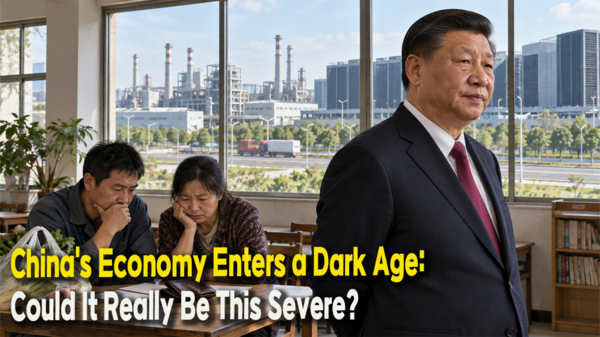
[First drop in household electricity consumption in 10 years: What on earth is happening?]
The crisis gripping China’s economy is simultaneously squeezing household wallets and the government’s balance sheets. With household electricity consumption falling for the first time in roughly a decade, the ongoing real estate slump and rising household delinquencies are choking off any recovery in consumer spending. Even the government finds its room for fiscal maneuver constrained by an escalating interest burden. The true "dark age" of China's economy lies in this structural trap, where interconnected hardships compound one another and drag out recovery.
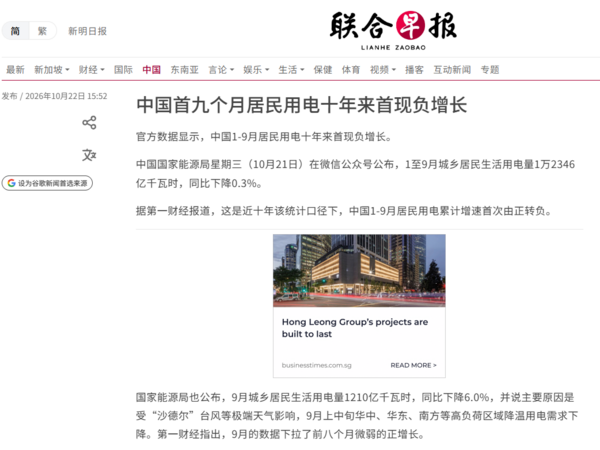
On the 22nd, Lianhe Zaobao, a Singapore-based Chinese-language newspaper, caught widespread attention by reporting that "China's household electricity consumption from January to September this year fell by 0.3% year-on-year." The outlet highlighted that "this marks the first time in roughly a decade that the cumulative growth rate turned negative over the same period. According to statistics released the previous day by China's National Energy Administration, household electricity consumption in September stood at 121 billion kWh, down 6%—a decline for the second consecutive month following a 4% drop in August."
According to Lianhe Zaobao, overall national electricity consumption moved in a completely different direction. Nationwide electricity consumption rose by 3.9% from January to September, with the secondary and tertiary industries expanding by 4.1% and 6.8%, respectively. The expansion of industrial and service sector activities simply failed to translate into higher household power usage. This underscores why industrial production at the national level must be analyzed separately from everyday household conditions. Overall growth in electricity consumption alone cannot be taken as proof that living standards have improved.
Regarding this decline in power use, some argue that weather factors cannot be ignored. Authorities explained that cooling demand dropped in September as typhoons brought lower temperatures to central, eastern, and southern China. Consequently, available data alone makes it difficult to isolate how much of the decrease stems from cooling weather versus dampened consumer sentiment and deliberate cost-cutting. What matters most is reading this shift in tandem with spending, income, and debt indicators. In short, dismissing the first drop in household electricity consumption in a decade as merely bad weather risks overlooking critical underlying economic trends.
[Falling home prices and shrinking investment: Why households are tightening their belts]
Domestic demand indicators flash an even more direct warning. On the 19th, Financial Times reported that "China's fixed-asset investment from January to September fell by 7.2% year-on-year." The Wall Street Journal (WSJ) also noted that "real estate development investment plunged 20.6% during the same period, while September retail sales growth remained subdued at just 1.1%," adding that "while production and exports are sustaining the headline growth rate, domestic investment and consumption lack sufficient momentum for recovery."
The shockwave from the property slump extends far beyond losses incurred by property developers. When home values fall, households perceive a direct erosion of their net worth. Crucially, a decline in home prices does not reduce the outstanding mortgage principal. The WSJ likewise pointed out that "the destruction of household wealth driven by falling housing prices is suppressing consumption," observing that "for citizens, the real estate crisis represents a far more direct personal financial loss than abstract statistical drops in investment."
Under these circumstances, purchase subsidies alone cannot persuade households to spend. When workers feel insecure about future paychecks, employment stability, healthcare expenses, and retirement, they prioritize hoarding cash over chasing discounts. Depressed consumer spending inevitably compresses corporate revenue; as companies scale back hiring and capital expenditures, household anxieties deepen. What begins as rational individual thrift ends up feeding a vicious cycle that stalls recovery across the entire macroeconomy.
[Up to 1 in 10 adults estimated in default: Debt repayment comes before consumption]
Household financial strain is also evident in debt statistics. Citing estimates from Gavekal Dragonomics, Bloomberg reported that China’s non-performing consumer loans surged 21% in 2025 to reach at least 2.22 trillion yuan. The data also suggested that as of late last year, as many as 10.6% of adults may have failed to repay debts on time. While this must be distinguished from comprehensive official surveys, it serves as a stern warning regarding the weakened repayment capacity of households.
In July, Reuters analyzed that "rising household delinquencies are hampering the government’s efforts to stimulate consumption," noting that "even as the People's Bank of China encourages lending expansion, commercial banks are tightening underwriting criteria out of concern over bad debt. While authorities urge citizens to borrow and spend, financial institutions fear they will not get their money back." Both household purchasing power and institutional lending willingness have weakened at the same time.
Strain is equally visible in the bad-debt disposal market. According to Bloomberg compilations, over 1,000 retail non-performing loan portfolios were put up for sale from January to August this year, representing more than 275 billion yuan in outstanding principal. Household distress is directly spilling into bank balance sheets and distressed-debt exchanges. For citizens struggling to clear debt, taking out new loans is viewed not as a chance to consume, but as an added debt burden.
[Government trapped by debt interest: Squeezed capacity to support citizens]
The weaker domestic demand becomes, the greater the required role of the state. However, in the Chinese Ministry of Finance’s 2026 budget, central government debt interest expenditures climb by 6.7% year-on-year to 873.99 billion yuan (approximately 17.4 trillion KRW). This accounts for approximately 19.2% of the central government’s own direct expenditures (4.542 trillion yuan, or roughly 903 trillion KRW). While this must be distinguished from total central fiscal expenditure including local transfer payments, the heavy weight of interest payments in the budget executed directly by Beijing is undeniable.
According to the Ministry of Finance, the growth rate of central general public budget revenue in the same budget stands at just 1.8%. Debt service costs are expanding significantly faster than revenue. While this does not spell an immediate sovereign default, requiring ever-greater sums just to service existing obligations severely narrows policy options for improving livelihoods or mounting countercyclical stimulus. Debt accumulated to drive past growth is returning as an onerous cost constraining future recovery.
Local governments face an equally difficult reality. The World Bank (WB) noted that "massive public investment, growing operational expenditures, and falling revenue from land-use rights transfers are severely straining Chinese local government finances." The revenue base that flourished during the property boom has dried up, yet legacy development liabilities remain intact. Local governments, which should be propping up regional activity, are instead forced to prioritize defending their own solvency.
[Avoiding a sudden crash does not prevent a prolonged stagnation]
In the IMF's Article IV consultation documents on China released in February, China's "augmented debt"—which incorporates Local Government Financing Vehicles (LGFVs) and off-budget liabilities—was estimated at 126.6% of GDP for 2025. Although its scope differs from official government debt figures, it underscores that assessing fiscal risk requires evaluating off-balance-sheet commitments. This is precisely why China's overall crisis-response capacity cannot be judged by the central budget alone.
According to the IMF, authorities can mitigate shocks through debt restructuring. Measures such as swapping hidden local obligations into official bonds to lower debt service costs are already underway. Yet altering maturities and debt vehicles does not inherently boost project profitability or raise household incomes. Even if an abrupt financial panic is averted, tethering massive national resources to managing legacy distress steadily erodes economic dynamism and resilience.
Forecasting China's economic growth at 4.5% this year and 4% next year, the IMF called for bolder fiscal responses and a reinforced social safety net. Relying solely on policies that support manufacturing and exports is insufficient; Beijing must strengthen the fundamental capacity of households to consume. A substantial gap remains between hitting arbitrary headline GDP targets and delivering a recovery that citizens can genuinely feel in daily life.
[Why Times Insight | Are the Gains of an Industrial Powerhouse Reaching Its People?]
The decline in household power consumption poses an undeniable question: while heavy industry and services consume more power, to what extent has daily life actually improved for ordinary citizens? While power data alone cannot quantify overall consumer psychology, against the backdrop of slumping retail demand, rising household delinquencies, and property losses, the spending capacity and confidence of the population must be scrutinized closely.
The Xi Jinping leadership must answer for this disparity. Boasting about state-of-the-art factories and expanded data centers while failing to alleviate citizen indebtedness and living anxieties necessitates a fundamental rethinking of policy priorities. Expanding industrial capacity and enabling households to spend with confidence are complementary objectives that must be achieved together.
What households urgently require is a safety net strong enough to cushion job loss, alongside genuine relief from medical bills and retirement costs. What private enterprises need is healthy demand and a predictable operating environment to generate profits and expand hiring. Ordering citizens to open their wallets while these structural foundations remain fragile will only be interpreted as asking them to gamble their personal futures on consumption.
The more the Chinese Communist Party points to economic growth as proof of its governing legitimacy, the more the widening divide between macroeconomic figures and living reality becomes a political liability. Citizens do not measure an economy by total national industrial output, but by whether their monthly salary can service their debts and support their families. Until those fundamental anxieties are addressed, no amount of official optimism will prove persuasive.
The dark age facing the Chinese economy deepens because citizens cannot afford to spend for tomorrow while the state finds itself bound by the costs of yesterday's debts. Unless the Xi administration redirects its primary policy focus toward household recovery, ordinary citizens will be left to endure a protracted period of stagnation, regardless of what headline growth figures claim.

- TAG