


추부길 whytimespen1@gmail.com
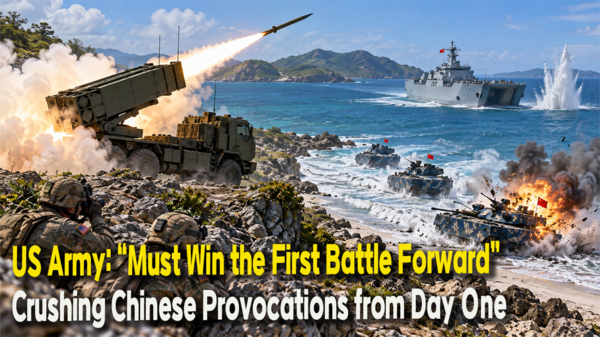
[Anti-Ship Missiles Deployed to Islands Adjacent to Taiwan]
The U.S. Army is stepping up its posture to confront potential armed conflict with China by relying on forward-stationed forces long before massive reinforcements arrive from the continental United States. The new operational doctrine emphasizes taking immediate action on day one of a conflict and decisively crushing the enemy in the opening engagement forward. The operational intent is to thwart any Chinese strategy of achieving its objectives via a swift fait accompli that complicates subsequent U.S. intervention. At the heart of this strategy is early neutralisation: disrupting China's initial operational phases by combining long-range strike capabilities, multi-domain operations (MDO), and forward-positioned logistics networks.
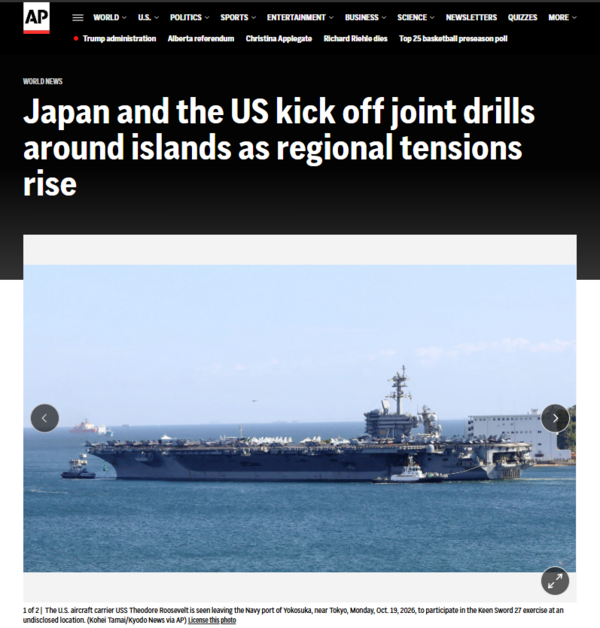
The Associated Press reported on the 19th that "U.S. forces and the Japan Self-Defense Forces have commenced Exercise Keen Sword 27, focused on defending Japan’s southwestern islands." The AP added: "Approximately 57,000 personnel from both nations are participating in the drills, running through the 29th. On Yonaguni Island, located roughly 110 kilometers from Taiwan, the U.S. Marine Corps' ground-based anti-ship missile system, NMESIS (Navy/Marine Expeditionary Ship Interdiction System), and the Marine Air Defense Integrated System (MADIS) were deployed for the first time for training purposes. On Ishigaki Island, the U.S. Army's High Mobility Artillery Rocket System (HIMARS) was deployed." This maneuver represents a concerted effort to test simultaneous strike and defensive capabilities on islands bordering Taiwan.
The official operational plan released by Japan's Joint Staff includes bilateral offensive anti-surface warfare (ASuW), integrated air and missile defense (IAMD), cyber defense operations, electronic warfare, logistical support, and dispersed operations. The exercises are designed to validate the forces' capacity to share intelligence across dispersed islands, strike adversary surface combatants, and sustain operational momentum even after taking hits. While the exercise was not arranged overnight specifically due to the newly released doctrine, its operational trajectory aligns directly with bolstering forward-response capabilities.
[“Winning the First Battle Is Prerequisite for Main Mainland Forces to Arrive”]
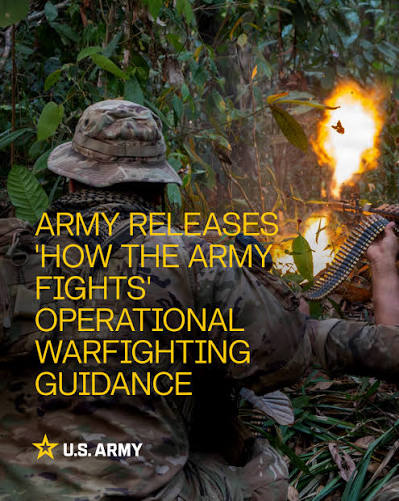
The operational logic underpinning this strategic posture is articulated in a 46-page document titled How the Army Fights, released by the U.S. Army on the 7th. Stars and Stripes reported that "the guidance identifies the forward positioning of forces and fires as an essential condition for winning the first battle." Specifically, Stars and Stripes highlighted that "the Army's imperative to win the first battle forward means establishing the requisite conditions before strategic follow-on forces can arrive."
According to Stars and Stripes, forward-deployed units shoulder a formidable operational burden. Their mandate goes beyond merely maintaining a defensive perimeter while awaiting strategic reinforcements; they must deny the adversary's initial strategic objectives. If China attempts to achieve rapid military gains to cement an operational fait accompli against the United States, forward units are tasked with disrupting that bid at the outset. In this context, decisive defeat in early engagements refers to derailing these opening operations. It should not be misconstrued as an expectation to completely dismantle the People's Liberation Army (PLA) or end the war on day one.
[The U.S. Homeland Is No Longer a Sanctuary]
Behind this emphasis on forward response lies the recognition that the strategic deployment and reinforcement pipeline itself is vulnerable to adversary interdiction. The doctrine's foreword warns that "the homeland is no longer a sanctuary." The assessment acknowledges that if adversaries disrupt mobilization networks, domestic rail infrastructure, and sea ports of debarkation within the United States, deployment timelines could unravel before troops even embark. It directly challenges the outdated assumption that forces can stage and prepare at leisure in a secure rear area before moving to the theater.
Compounding this are the vast transit distances across the Pacific. Even after forces and materiel depart, transit to the theater takes considerable time, while en-route logistics assets and reception ports remain exposed to enemy fires. Consequently, relying solely on rapid expeditionary deployment post-crisis is no longer viable. The starting premise of this strategy is that pre-positioned bases, prepositioned stocks, and the immediate response readiness of in-theater forces dictate the operational options available at the onset of hostilities.
[Fighting Inside China’s Anti-Access Envelope]
USNI News reported on the 16th that "the new doctrine treats the PLA's Anti-Access/Area Denial (A2/AD) capabilities as a premier operational challenge." In short, "China’s long-range precision fires and integrated defense umbrellas threaten to deny U.S. power projection into the Western Pacific from the homeland. In response, the U.S. Army is hardening command-and-control facilities, logistics infrastructure, and munitions stockpiles along the First Island Chain, while posturing forward forces to fight on day one."
According to USNI News, the primary operational intent is to complicate China’s operational calculus. Even if Beijing manages to delay the arrival of external reinforcements, it will be unable to suppress the immediate combat response of in-theater U.S. forces. Facing distributed strike threats across multiple axes, the PLA cannot concentrate its combat power entirely on an initial offensive push. It would be forced to divert critical resources toward protecting offensive formations, shielding command nodes, and securing contested lines of communication.
[Prepositioning Munitions and Fuel Alongside Missiles]
The backbone of a day-one response is prepositioned materiel. The doctrine's Total Army Power Projection Equipment (TAP2E) concept outlines the forward-staging of equipment, munitions, and sustainment supplies for use by forward-stationed, rotational, and contingency-response forces. Hardened fuel and munitions storage facilities, along with resilient distribution nodes, are being expanded along the Second Island Chain. The intent is dual-track: establish the capacity to initiate combat on day one while preserving the stamina required for a protracted industrial-age conflict.
In the Pacific, intra-theater island-to-island logistics is itself a contested domain. According to USNI News, the U.S. Army envisions using uncrewed surface vessels (USVs) and uncrewed aerial vehicles (UAVs) alongside crewed transports for tactical sustainment. However, the volume and production capacity of long-range precision munitions needed to engage land and maritime targets in the Western Pacific remain acute operational challenges. The publication of a doctrinal manual cannot be conflated with full combat readiness.
[Activation of 4th MDTF: Expanding the Multi-Domain Strike Network]
On the 8th, just a day after unveiling the doctrine, the U.S. Army activated the 4th Multi-Domain Task Force (MDTF) at Fort Carson, Colorado. This formation is designed to synchronize long-range precision fires across the Indo-Pacific to deny, disrupt, and neutralize adversary capabilities while enabling joint force freedom of action. Its core mission is to penetrate and attrite China’s anti-access umbrellas, creating operational openings for the broader joint force.
According to Defense News, the 4th MDTF will comprise four battalions, scaling to roughly 2,100 personnel. Activation does not mean the task force has reached full operational capability (FOC) overnight. Nevertheless, the trajectory of standing up dedicated formations that integrate long-range fires, intelligence, and cyber/electronic warfare is clear. This proliferation of multi-domain strike nodes denies China the luxury of relying on a single defensive countermeasure.
[Base Access and Allied Consultations: Critical Implications for the Korean Peninsula]
The U.S. Army views allies and regional partners as an interconnected terrestrial power network. Access to sovereign bases, logistics nodes, forward prepositioning, and interoperability with host-nation militaries fundamentally dictate theater operational capacity. Concurrently, the doctrine emphasizes designing operational constructs that respect host nations' sovereign constraints. This has drawn scrutiny, as it holds direct implications for potential adjustments to the operational scope of United States Forces Korea (USFK) during a contingency over Taiwan.
For South Korea, this presents the dual imperative of maintaining firm deterrence against North Korea while thoroughly assessing the spillover effects of a regional crisis. Ambiguity regarding base access, logistical throughput, intelligence sharing, and crisis consultation protocols could severely complicate decision-making during a rapid operational escalation. The U.S. military's pivot toward high-tempo, forward-deployed response makes it imperative to clarify these operational arrangements during peacetime.
[Why Times Insight] Dismantling China’s ‘Short War’ Calculus
The most unequivocal message this doctrine sends to Beijing is: do not calculate the window before U.S. reinforcement as a window of Chinese victory. If the PLA assesses that it can achieve its operational objectives before full U.S. military intervention materializes, the temptation to execute a fait accompli escalates. Conversely, if Beijing must anticipate that its initial assaults will be disrupted, attrited, and contested from day one, the political and operational threshold for launching an attack rises significantly.
Herein lies the strategic value of early decisive neutralisation. It is not merely about absorbing an adversary's opening strike and preparing a counteroffensive; it is about denying the adversary its intended operational gains from the onset. When the element of operational surprise is degraded and operational timetables stall, Chinese military planners must account for the staggering risks and costs of a protracted conflict rather than a localized, short war. Imposing that operational calculus during peacetime is the essence of deterrence.
Ultimately, strategic deterrence hinges on concrete implementation. Precision fires are useless if targeting architecture fails, and intact communication links mean little if munitions and fuel run dry. The initial gains of early engagements can only be sustained if forward distributed hubs remain functional after being targeted, units maneuver under fire, and logistics flow uninterrupted. This operational reality is why the new doctrine places equal weight on lethality and logistical endurance.
South Korea must not evaluate these strategic shifts strictly through the lens of static USFK troop counts. What matters is the operational architecture: the actionable intelligence shared, the sustainment and logistics integration established, and the clarity of bilateral crisis consultation mechanisms. The true power to deter Chinese coercion stems not from bellicose rhetoric of early defeat, but from tangible, resilient peacetime posture capable of derailing the adversary’s operational design from day one.
- TAG