


추부길 whytimespen1@gmail.com
[NK News Traces the Route of Contagion: From Social Media to Tabloids]
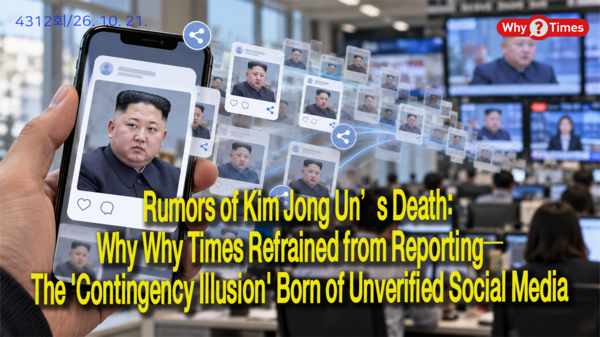
Rumors alleging the death of North Korean leader Kim Jong Un have spread through foreign social media platforms and into several domestic and international outlets. Beginning with claims of a cerebral hemorrhage and emergency transfer to a Chinese hospital, the narrative quickly expanded to encompass Kim Yo Jong seizing power and the deployment of Chinese troops to Pyongyang. Yet, Why Times declined to treat this as breaking news of a North Korean contingency. This editorial decision was straightforward: the primary source failed to establish credible access to internal intelligence, nor did they present verifiable evidence corroborating the leader’s death.
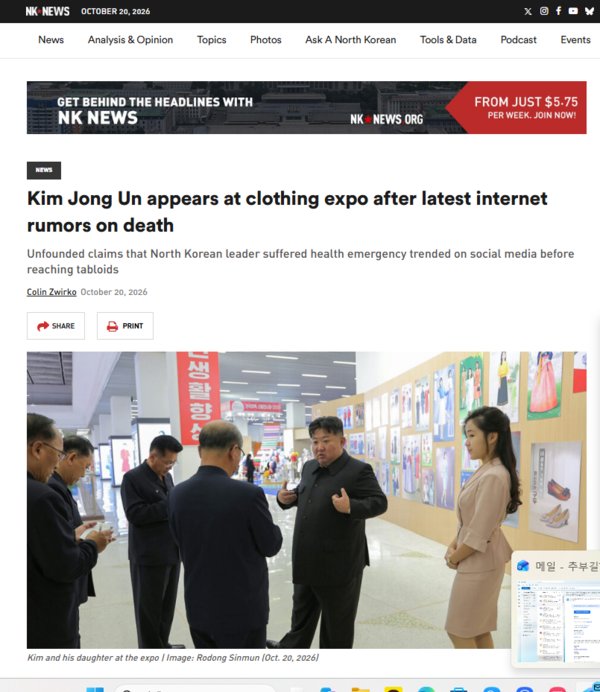
On October 20, NK News, an English-language outlet specializing in North Korea, reported that Kim Jong Un had attended an apparel and footwear exhibition, while tracing the trajectory through which the death rumors proliferated. According to the report, at least two anti-CCP accounts alleged that Kim was either dead or in a coma and had been moved to a Beijing hospital, yet offered zero substantiating evidence. Baseless online claims gained traction on social networks before filtering directly into tabloid coverage.
On the same day, North Korean state media reported that Kim had visited the Pyongyang apparel and footwear exhibition the previous day alongside his daughter. NK News covered his public appearance side by side with the circulating rumors. What demands attention here is not the viral scale of the rumor, but its origin. The mere fact that a claim trends on social media or gets picked up by foreign tabloids does not mean it has survived factual scrutiny.
[IBTimes UK Edition: “No Independent Verification for Death or Troop Deployment”]
The UK edition of the International Business Times noted in its coverage on October 19 that “neither the rumors of Kim Jong Un's death nor the deployment of Chinese troops have been independently verified.” At the center of these assertions was a post by Xie Wanjun, a U.S.-based Chinese dissident. Xie alleged that Kim had collapsed from a cerebral hemorrhage and died while receiving medical care in China; however, he produced no independently verifiable material to validate his claim.
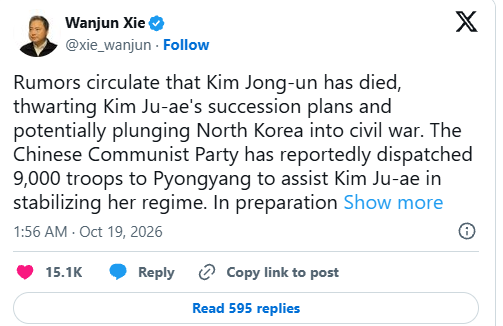
His succession narrative shifted as well. He initially claimed Chinese forces were dispatched to bolster Kim Ju Ae, only to assert later that Kim Yo Jong had taken the reins of power. The outlet pointed out that the claim of Chinese military intervention originated from the very same source as the medical narrative, meaning it could not serve as corroborating evidence for the death rumors. While sensational narrative layers—death, foreign military intervention, and succession struggle—were tacked on, not a shred of independent verification was added.
[Specific Hospital Names Do Not Guarantee Credibility]
Xie went so far as to detail that a medical team from Peking Union Medical College Hospital was dispatched to North Korea, that Kim was subsequently moved to Beijing where he died, and that his body was secretly repatriated. Yet, he offered no indication of how this medical intelligence was acquired, nor did he provide proof that his source had access to real-time events.
Stories sound credible when peppered with specific hospital names and logistics. However, granular narrative must not be conflated with evidence. True reporting requires hospital records, testimony from identifiable officials, or corroborating reporting through separate intelligence channels. Absent this verification, even the most elaborate description remains mere hearsay.
The issue is not Xie’s status as a political dissident. Dissidents can indeed obtain critical internal intelligence. Rather, what renders this claim untrustworthy is the complete absence of a proven pipeline into the North Korean supreme leader’s medical status or elite dynamics. Political titles or ideological leanings cannot substitute for genuine intelligence access.
Our own network cross-checked these claims through sources in China and received clear confirmation that nothing of the sort could be corroborated. Given this degree of scrutiny, our channel concluded that the claims regarding Kim Jong Un’s death and transfer to Beijing were outright fake news.
[Citations Across Multiple Outlets Do Not Equal Multiple Verifications]
The rumor reverberated through outlets including Britain's The Sun, the New York Post, and India's The Economic Times. Yet the sheer number of countries reporting on the narrative must not be mistaken for each outlet having confirmed the death. Several South Korean outlets noted that these international reports themselves explicitly acknowledged the lack of independent evidence supporting either the death or a Chinese troop deployment.
When an individual social media post is amplified by foreign tabloids and subsequently cited by domestic media, readers easily assume the information has been multi-vetted. However, tracing the chain of citations back to a single original post reveals that the evidentiary weight remains precisely zero. An unverified claim remains unverified, even if echoed by ten different publications.
The phrase "according to foreign media reports" is never sufficient on its own. One must determine whether the outlet conducted primary investigative reporting, merely quoted another publication, or was simply reporting on the viral spread of an internet rumor. In particular, analytical pieces dissecting the veracity of a rumor must never be misread as reporting verifying the death.
[Doubting North Korean Photos Does Not Prove the Death Rumor]
Following the spread of the rumors, the Korean Central News Agency (KCNA) and Korean Central Television (KCTV) reported on October 20 that Kim inspected the "National Apparel and Footwear Exhibition-2026" in Pyongyang the previous day. Released photos depicted him examining women's clothing and children's footwear alongside his wife, Ri Sol Ju, and daughter, Kim Ju Ae. South Korean foreign affairs and security officials similarly dismissed the rumors as "unheard of" and "absurd."
Photographs from North Korean state media naturally demand critical scrutiny. A single batch of photographs cannot definitively establish a leader's overall health. However, noting that the exact timing of a photo requires further vetting is entirely different from claiming it is recycled archival footage. Casting doubt on state imagery does not relieve the claimant of their burden of proof.
According to South Korean media, Xie asserted after the photos were released that Pyongyang was reusing old materials. Yet he offered no evidence showing when the images were purportedly taken, nor could he point to any prior publication of the identical photos. Faced with contradictory evidence, he simply layered on a fresh allegation of a cover-up. If every piece of conflicting evidence is dismissed as manipulation, distinguishing truth from fabrication becomes impossible.
[Claims of Kim Yo Jong Seizing Power Rest on Unproven Foundations]
No evidence was offered to support the claims that Kim Yo Jong has taken control of the regime or that 9,000 Chinese troops entered Pyongyang. Yonhap News also noted that while such assertions surfaced online, they lacked supporting documentation. With the premise of Kim Jong Un's death unproven, succession shifts and foreign military interventions must not be framed as established geopolitical realities. Our channel likewise checked with contacts in China and found no indications supporting these claims.
Contingency planning for North Korean instability is essential. However, hypothetical scenarios must be rigorously separated from unfolding facts. Analyzing Kim Yo Jong's institutional influence does not equate to proof of a power grab. Nor does Beijing's acute sensitivity to North Korean affairs confirm a military deployment. Piling conjecture atop unverified assumptions only risks leading readers to mistake speculation for fact.
[Why Times Insight | No Reason to Elevate Untrustworthy Claims into News]
As rumors of Kim Jong Un’s demise gained traction, many readers requested in-depth coverage from our channel. The reason Why Times refrained from reporting the death is simple: the original source lacked verified access to internal intelligence, and the claim was unaccompanied by corroborating evidence. A surge in foreign media citations alone cannot justify publishing an analysis of a North Korean collapse.
Nor should the decision rest solely on China’s information control. While silence within China is a relevant data point, the absence of chatter alone cannot confirm an event did not happen. A lack of incoming reports across a specific network is distinct from the absolute absence of an occurrence. The decisive criterion is that the party alleging the death failed to provide credible evidence.
This does not mean journalists must pause all reporting until an official government statement is issued. Credible investigative reporting backed by independent evidence warrants publication ahead of official announcements. This case, however, fell far short of that standard. Speculation from opaque sources and circular citations ran well ahead of verified reporting.
Kim Jong Un's status directly affects the security landscape of the Korean Peninsula. For that very reason, rigorous standards of evidence are non-negotiable. The more explosive the claim, the more urgent the verification. One can analyze the propagation of a death rumor, but the rumor’s reach must never be treated as proof of the death itself.
What is confirmed at this moment is simply that a rumor spread. Kim Jong Un's death, Kim Yo Jong's power grab, and a Chinese military deployment remain completely unverified. Should verifiable new evidence emerge, assessments will adjust accordingly. Until then, repeated assertions must not be mistaken for cumulative proof.
Why Times concluded that claims built on untrustworthy origins and zero evidentiary backing should not be elevated into reports of a North Korean contingency. Editorial judgment hinges not on how sensational a narrative sounds, but on how it has been verified. Why Times will remain sharply tuned to internal developments in North Korea. Should a genuine contingency arise, we will report and analyze it with speed and uncompromising accuracy.
- TAG