


추부길 whytimespen1@gmail.com
[UPI Reports “Multi-Layered Surveillance System”: The “Eyes of the Battlefield” America Wants to Add to South Korea]
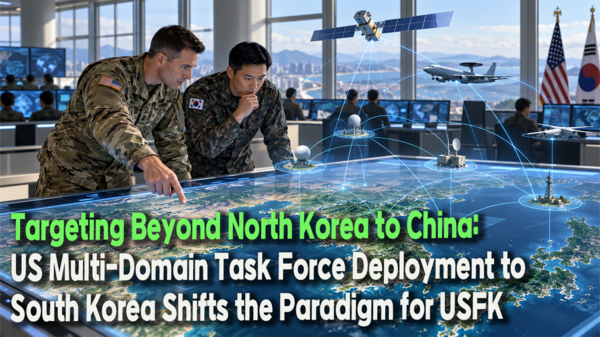
As the United States pushes for the deployment of a Multi-Domain Task Force (MDTF) to South Korea, the commander of United States Forces Korea (USFK) highlighted the establishment of multi-layered surveillance and detection capabilities as a core mission. The concept aims to seamlessly integrate capabilities across space, cyber, and electronic warfare domains to gain a more precise understanding of North Korea and the surrounding military environment. This indicates that the significance of the incoming forces lies in intelligence and operational capability rather than sheer troop numbers. How USFK, tasked with defending the Korean Peninsula, will connect to a broader regional operational network is emerging as a major new point of discussion.
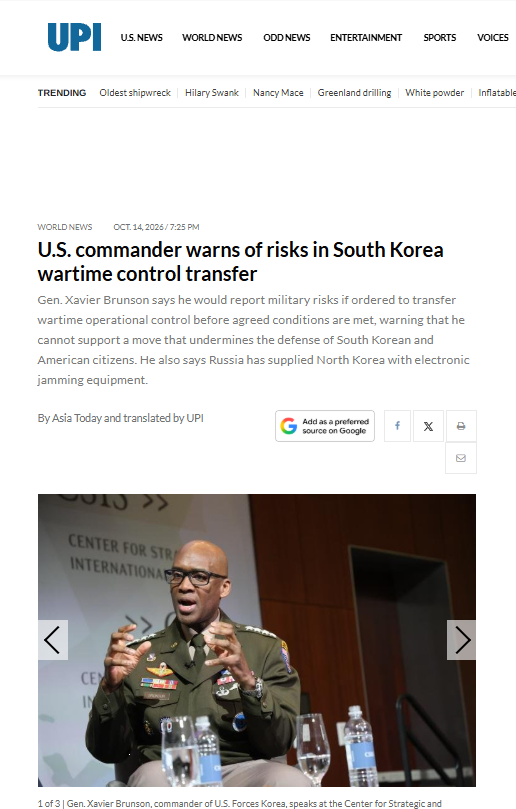
On October 14, United Press International (UPI) reported that "Gen. Xavier Brunson, commander of USFK, emphasized surveillance and detection capabilities while outlining the role of the Multi-Domain Task Force." UPI noted that during a conversation at the Center for Strategic and International Studies (CSIS) in Washington the previous day, "Brunson detailed a vision connecting space-based surveillance assets, high-altitude platforms, tethered balloons, and unmanned aerial vehicles, while also mentioning the potential operation of tethered aerostat radar systems near the Demilitarized Zone (DMZ)."
UPI further observed that "the true value of this concept stems from connectivity rather than individual platforms." By synthesizing intelligence gathered across varying altitudes and operational domains, the system aims to track changes in North Korean military activity and foster a clearer understanding of the operational environment on and around the Korean Peninsula. "What the US seeks to add to South Korea is a multi-layered set of 'battlefield eyes' that continuously track enemy movements and support responsive decision-making," UPI explained.
[Not a Special Forces Unit: Connecting Discovered Targets to Strike Assets]
While the term "Task Force" often evokes images of small-unit special forces infiltrating enemy territory, the hallmark of the Multi-Domain Task Force (MDTF) is its integration of capabilities across diverse operational domains. Its core component, the Multi-Domain Effects Battalion (MDEB), links detection, reconnaissance, and surveillance directly to target identification across vast operational areas. Its primary role is to track mobile missile launchers, command posts, and communication networks, delivering the crucial intelligence required for countermeasures.
In modern warfare, possessing powerful missiles is ineffective if targets cannot be located. Even if an enemy's position is known, delayed information sharing and decision-making cause opportunities for counteractions to slip away. The MDEB bridges this precise gap. The U.S. Army explains that the MDEB concentrates both kinetic and non-kinetic effects against enemy command networks, missile units, surveillance systems, and critical logistical nodes. It is an operational concept that combines strike assets with electronic warfare and cyber capabilities to disrupt enemy operations.
Therefore, sensing is not a passive mission that ends with observation. It serves as the starting point for a process that identifies the enemy and uses that intelligence to degrade their operational effectiveness. However, this represents the overarching operational concept of the MDEB as a whole; the exact missions and capabilities performed in South Korea will depend on the specific units and equipment deployed.
[“From Beijing to Seoul”: The US Looks Beyond North Korea]
During his CSIS dialogue, Gen. Brunson noted the geographical distance between Beijing and Seoul. Framed alongside his emphasis on understanding the broader regional environment, this suggests that the U.S. does not view South Korea's military utility through the narrow lens of North Korean deterrence alone. The detection and intelligence assets deployed to South Korea, while fortifying the defense of the Korean Peninsula, can also be leveraged to monitor military maneuvers in neighboring areas, including China.
The Institute for the Study of War (ISW) previously connected the proposed relocation of select MDTF assets to South Korea with an expanding strategic deterrence perimeter that encompasses not only North Korea, but also China and Russia. As China fortifies defense networks designed to hinder U.S. power projection and operational maneuver, combining South Korea's strategic location with multi-domain operational capabilities becomes increasingly vital. This move can be seen as an effort that simultaneously bolsters deterrence against North Korea while enhancing U.S. regional operational capabilities.
[From Europe to South Korea: A Realignment Predating Recent Provocations]
Discussions regarding this deployment did not materialize overnight in response to recent North Korean missile tests. On August 19, The Wall Street Journal (WSJ) cited U.S. Army officials reporting that "the Army is relocating parts of its Multi-Domain Task Force from Europe to South Korea" as part of a broader force realignment. Frame this development solely within a short-term cycle of North Korean launches and U.S. responses, and one misses the backdrop of long-term U.S. global force repositioning.
When evaluating specific deployment details, a distinction must be drawn between the overarching MDTF and its subordinate units. On September 3, Stars and Stripes covered plans to deploy hundreds of personnel from the 2nd MDTF’s Multi-Domain Effects Battalion—currently stationed in Germany—to South Korea by the end of the year. According to Stars and Stripes, Gen. Brunson’s recent remarks are significant because they publicly outlined the deployment concept and core mission. However, this does not mean that troop numbers, timelines, permanent rotational status, or hardware configurations are fully finalized. The true scope of this change will depend on the unit structures and operational models confirmed moving forward.
[Increasing the Burden on North Korea: Tracking Fleeting Targets]
From a North Korean deterrence perspective, the deployment carries immense strategic weight. The threat posed by North Korea's missile arsenal stems not only from speed and range, but also from the difficulty in predicting launch times and locations. By networking diverse detection assets and enabling rapid intelligence sharing, the ROK-U.S. alliance expands its opportunities to identify and react to North Korean movements.
This interconnected operational model has already been put to the test. The U.S. Army stated that "the 3rd MDTF participated in Exercise Freedom Shield in March 2026, integrating intelligence, fires, cyber, and space capabilities alongside ROK and U.S. forces." Long-range precision strikes were conducted via simulation during the exercise. The crux of the current development is not the MDTF's initial appearance in Korea, but rather how the capabilities validated during exercises will evolve in terms of permanent force posture and operational execution.
[OPCON Transfer Also Hinges on Capability and Command Structure]
On October 15, Reuters reported that "a spokesperson for South Korea's Ministry of National Defense (MND), expressing a personal view, noted that if conditions for the transfer of Operational Control (OPCON) continue to shift, the transfer itself may become impossible." The official stance of the MND remains that "the two nations are working closely under the agreed conditions-based OPCON transfer plan," underscoring that required capabilities and evaluation benchmarks remain sensitive issues.
There is insufficient evidence to suggest that MDTF deployment and the OPCON transfer are tied together in a single transactional arrangement. However, as operations integrating multi-domain intelligence and strike capabilities grow paramount, the ROK military's capability to understand and lead these joint operations becomes equally critical. To give substantive weight to an OPCON transition, South Korean forces must possess synchronized capabilities in intelligence integration, situational assessment, and combined operations coordination.
[Why Times Insight | A Changing Paradigm for USFK Means the OPCON Timeline Demands Re-evaluation]
The proposed U.S. deployment of the Multi-Domain Task Force presents a critical variable in discussions surrounding South Korea's OPCON transfer. If USFK's operational capabilities and combined battle methods undergo structural transformation, how the ROK military leadership will integrate and command these assets must be thoroughly re-evaluated. This means it is becoming increasingly difficult to prioritize a rigid, pre-established transfer schedule.
Indeed, according to Reuters' October 15 report, Gen. Brunson stated that the security environment and operational plans have evolved significantly since the original OPCON conditions were established. The MND spokesperson's personal observation that "if the target moving line keeps shifting, OPCON can never be transferred" reflects how tension between evaluation benchmarks and fixed timelines has already materialized into a practical debate.
If the MDTF settles in South Korea as a cornerstone of combined operations, the timeline for OPCON transfer will face mounting pressure for a comprehensive review. Questions must be rigorously answered: Who will synthesize multi-domain intelligence across space, cyber, and electronic warfare? Under what command structure will U.S. detection and strike support be utilized? Is the ROK military leadership fully prepared to command these capabilities? Setting a firm deadline without resolving these issues threatens to create a dangerous gap between command responsibility and actual operational capability.
Ultimately, the deployment of the MDTF represents far more than the simple addition of another U.S. unit. For South Korea, it offers an opportunity to significantly fortify deterrence against North Korea; for the United States, it provides a mechanism to weave Korean Peninsula defense seamlessly into its broader regional operations. As the strategic role of the Korean Peninsula and the nature of combined operations evolve, evaluating OPCON transfer based strictly on old timelines becomes untenable. What matters now is clarifying what the ROK military will command, and ensuring it possesses the capabilities required to lead operations effectively.
- TAG