


추부길 whytimespen1@gmail.com
[People’s Daily Joins Criticism of Huawei’s Automobile: Internal Alarm Bells Ring in China]
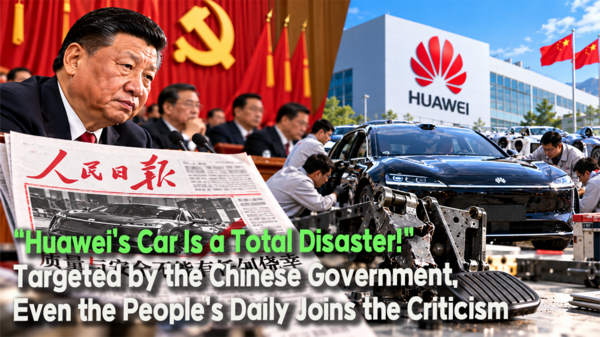
An unexpected warning light has flashed in China's automotive industry—a sector into which Beijing has poured vast national resources to dominate the global market. As controversy expands over broken brake pedals in a ultra-luxury vehicle produced with Huawei's participation, even the People's Daily, the flagship newspaper of the Chinese Communist Party (CCP), has launched a public critique. Compounding the turmoil, the Chinese government announced measures to tighten automotive safety verifications, while actual buyers are forfeiting deposits to cancel their orders. The issue is now escalating beyond a single Huawei-backed model into a broader critique of the Chinese auto industry's "fast-track development" strategy itself.
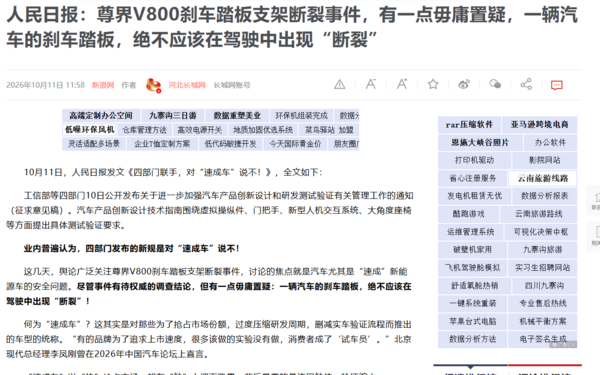
On October 11, the People's Daily published a commentary titled "Four Government Ministries Join Forces to Put the Brakes on Fast-Track Automobile Development," explicitly addressing the broken brake pedal bracket incident involving the Maextro V800, a high-end MPV jointly developed by Huawei and JAC Motors.
While premising that "official investigation results on the cause of the accident have not yet been released," the commentary underscored that "a vehicle's brake pedal must never break under operational conditions." Notably, the article directly linked the incident to the problem of "fast-track development" within China's automotive sector. Fast-track development refers to the practice of drastically shortening new vehicle development cycles and reducing necessary real-world test drives to rush products to market in a bid to capture market share.
Citing Li Fenggang, General Manager of Beijing Hyundai, the People’s Daily pointed out that "some automakers are skipping mandatory tests to expedite new model launches, effectively turning consumers into test drivers." In short, this delivered a critical blow to Huawei.
Professor Zhu Xichan of Tongji University also explained: "To properly validate a new vehicle, road testing across two winters and two summers is required. Even partial facelift models require seasonal testing and substantial real-world road validation." This serves as a stark warning that the rapid development and launch cycles long praised as strengths of China's auto industry may actually represent a fatal vulnerability regarding safety verification.
[Chinese Government Takes Action: Putting the Brakes on "Build Fast, Fix Later"]
On October 10, four Chinese regulatory bodies—the Ministry of Industry and Information Technology, the Ministry of Public Security, the Ministry of Ecology and Environment, and the State Administration for Market Regulation—jointly released a draft proposal soliciting public feedback to strengthen innovative design and R&D testing/verification for automotive products. The proposal mandates comprehensive risk assessments and verifications before introducing new technologies to vehicles, with heightened safety evaluations specifically targeting electronic drive-by-wire controls, door handles, and novel driver control interfaces.
This is not the first time Beijing has turned its focus to automotive quality. In August, authorities launched a one-year initiative to strengthen quality control, focusing on production consistency, reliability, durability, and new technology verification. Therefore, this draft proposal was not created out of thin air solely due to the Huawei incident. However, the Maextro V800 scandal clearly served as a major catalyst, imprinting the necessity for stricter government regulation on the public mind. The People’s Daily similarly evaluated these regulatory enhancements as "a direction meant to rectify the prevalent practice of 'fast-track development' across China's auto industry."
[Refusing the Car Even at the Cost of Losing a 10 Million Won Deposit: Shaken Consumer Trust]
Earlier, during a vehicle test published on October 8 by the automotive platform Dongchedi, the brake pedal brackets on three Maextro V800 vehicles all snapped during repeated hard braking maneuvers. The manufacturer pushed back, asserting that this was a non-standard extreme test exceeding normal driving conditions. Nevertheless, they announced plans to improve the design of the brake pedal bracket and offer free replacements to existing customers.
However, consumer anxiety remains unassuaged. According to Chinese media reports, a prospective buyer in Chengdu, Sichuan Province, stated he would refuse delivery of the vehicle even if it meant forfeiting his non-refundable deposit of 50,000 RMB (approx. $7,000 / ₩10 million). A primary reason for purchasing a luxury automobile is confidence in its safety; that confidence has now crumbled.
Maextro's customer service center explained that operations to install upgraded components will begin in November. Yet the core issue extends far beyond mere component replacement. Crucial questions remain as to why identical structural failures occurred across three separate test vehicles and what rigorous testing will be conducted to prove the safety of the redesigned parts.
[Direct Critiques by State Media Vanish: The Two Faces of Chinese Public Opinion]
A noteworthy element of this incident was the divergent level of criticism among Chinese state media outlets. On October 10, Xinjiang Fabu, the official account of the Xinjiang Uyghur Autonomous Region government, published an article directly criticizing Maextro's response. Evoking Huawei's frequently used slogan—"Safety is the ultimate luxury"—the post noted that consumers needed responsible explanations guaranteeing absolute safety, rather than dismissive excuses about non-standard test conditions. However, subsequent reports indicated that the post became unavailable shortly thereafter.
Conversely, the People’s Daily’s broader critique of the industry continued to circulate widely. This contrast is revealing: while open criticism regarding safety within the automotive industry is permitted in China, high-intensity critiques directly targeting specific state-champion corporations trigger a far more cautious response.
[Even Hu Xijin Steps In: Patriotism Cannot Cover Up Safety Flaws]
Hu Xijin, former Editor-in-Chief of the Global Times and a prominent state media commentator, also weighed into the controversy. He observed that "Maextro's choice to frame the issue as an 'upgrade' rather than a 'defect' is a roundabout way of admitting the problem." Simultaneously, he cautioned that "some Huawei supporters attempting to dismiss the test itself as a malicious attack or conspiracy are ultimately harming the company." Hu emphasized that "the fact that the brake pedal bracket broke during actual testing cannot be denied," citing the warnings issued by the People’s Daily.
This dynamic touches directly upon the unique public image Huawei has cultivated. The tech giant has positioned itself as the supreme symbol of Chinese technological self-reliance in defiance of U.S. sanctions. However, no enterprise—even one representing national pride—can be exempt when it comes to safety issues linked directly to human life. This explains why the incident has generated such intense sensitivity within China.
[Why Times Insight | The CCP Openly Criticizes Huawei: What Is Xi Jinping’s Real Calculation?]
The most significant aspect of this entire affair is that the People’s Daily, the official mouthpiece of the Chinese Communist Party, publicly criticized safety defects in a vehicle associated with Huawei—the very symbol of national technological self-reliance. Moving beyond a simple quality control dispute, this exposes Beijing's profound policy dilemmas regarding the future of the Chinese automotive industry.
First, for Xi Jinping, the survival of China's automotive industry as a whole outweighs the prestige of a single firm like Huawei. China successfully expanded its global market share through rapid new vehicle launches and aggressive price competition. However, it now faces severe side effects, including market overcapacity, eroding profitability, and mounting quality concerns. Demonstrating that even a national champion like Huawei is subject to public criticism serves as a powerful warning shot across the entire industry.
Second, the boundaries of party-sanctioned criticism warrant close attention. While the People’s Daily critiqued industry-wide systemic flaws, the Xinjiang state account's post explicitly calling out Huawei's evasiveness quickly vanished. While the exact circumstances surrounding its removal remain unconfirmed, it demonstrates that while Beijing seeks to enforce industrial discipline, it remains vigilant against actions that damage the core authority of national champion enterprises.
Third, internal contradictions in Xi Jinping’s industrial policy are surfacing. The rapid development cycles and hyper-aggressive competition that initially drove China’s electric vehicle rise are now identified as factors threatening safety and build quality. Tightening regulations risks slowing economic growth, whereas leaving the status quo unchecked risks shattering international credibility and market trust. Xi finds himself caught in a dilemma, forced to calibrate the very growth model he constructed.
Ultimately, the essence of this crisis extends beyond a broken brake pedal on a Huawei-backed car. It signals that the Chinese Communist Party has begun openly confronting defects in its state-nurtured industrial champions to enforce a strategic pivot across the entire sector. Whether Xi Jinping can alter the growth paradigm of the auto industry he built remains an open question—making the Huawei affair a crucial test of his political resolve.
- TAG