


추부길 whytimespen1@gmail.com
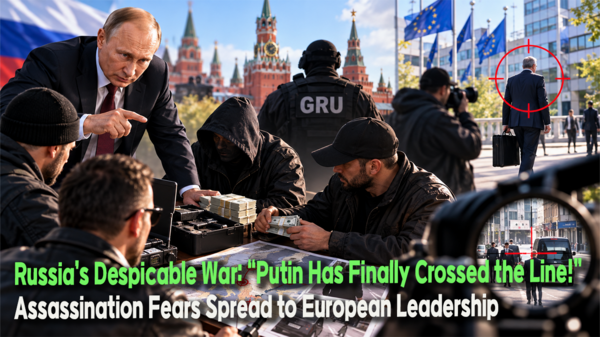
[What Couldn't Be Won on the Battlefield, Putin Seeks to Gain Through European Terror]
Amid Russia's struggle to find a breakthrough in the war in Ukraine, shocking warnings have emerged that Moscow is expanding assassination operations directly targeting executives of European defense companies. The Financial Times (FT), citing intelligence officials from five European nations, reported that "Russian military intelligence is collaborating with organized crime syndicates to undermine European support for Ukraine." Compounding these concerns, a man was arrested in Poland after threatening to assassinate the Prime Minister and Defense Minister, raising alarm over the personal safety of Europe’s leadership. Analysts note that Putin's methods of warfare have entered a dangerous new phase, as Russia, having failed to achieve its desired results on the battlefield, now attempts to instill terror among civilians in Europe’s rear guard.
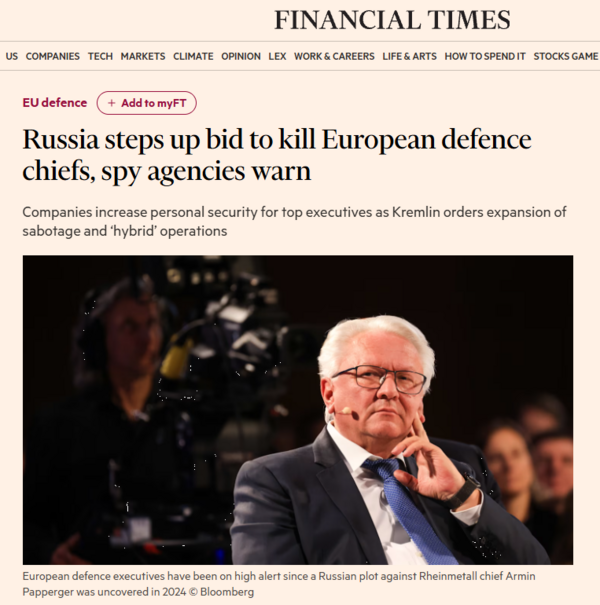
On October 11 (local time), the FT reported that "Russia's method of warfare is becoming increasingly dangerous." Based on interviews with intelligence officials across five European countries, the report warned that Russia is stepping up targeted assassination plots against CEOs and senior executives of European defense firms. It emphasized that "targets include not only major defense contractors, but also small and medium-sized enterprises (SMEs) supplying drones and related components to Ukraine."
The FT further noted, "European intelligence agencies assess that, amid the prolonged war in Ukraine and growing economic pressure, Russia is expanding sabotage and so-called 'hybrid warfare' to weaken Western arms supply." Hybrid warfare refers to a strategy that combines standard military operations with hacking, infrastructure sabotage, dissemination of disinformation, and covert operations to pressure adversary nations.
Crucially, Russia’s targets are shifting from physical infrastructure—such as railways and telecommunications networks—to human lives. A senior European intelligence official warned the FT that "the threat in Europe is rising from property damage to human casualties." The underlying calculation is to intimidate executives of arms-supplying firms directly, thereby paralyzing weapon production and support at its source.
[Mobilizing Organized Crime: The Kremlin Outsources Assassinations]
Even more alarming is the operational methodology employed by Russian intelligence. According to the FT, European intelligence agencies believe the Russian Military Intelligence Directorate (GRU) plays a central role in these assassination plots. Notably, GRU operations have evolved to collaborate with organized crime groups and utilize multi-national proxy networks.
In the past, tasks were often assigned to "disposable operatives" recruited online for cash. Recently, however, operations have become compartmentalized: separate actors are tasked with tracking a target's movements, procuring funds and equipment, and executing the actual act. This structure makes it difficult to trace the broader organization even if an individual operative is captured.
This framework also affords plausible deniability to the Russian government. Should organized crime figures or local accomplices be arrested, the Kremlin can dismiss the act as independent criminal activity unrelated to the state. In effect, Moscow can intimidate foreign civilians without deploying formal armed forces while successfully dodging state accountability.
Sinan Selen, Vice President of Germany’s domestic intelligence agency (the Federal Office for the Protection of the Constitution, BfV), recently warned parliament that "Russia is planning acts of violence against individuals through state or state-controlled actors." He particularly highlighted that "the utilization of organized crime syndicates has become increasingly prominent."
[Rheinmetall CEO Assassination Plot: Russia's Dangerous Operations Are Already Underway]
That these threats are far from hypothetical was laid bare in Germany in 2024. Reuters reported that "U.S. intelligence agencies uncovered information at the time that Russia was planning to assassinate Armin Papperger, CEO of German defense giant Rheinmetall." The U.S. relayed this intelligence to the German government, enabling German security authorities to thwart the plot by enhancing his security detail.
Rheinmetall is a pivotal firm supplying artillery shells and military vehicles to Ukraine. Papperger has actively championed military aid and the expansion of manufacturing facilities in Ukraine. From Moscow's perspective, he represents a key figure bolstering Ukraine’s warfighting capability.
More notably, the plot against Papperger was not an isolated incident. CNN, citing five U.S. and Western officials, reported that it was "one of several assassination plans targeting European defense industry executives." CNN added that "while Russia dismissed the allegations, Papperger remains under heightened security protection," noting that targeting civilian executives in third-party nations simply for supplying arms to Ukraine represents a breach of the fundamental boundaries of warfare.
[Success Without Pulling the Trigger? Putin’s Calculation to Plunge Europe into Fear]
What makes Russia’s strategy particularly insidious is that actual execution is not required to achieve its objective. European intelligence officials explained to the FT that "Russia's primary goal is psychological pressure." The mere realization among defense executives that they could become assassination targets can induce hesitation when dealing with Ukraine. In response, German intelligence has been stepping up security measures for defense industry executives and personnel. Following government recommendations, several executives have expanded their private security details, with some receiving special protection during overseas business trips.
This financial and operational burden is particularly devastating for SMEs compared to large defense conglomerates. Startups supplying drones or components to Ukraine lack the resources to fund heavy executive security and facility protection. Some companies have even relocated production facilities out of security concerns. Russia aims precisely for this spread of anxiety and resource drain. If European firms must weigh executive safety and corporate survival every time they supply weapons to Ukraine, the efficiency of the entire defense supply chain suffers.
However, this strategy carries a fatal flaw. As the Russian threat intensifies, European governments are increasingly viewing the protection of defense firms as a matter of core national security, spurring coordinated countermeasures. Putin's attempt to divide Europe through intimidation may ultimately backfire, strengthening Europe's collective front against Russia.
[Assassination Threats Reach Polish Prime Minister: Growing Anxiety Among European Leaders]
Adding to the tension, an incident involving threats against Poland’s Prime Minister and Defense Minister occurred on October 11, elevating alarm across Europe. AP News reported that "Polish police arrested a man who threatened to attack Prime Minister Donald Tusk and Defense Minister Władysław Kosiniak-Kamysz." Polish Interior Minister Marcin Kierwiński stated that the suspect was identified after analyzing online posts. The Polish government is treating the threat with utmost severity, launching an emergency response involving police and intelligence agencies. Prime Minister Tusk publicly expressed gratitude for the swift police action.
At this stage, there is no verified evidence linking this specific incident directly to Russian covert operations. Polish authorities stated that it is premature to determine any connection to foreign powers. Therefore, Russia's alleged assassination plots against defense executives and the threat against the Polish Prime Minister should be treated as separate matters for now.
Nonetheless, the incident drew immediate international attention due to Poland's strategic position. Poland serves as a crucial transit hub for Western military aid entering Ukraine and remains a steadfast NATO member advocating a firm stance against Moscow. Amid heightened anxiety over Russian hybrid attacks, the occurrence of threats against Poland's top leadership highlights the gravity of Europe's security exposure. Europe can no longer take for granted that the conflict will remain confined within Ukrainian borders.
[Why Times Insight | Putin’s Despicable Assassination War: A Sign of Desperation, Not Strength]
The most critical takeaway from these developments is why Putin is resorting to such risky tactics. Since invading Ukraine, Russia has incurred immense human and economic costs without securing a favorable conclusion to the war. Under these circumstances, disrupting Western military supplies to Ukraine has become a paramount strategic priority for Moscow.
First, the escalation of assassination plots underscores Russia's strategic limitations. Having failed to decisive break Ukraine's military capabilities on the battlefield, Moscow is expanding its pressure campaign to target the individuals operating the rear supply chain. Rather than demonstrating strength, this reflects the reality that standard military means alone are insufficient to achieve Putin's objectives.
Second, Putin is walking a dangerous tightrope, seeking to strike Europe while avoiding direct military confrontation with NATO. Relying on intelligence agencies and organized crime syndicates offers a veil of plausible deniability. However, if state-directed assassinations on NATO territory are definitively proven, Europe's response could escalate significantly. While such actions would not automatically trigger NATO’s Article 5 collective defense clause, they hold clear potential to ignite a severe diplomatic and security crisis.
Third, Putin's greatest miscalculation lies in assuming that fear inevitably leads to submission. The intimidation of European defense executives will not guarantee that governments abandon their support for Ukraine. On the contrary, it is more likely to serve as a catalyst for fortified supply chain defense, deeper intelligence coordination, and expanded sanctions against Russia.
Ultimately, these developments illustrate how dangerously Putin is expanding the parameters of this war. Invading Ukraine and subsequently targeting civilians in European nations aiding its defense cannot be categorized as a normal state security strategy.
Putin's calculation—to achieve through assassination and terror the victory he failed to secure on the battlefield—is as reckless as it is despicable. Should this gamble fail, Russia will not face a submissive Europe, but a far more unified and formidable opposition.

- TAG