


추부길 whytimespen1@gmail.com
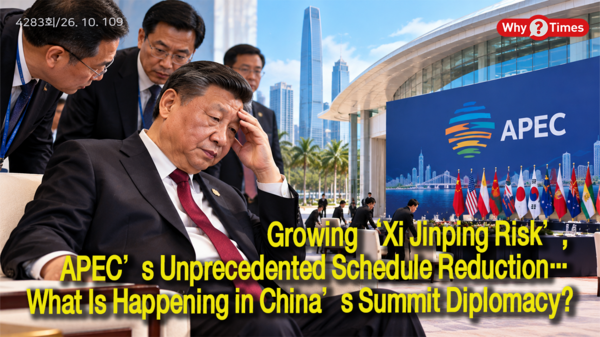
[FT Exposure: Ministerial Meetings Moved Online… Will Closed-Door Leaders’ Sessions Also Be Canceled?]
Backlash among member states is growing as China seeks to drastically scale back key schedules for the Asia-Pacific Economic Cooperation (APEC) summit to be held in Shenzhen this November. This comes shortly after reports surfaced that China made unusual demands for private rest areas and schedule adjustments during President Xi Jinping’s recent state visit to the United States. Now, China is moving to reduce even an international summit that it is hosting. As these two developments intertwine, questions are emerging as to whether Xi Jinping’s health and physical stamina have become new constraints on China’s summit diplomacy. Particularly within China’s one-man power structure where the succession plan remains opaque, this controversy draws intense scrutiny because it extends beyond mere health rumors into structural risks for governance.
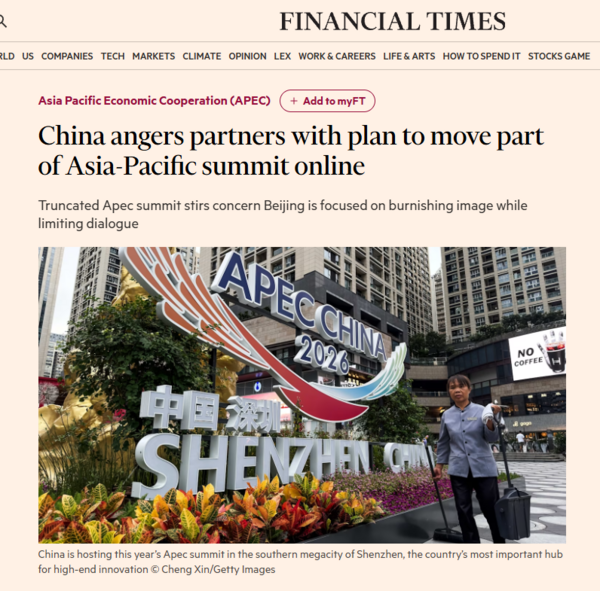
The Financial Times (FT) reported on the 7th, “China is drawing pushback from member economies as it pushes to drastically pare down key events for the APEC summit in Shenzhen, Guangdong Province, scheduled for November 18–19. China has proposed conducting the Joint Ministerial Meeting of Foreign and Trade Ministers—a major APEC fixture—virtually instead of in person, while also seeking to eliminate closed-door sessions where leaders exchange views in a relatively candid environment.”
Six sources cited by the FT stated that “China proposed transitioning the ministerial meeting online,” while five sources confirmed that “plans to cancel the leaders’ closed-door retreat are also being pursued.” If China’s blueprint is implemented, the only primary events remaining for leaders to attend in person could be the gala dinner and the formal plenary session.
The issue is that China is hosting the APEC summit again for the first time in 12 years since 2014. Through this event, China intended to project an image of itself as a guardian of multilateralism standing against the U.S. and as the central pillar of Asia-Pacific economic cooperation. Yet, it is seeking to reduce the very working sessions where member states engage in substantive negotiations.
Furthermore, when the Chinese Foreign Ministry announced its hosting plan for the 33rd APEC Summit last December, it presented the Joint Ministerial Meeting and the CEO Summit as flagship events. Yet now, it is attempting to shift the core ministerial meeting online. A glaring contradiction has thus emerged: while China champions the importance of multilateralism, it is actively curtailing opportunities for multilateral dialogue.
[“Are They Trying to Turn APEC into a Political Show?”… Fierce Backlash from Member Economies]
APEC member states are reacting with particular hostility to this schedule reduction plan because it threatens to eliminate opportunities for substantive diplomatic negotiations. An APEC summit is not merely a ceremonial event where heads of state gather to take group photos and issue joint declarations. At the ministerial meetings preceding the leaders' summit, working-level negotiations take place over concrete economic issues such as trade disputes, supply chains, the digital economy, and investment norms. Moreover, informal leaders' retreats often allow leaders to address sensitive topics that are difficult to raise in formal sessions or forge unexpected diplomatic breakthroughs.
However, if China scales back these meetings, the summit will inevitably be reduced to pre-orchestrated speeches and official ceremonial functions. According to the FT, an official remarked, “China is trying to strictly stage-manage the event,” adding that “this action undermines the core spirit of APEC.” Notably, APEC is one of the few major multilateral cooperation bodies in which both China and Taiwan participate jointly. Consequently, analysts suggest that China may be trying to reduce opportunities for unscripted dialogue in order to avoid sensitive political issues or unexpected diplomatic clashes.
[WSJ Reveals Unusual Signs Surrounding Xi Jinping]
This controversy over APEC’s schedule reduction is drawing heightened attention precisely because of the unusual scenes revealed during Xi Jinping’s state visit to the United States. The Wall Street Journal (WSJ) reported on the 2nd that “when Xi Jinping visited the United States last September, the Chinese side made extraordinary requests to the White House.”
At the center of these requests was a dedicated rest area for Xi Jinping. Chinese officials requested a private "hold room" inside the West Wing of the White House specifically for Xi to rest. Even more unusual were the access restrictions placed on this room. According to reports, only Xi’s wife, Madame Peng Liyuan, was permitted entry, while even Cai Qi—Director of the General Office of the CCP Central Committee and one of the highest-ranking figures in the Chinese leadership—was denied access.
The itinerary itself underwent major adjustments. Chinese officials declined a working lunch with President Trump that had originally been under consideration. As a result, a gap of roughly five hours opened up in the middle of the two leaders' main schedule. Xi’s visit to the National Archives on the final day of his U.S. trip was also reportedly kept much shorter than U.S. officials had anticipated. That such drastic schedule management occurred during a U.S.–China summit—one of the most critical summit diplomacy events in the world—is a development of profound significance.
[What Remains Is Summit Diplomacy with Trump and Putin… What Is China’s Calculation?]
Another noteworthy aspect of this APEC summit involves the moves of the U.S. and Russian leaders. President Trump is scheduled to attend the Shenzhen APEC, and an additional bilateral summit between the U.S. and Chinese leaders is considered a major diplomatic agenda item. In Russia, the possibility of a trilateral meeting involving President Putin, President Trump, and President Xi has also been raised, though the realization and specific timing of such a trilateral session remain unconfirmed.
An intriguing dynamic emerges here. While China seeks to reduce ministerial meetings and informal leaders' retreats, it appears intent on placing diplomatic weight on direct encounters with leaders of major powers like the U.S. and Russia. This setup raises questions about whether China is treating APEC less as a forum for substantive multilateral negotiations and more as a stage to showcase major-power summit diplomacy. Especially if managing Xi Jinping's stamina and schedule has become a paramount concern, China may naturally prefer pre-arranged bilateral meetings that can be tightly controlled over unpredictable multilateral debates.
[Why Xi Jinping’s Health Poses a Structural Risk to China as a Whole]
The reason this controversy goes beyond simple health rumors lies in China’s power structure. Since taking power in 2012, Xi Jinping has concentrated primary decision-making authority within the Chinese Communist Party around himself. He has consolidated control over diplomacy, national security, and economic policy, as well as the military and party apparatus. In 2018, he removed presidential term limits through constitutional amendments, and at the 20th National Congress of the CCP in 2022, he secured a third term as General Secretary.
Throughout this process, the CCP's institutionalized power succession norms of the past were fundamentally altered. Previously, predictability in succession was maintained by bringing prospective future leaders into the Politburo Standing Committee in advance. Today, however, there is no officially designated successor to Xi Jinping within China’s top leadership.
This represents the most critical issue. As long as Xi Jinping normalizes governance, extreme centralization of power can act as a driver for policy consistency. However, if a situation arises where the supreme leader suddenly becomes unable to perform his duties, the calculus changes completely. While China’s constitution contains provisions for presidential succession, actual supreme power in China is bound to the combined authority of the President, General Secretary of the CCP, and Chairman of the Central Military Commission.
Thus, legal succession to the presidency does not automatically resolve the transfer of supreme authority over the party and the military. Furthermore, China strictly limits the release of information regarding the supreme leader's health. External observers are forced to infer his condition through subtle shifts in summit schedules or the frequency of public appearances. Ultimately, should Xi Jinping’s health emerge as a physical constraint on his duties, China could simultaneously face both a personal issue regarding its leader’s stamina and a structural crisis born of an opaque succession framework.
[Will the Shenzhen APEC in November Become a Proving Ground for the ‘Xi Jinping Risk’?]
International attention is now fixed on the Shenzhen APEC summit in November. China aims to use this event to display its global influence in the international economic and geopolitical order. Yet as prospects grow that the core itinerary will be truncated, doubts regarding China's management of summit diplomacy are intensifying.
Moving forward, three key indicators warrant close observation: First, whether China actually converts the ministerial meetings online and cancels the informal leaders' retreat. Second, how many bilateral summits Xi Jinping personally handles during APEC, and whether extended breaks or unusual schedule changes recur. Third, whether these adjustments remain isolated to this event or become a recurring pattern across China’s summit diplomacy as a whole.
If these trends persist, analysis suggesting that Xi Jinping's physical stamina and health have become major operational constraints on Chinese foreign policy will gain significant weight. Ultimately, the Shenzhen APEC is set to serve as a dual proving ground: testing both the powerful leadership China wishes to display to the world and the actual operational stability of its Xi-centric diplomatic system.
[Why Times Insight | The Growing ‘Xi Jinping Risk’: What Is China’s Greatest Vulnerability?]
What matters most in this APEC schedule reduction controversy is not the specific medical diagnosis Xi Jinping might be facing. It is the structural reality that the politics and diplomacy of a giant nation like China have become excessively dependent on the personal health and capacity of a single supreme leader.
A direct causal link between the APEC schedule reductions reported by the FT and the extended rest breaks during the U.S. visit reported by the WSJ has yet to be officially confirmed. However, coming in close succession, these two developments strongly suggest that Xi Jinping’s physical stamina may have emerged as a new variable in Chinese summit diplomacy.
The true risk confronting China is not the health rumors themselves, but rather the reality that immense power is concentrated in one individual with no clear, predictable succession mechanism in place should he suddenly become incapacitated. This is why the November Shenzhen APEC commands such intense global attention. While China seeks to demonstrate Xi Jinping’s decisive leadership, the international community is watching to verify just how stable a system built entirely around that individual truly is.
While a stronger Xi Jinping once seemed to equate to a stronger China, the paradox is now laying bare: the uncertainties surrounding a single man risk escalating into uncertainties for all of China.
- TAG